Direct mail/e-mail is not for the faint-of-heart . . . OR for the impatient. When a campaign is working well, results tend to be measured in single digits with the difference between success and failure often just tenths of a point. (Try explaining that to someone and justifying the value of the effort.)
Despite the negative sound of my opening remarks, I am, indeed, a strong proponent of direct response tools.
Why?
- You have a blank page just waiting to be filled with a refined, well-branded message that can include a sales pitch as well as a reminder about who you are and plan to be – providing a glimpse into your culture.
- Direct mail and e-mail are extremely inexpensive and can be repeated many times without a loss of effectiveness, which aids branding through repetition; in fact, by sending your message over and over again to the same list, you ensure your message is heard at the right time – buying time . . . which, in turn, can occur as often as every day or so . . . or as infrequently as once or twice a year.
- While the numbers measuring results tend to be low for any single mailing, the cumulative impact can be great as you produce small gains on a very regular basis and retain those new customers over time.
Note: According to the Direct Marketing Association, the average response rate for direct mail house lists is 9% and 5% for prospect lists. However, if your direct mail piece is advertising an expensive or complicated product, a response rate that is less than one percent is not unusual. (Responses / Pieces Sent = Response Rate)
While the quality of your “creative” (i.e., text, art, branding, etc.) DOES matter as well as the quality of your mailing list, timing may be the single most important factor in determining your success.
More About the Message
Direct marketing provides an excellent blank tableau for you to communicate who you are, what you sell, and the company you hope to become. Furthermore, you can express this information in a manner consistent with your culture and the image you want to project. Beyond that, your self-portrayal needs to reflect reality to resonate with your audience and, therefore, be more memorable.
The Headline – Headlines matter and create your first (and often only) chance to grab the attention of your audience. Short, memorable, and descriptive works best . . . but ain’t easy to accomplish!
I developed my first appreciation for the potential impact of the headline many, many years ago. The company I worked for had bought an old furniture store and was disposing of the contents via flash sales conducted by their small group of employees, most with non-sales jobs.
The first two weekends went great and all of the big, expensive, and nicer items were sold pretty quickly. Clearly, we had gotten the word out. By week three, however, only lots and lots of odd accent items were left . . . and we weren’t having much luck selling them out.
Our solution: we took out a large full-page ad in the newspaper (which people actually read back then) that ran under the headline “Adopt an End Table or Be a Foster Family to a Few Good Lamps and Chairs!”
Something about the line struck a chord because the crowds returned the very next weekend, and the majority of the remaining merchandise was moved. Since then, I always pay close attention to the headline, very often using that as my starting point when creating an ad, flyer, or direct mail letter.
Copy (The Message and Offer) – This point raises one of the great disputes of all time. What sells best? Long copy or short. If you can conclusively answer that question, your name will be entered into the annals of the direct marketing hall of fame.
Just search long copy vs. short copy, and you’ll get the general idea:
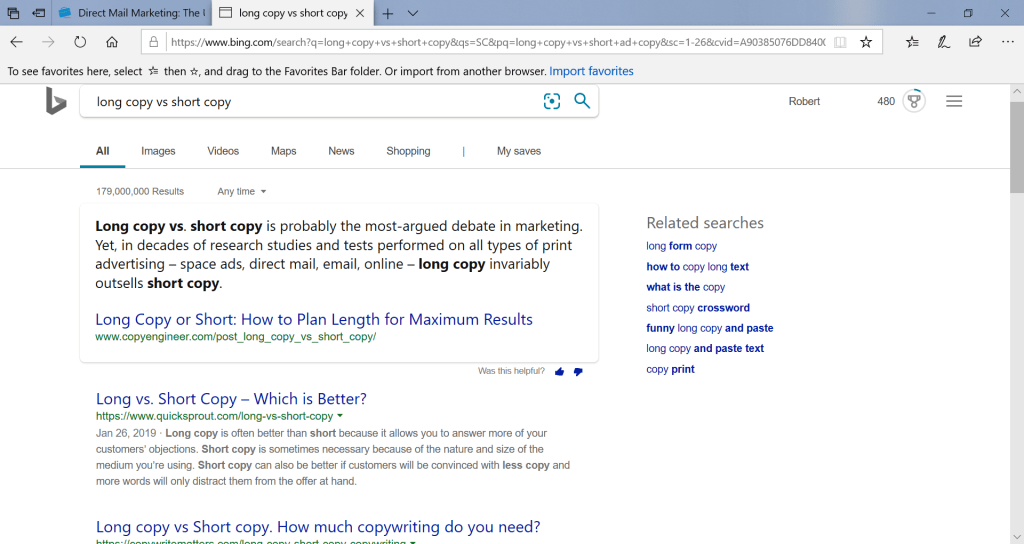
Frankly, I’ve used both successfully. Cop-out? No. My personal preference has always been long copy . . . and I have identified substantial amounts of expert opinion in support of the long-copy case (ex: David Ogilvy in Ogilvy on Advertising – an industry standard). However, my professional career has mostly involved parties who believe “no one reads anymore!” . . . so “bulletize” (another way of saying “dumb-down the content”), though the words used to express the sentiment are generally more like “keep the wordiness to a minimum.” (Just writing this paragraph has kicked up my stress level a notch or two.) In the end . . .
If you are preparing a direct mail piece and answering only to yourself, I suggest using as many (or few) words as are necessary to make your point persuasively, remembering that one or two pieces of carefully chosen and cited data can be the key to establishing credibility and making your point in the most convincing possible way.
Artwork/Graphical Visual and Format – Your need for (and selection of) artwork will depend upon whether you are sending just a letter, just a flyer, or both. Traditionally, multiple pieces were recommended (though current conventional wisdom is far more flexible). Personally, I’ve used all of those approaches in format and have not noticed a significant difference in the outcome. Other factors – such as the quality of the list, effectiveness of the message/offer, and timing – seem to be the determining factors.
That said, artwork – when included – can be an attention-grabbing element. As a result, choose the most compelling OR familiar image available. If you have some well-known quality with a high degree of recognizability (perhaps your physical location), use that to your advantage and stick to a picture that capitalizes on a good address. Humor can be successful as well as art that in some form presents the unexpected.
To state the obvious, always be sure your logo and any byline are prominently displayed as part of your basic branding of the piece.
Note: While the choice of traditional mail vs. e-mail will affect your selection and use of some of the items discussed in this article, your choices can be easily tweaked to work in either environment. In fact, these elements should be similar to ensure consistency across various media.
Snail Mail vs. e-Mail – So . . . which works better?
The answer may ultimately depend upon the nature of your mailing list (with the first question being whether or not e-mail addresses have been included).
Needless to say, e-mail solicitations are faster, less expensive, and very immediate – all very attractive qualities. You can:
- Link to large volumes of supplemental materials.
- Create custom “landing pages” that provide an easy (and very trackable) opportunity for immediate response expressing an interest.
- Repeat the process many times.
- Get immediate feedback about mailing list names that are no longer valid and are now undeliverable.
However . . .
- In this era characterized by inundations of electronic messaging and spam e-mail, you can be easily ignored AND DELETED UNREAD!
- Spam and junk mail filters can keep your messages from being seen by the intended party.
While one might logically guess that the cost, time, and immediacy of e-mail would doom snail mail to extinction, I have found that certain (often demographically older) audiences pay more attention to physical mailings. Interestingly, the traditional approach also has the added benefit of a longer shelf life with parties interested but not currently at “buying time,” causing them to set aside the printed letter or flyer for a quick review at a later date closer to the actual time of need, which gives you the best possible chance of success.
My proof? I’ve had mailings that produced a response that could be absolutely traced back to a physical mailing occurring six months before. While an electronic equivalent to setting a piece of paper aside clearly exists, I’ve seldom seen evidence of that occurring.
A Direct Response Project for Our Own Blog
Huh?
Well . . . one of our goals for this blog is to build an audience. As a result, we searched for (and found) a list of associations, agencies, and affinity groups that appear to have a connection to small businesses (https://smallbiztrends.com/2018/05/small-business-associations.html). As a result, we are planning to systematically approach at least some of them via e-mail and/or mail with a request to link our blog from their web sites. Unlike some mailings, our intention is to do just a few at a time to properly manage the kind of follow-up required.
Since our blog is still in the early stages of development, we will wait until we feel we have accumulated a sufficient amount of content. (Perhaps 20 or so articles?) Also, we realize we do not yet have any meaningful performance data (i.e., visitors, followers, likes, etc.). So, the letters will initially have to be created without those key elements that will be added upon becoming available.
Nevertheless, we have drafted the text of a message and included an offer with the intention of sending out the first few inquiries in the upcoming weeks with plans to revise our message as time passes based on new feedback, performance results, and early results. (We’ll keep you posted. Until then, feel free to comment upon our draft.)
Looking for More Concrete DIY-Type Information?
At least two more direct response articles are planned for the upcoming weeks.
- Detailed instructions on preparation of a Word Mail Merge document that can be linked to an Excel address spreadsheet to generate your own mailing.
- An article explaining the various alternatives that exist for generating a mass e-mailing, including the use of vendors vs. your own word processing and e-mail programs.
Until then, good luck moving forward with your campaigns.
Other Resources
For information about the typical elements of a direct mail package, see:

 Brand Building for Small Business