Role of Branding in Direct Mail/E-mail

Political Branding in the USA

Let’s start with a quick quiz.  Ever see these images?

Sagearbor, CC BY-SA 4.0 <https://creativecommons.org/licenses/by-sa/4.0&gt;, via Wikimedia Commons

What does this picture of a red elephant mean to you?

  • Conservatism.
  • Preservationists.
  • Wealth.
  • Less government intervention (i.e., small government).
  • Donald Trump and George Bush.
  • The Republican Party.
  • . . . and perhaps more?

How about the blue donkey?

  • Liberalism.
  • Change.
  • Labor.
  • Government-funded programs (i.e., big government).
  • Barack Obama and Joe Biden.
  • The Democratic Party.
  • . . . etc.?

In other words, simply seeing these logos immediately brings to mind a wide range of adjectives and accompanying images . . . as well as an emotional response!  That said, we recently had an opportunity to witness the practice (and impact) of this very successful branding in action during the American presidential and legislative elections. 

Frankly, we waited until the election was over (and the votes had been counted) to avoid getting lost in endless partisan digression over details when our reason for bringing up the matter is to highlight these examples of powerful branding while the specifics were still front and center in people’s minds.

In politics, branding is sometimes the only basis upon which individuals vote (and brand loyalty plays a huge role).  Since the issues tend to be numerous, complex, frequently boring, and very often as clear as advanced calculus or nuclear physics, people tend to rely upon simplified measures that allow them to cast a vote that will – they feel – provide a shortcut to their approximate philosophical position.   When a Republican or Democrat votes along party lines, that choice generally assures that certain basic qualities will be present and criteria met by the candidate.  For their part, politicians benefit by closely aligning themselves with their chosen brand . . . rather than get lost in platform details.

In general, the most successful politicians not only align themselves closely with their party’s brand but also manage to enhance that foundation with a strong personal brand through use of campaign slogans, colors, and spokespeople-influencers who, in turn, lend their personal brand to the candidate’s.

Questioning whether a campaign slogan really makes a difference?  Then, check out these seven examples that appeared among the “Top 15 Presidential Campaign Slogans” identified by Martin Kelly (updated February 21, 2018):

Don’t Swap Horses in Midstream

“This presidential campaign slogan was successfully used two times while America was in the depths of war. In 1864, Abraham Lincoln used it during the American Civil War. In 1944, Franklin D. Roosevelt won his fourth term using this slogan during World War II.”

All the Way With LBJ

“In 1964, Lyndon B. Johnson used this slogan to successfully win the presidency against Barry Goldwater with over 90% of the electoral votes.”

Are You Better Off Than You Were Four Years Ago?

“This slogan was used by Ronald Reagan in his 1976 bid for the presidency against incumbent Jimmy Carter.”

Happy Days Are Here Again

“In 1932, Franklin Roosevelt adopted the song, ‘Happy Days Are Here Again’ sung by Lou Levin. America was in the depths of the Great Depression and the song was chosen as a foil to candidate Herbert Hoover’s leadership when the depression began.”

Give Em Hell, Harry

“Both a nickname and a slogan, this was used to help bring Harry Truman to victory over Thomas E. Dewey in the 1948 election. The Chicago Daily Tribune erroneously printed ‘Dewey Defeats Truman’ based on exit polls the night before.”

I Like Ike

“The quintessentially likeable hero of World War II, Dwight D. Eisenhower, rose handily to the presidency in 1952 with this slogan proudly displayed on supporters’ buttons across the nation. Some continued the slogan when he ran again in 1956, changing it to ‘I Still Like Ike.’”

Change We Can Believe In

“Barack Obama led his party to victory in the 2008 presidential election with this slogan often simply reduced to one word: Change. It mainly referred to changing presidential policies after eight years with George W. Bush as president.”

In addition to the slogans identified by Kelly above, another recent example would be Donald Trump’s “Make America Great Again” slogan (MAGA) modified to “Keep America Great” for re-election.  An expert brander, Donald Trump produced a wide range of paraphernalia bearing the phrase . . . and used the words to incite supporters at rallies.

Clearly, catchy statements such as these have been used to define the brand of a candidacy and get voters to identify with the candidate’s cause – tapping into existing associated emotion.   Certain songs have also been employed for branding purposes.  In fact, the artists – recognizing the power of branding – have sometimes ordered campaigns they did not support to stop using the tune – obtaining legal “cease and desist” intervention.

 So, what is the lesson to be learned about branding from the masterful uses employed by politicians?

Branding is the best – and often only – way to simplify complex content for a consumer audience in a way that attaches an emotional response and builds a sense of allegiance to a product.  Furthermore, political branding must (as always) be executed consistently and across all media from billboards to speeches to commercials to ads to pamphlets and flyers to promotional items and more.  The further a brand can be simplified and identified via a short phrase, use of a color, a few bars of a song – the better!

Small businesses can learn much by mimicking the example (however seemingly unsophisticated) of their local politicians building a base of support . . . a constituency.  Frankly, they tend to know their audience well and have found an effective way of appealing to them . . . and those people all represent your existing and potential customers.

A Bit of Trivia:

Ever wonder about the origin of the American political symbols – the elephant and the donkey?  The first appearances of both symbols are credited to the artist Thomas Nast for Harper’s Weekly during the late 1800’s.  (Frankly, some of his cartoons were “Nasty.”)

What Comes Between Black Friday and Cyber Monday?

Last year, we published a Small Business Saturday article that provided an overview of the history of the event as well as the potential importance, offering a glimpse at some of the strategies that could be used by small businesses to link this celebration to their brand.

That was last year, which now seems like a decade ago! 

Over 50 million confirmed Covid-19 global cases later, including over 10 million in the United States (see data), most small businesses have had to face incredible challenges as many countries closed down their economies in order to slow the progress of the pandemic.

While a truly unfortunate number of smaller operations have now permanently closed their doors, we need to take a moment this Small Business Saturday to celebrate the survivors . . . and support them in whatever means are available to us.

Expanded Internet activities.  Free delivery.  New products (maybe even including personal protective gear).  Go Fund Me initiatives.  Special Governmental programs.  All of these strategies and so many more have been essential to the continued existence of the survivors.

While statistics clearly indicate that a second wave of the pandemic is upon us and caution that the upcoming holidays will require us to practice some self-restraint, we feel confident that small businesses will survive while still managing to practice governmental safety standards.  Hopefully, by Small Business Saturday 2021 on November 27th, one or more vaccines will have been released and administered to a sufficiently large number of people to put this pandemic behind us for once and for all.

In the meantime, we will not use this article to do more than serve as a cheerleader for small businesses (including that of my blogging partner – Instant Invitation).  Instead, we will invite you to reread our story from last year and to check out some other valuable repositories of information and strategies.

Nicolas Straut, a contributing writer at Fundera, has put together an overview of Small Business Saturday

https://www.fundera.com/blog/small-business-saturday

Similarly, American Express, which founded the day and holds the registered trademark, makes a wide variety of useful resources available, including a Shop Small campaign:

https://www.americanexpress.com/us/small-business/shop-small/

https://www.americanexpress.com/us/merchant/shop-small.html#toolkit?linknav=us-loy-homepage-visittheshopsmallstudio

Nestled between Black Friday (a tradition which also appears to be undergoing transformations during this time of social distancing) and Cyber Monday, which continues to grow in size and significance, the role and importance of Small Business Saturday cannot be lost.

Black Friday Alert: Corel Draw

Disclaimer:  While we only recommend products we know and love, we want to note we use affiliate links and may earn a commission for purchases made through those links.

Photo from Corel

If you’re one of our loyal readers, you know we are big fans of the Corel Draw Graphics Suite, so we wanted to let you know about Corel’s Black Friday sale currently in effect.  The Draw Suite is now available for $100 off ($399 from $499), and four bonus items are included for free (ParticleShop, ParticleShop Brush Pack Bundle, Painter Essentials 7, and WinZip 24 Standard). 

Corel Draw is not one of those products that’s perpetually on sale, so right now is a great time to buy if you’re in the market for a graphics package.

As we’ve said in a number of our articles: if you’re a graphic designer by trade, Corel Draw is probably not your graphics editor of choice.  If you’re a small business owner without a lot of graphic design experience who is choosing to do branding in-house, Corel Draw is a great choice.  You can address all your web and print graphics needs and produce sophisticated, high-end products . . . for a fraction of the price of the typical designer preference, Adobe.  (These days, most Adobe products are only available via subscription, and their special Black Friday price for their annual subscription paid monthly is $39.99 – $479.88 for the year . . . to be paid year after year for as long as you would like access to their products.  For some people, paying that amount for the Adobe Suite is an ongoing invaluable investment.  For others – like us, it’s like buying a Ferrari to take your kids back and forth to school.)

Click here to read a tutorial on How to Set Up Simple Print-and-Cut Business Cards in Corel Draw.

Click here to go shopping and give the Suite a try yourself.

How to Market Your Small Business During Coronavirus Pandemic

GUEST BLOG INTRODUCTION: Just as business was gradually opening up a bit, new Coronavirus cases have increased dramatically worldwide. Marketing advice for small businesses trying to navigate this unprecedented territory is extremely important. We thank our guest blogger, Kally Tay, for her insights. Having more than 20 years as a manager in various industries, she founded a career website to help others to thrive in their jobs. Featured on numerous platforms such as WordPress Editor’s Pick and AllWomensTalk, her website MiddleMe.net discusses difficult and sensitive issues like workplace abuse and discord among coworkers while providing practical advice on how to handle those situations. We encourage you to read more about her in her bio.

Photo by tirachardz

The coronavirus pandemic has definitely changed the way many businesses conduct their business. They are now forced to try out several strategies to help them keep afloat, especially now that people are not going out to shop due to the fear of the virus.

Small businesses have it rough most of all because they have limited options available to guide them through the pandemic. Fortunately, these options are enough for small businesses to create an effective marketing strategy for their business to remain afloat even during this crisis.

To help you out, here are some ways on how you can do it in the most efficient way:

Always Focus On Open Communication

Maintaining an open communication with clients has always been a major marketing strategy for businesses even before the pandemic. It is a way to show customers that they are open for business and can assist with their daily needs.

But, with the pandemic changing the way businesses do business, having an active and open communication can help customers know you are still available for clients. Keep your customers updated through social media, text and even through your website and let them know what services you have to offer. You can even post your contact details on Google’s My Business Directory so people can search you more easily if they need a certain product or services.

Show How You Can Help During This Pandemic

When you are showcasing your business to customers, they don’t look at the promises you offer them. They remember you with the services and products that you offer. Since they can’t see your products and services in person because of the pandemic, you can show that your services and products still matter during this time.

To do this, spotlight the products and services that can help improve customer lives during this pandemic. Be honest and sincere when doing your campaign and provide discounts for frontliners and anyone working in the field in your area.

Check Out Your Loyal Customers

Got loyal customers who always check your products and services? If you do, do they know that you are still in business despite the pandemic. If they don’t know you are open, how can you rake in sales and stop them from trying out other brands that offer the same stuff as you do?

Check out your loyal customer database and reach out to them through social media or email. Since the pandemic has closed down many businesses, competition is not very fierce and you can use this opportunity to ramp up your brand for new users. Use the time wisely and you can definitely rake in these clients easily to your midst.

Put The Customer First

In business, the adage “the customer is always right” is a constant thing that must be followed religiously. During this time of pandemic, it opens up a great opportunity for your business to reach out to your customers and see how they are doing.

Since people are not allowed out, especially those who are vulnerable to the disease, they depend on businesses and other content creators to give them something to look forward to. They use the content to alleviate their fears and also pass the time because they exhausted everything they can do at home.

With this in mind, you can give your customers tips on how they can use their time wisely at home with the help of the products or services you have to offer. You can also offer advice on other things related to your business that your customers may not have realized before. For example, if you are offering your accountant services before, you can put in advice on your website regarding how they can save money even while at home.

Boost Your Social Media Presence

For several small businesses, it is no longer plausible for customers to visit you in your brick and mortar stores because of social distancing and other coronavirus prevention measures. If you want to keep people still checking out your offerings, you will need to find other ways to sell your product or services.

Social media is a great place to do this, especially now that people are looking online for everything they need. Customers can check your social media pages for what you offer and reach out if you need it. However, if your social media page isn’t up-to-date or your campaign strategy is all wrong, then it can be hard to get the conversion you need to make a profit. Look into how you update your social media and provide credible information that visitors need. If you stay consistent with your brand and offer relevant information, visitors will definitely check your brand often and peruse your products and services.

Use Your Creative Mind To Think Of New Ideas

With many people now stuck at home and running out of things to do, it is a great way for small businesses to offer solutions to this problem.

You can start selling things like coloring kits or startup planting kits for customers to use on their idle time or offer tutorials on how to photo edit or produce the next big viral hit. It doesn’t have to be related to your business. So long as it can help customers pass the time, it is a great way to get people to remember your business.

Stay Flexible And Learn To Adapt

If you want to market your small business during the coronavirus pandemic, it is important that you remain flexible. You can never tell what will happen next during this pandemic and you need to be on your toes for any changes that may affect your business. Learn how to adapt with these changes and be as flexible as you can for your customers who may need your services during this time.

It is unclear as to when things will go back to normal and for small businesses, this uncertainty can be disturbing. However, utilizing the best strategy available, like the ones above, can definitely make a difference and reduce the losses your business may be having due to the pandemic. See which of these tips above can help you and faithfully cultivate them because when you do, you will see things improve gradually.

Small Business vs. Entrepreneurship vs. “Influencer”: Which Best Describes You?

The three categories of activity identified in the headline above have both similarities and differences. 

Since correctly recognizing the term that best describes you could have some bearing upon the way in which you brand your operation, we are using this article to explore these different categories.  That said, be aware that branding does play a key role in each . . . and you should understand that your personal brand may (but does not necessarily have to) play an important part in shaping your company’s brand.

Small Business vs. Entrepreneurship

According to the website DifferenceBetween.com

“The difference between small business and entrepreneurship mainly depends on the persuasion of growth. If the owner/owners of the business are content with the manner in which the business is currently operating and do not wish to engage in more growth opportunities, then it can be categorized as a small business. On the other hand, if the entrepreneur/entrepreneurs operate their business with a clear and creative vision and are interested in expansion opportunities, this type of business is an entrepreneurship. Since small businesses do not pursue growth, they remain small or medium scale throughout their lifespan. However, this does not mean that they are not successful; some small businesses may be cash rich.”

Entrepreneur vs. Influencers

According to a National Geographic article entitled, “Influencers:  The Modern Entrepreneur,” the following applies:

“Entrepreneurs are people who organize, manage, and take on the risks of a business. They often start a new business in response to a perceived need for a good or service. An influencer, on the other hand, is someone who has the power to affect or change people and their behavior through social media—often to get them to buy something. Influencers who start their own business certainly fall under the first part of the definition of entrepreneur, as they are managing their business and taking on risk.”

Brand Building

Typically, small businesses build brands overtime that reflect the product and/or service being provided.  The process involves finding the qualities that set the business apart from others and developing strategies to reinforce those traits and communicate them to customers.  Each interaction with the general public and consumer audience then plays a part in refining the brand to reflect the feedback received via comments, reviews, complaints, and sales.  This process of evolution should be never-ending.  (See our articles designed to help you get started building a brand.)

Very often, the brands of both entrepreneurs and influencers seem to take on the characteristics of the personal brand of the individual(s) involved.  (That said, a strong personal brand can be useful to a small business, too, which may not necessarily be seeking growth but would want strong customer retention – an attribute that could be helped by loyalty to an individual.)

Common Qualities of an Entrepreneur/Influencer

An Inc. magazine article entitled “10 Essential Characteristics of Highly Successful Entrepreneurs,” indicated that these individuals tend to be:  creative; passionate; motivated; optimistic; future-oriented; persuasive; flexible; resourceful; adventurous; and decisive.  In my experience, many of those kinds of words also ultimately end up being among those that define the brand of both the person and the company.

When I first started at GUARD (pre-Berkshire Hathaway days), the company was small (15 employees) and had been founded by a pair of entrepreneurs who had sketched the original structure of the organization on a napkin over lunch.  Frankly, each of the words identified by the Inc. article describe this husband and wife team very well . . . and also became the kinds of words that applied to the culture, products, and services of the company.

In the early days in particular, GUARD was an entrepreneurship that was independent, creative in thinking outside the box in developing unique products and services, flexible in responding to marketplace opportunities, resourceful in stretching available capital, future-oriented in building toward a big long-term goal, etc.

Understanding that personal and company brands tend to merge can be important in either choosing to intentionally build a personal brand OR in making sure steps are taken to separate the brand of the entrepreneur from that of the company.  Very often, this choice should be one of the first made by small businesses.

Ways to Enhance Your Personal Brand

Patrick Ambron in an Entrepreneur magazine article (“Is Your Personal Brand Losing You Business?”) identified four fundamental steps that could be taken to have a strong on-line foundation for a personal brand.

  • Claim your domain name.
  • Build a personal website.
  • Set up profiles on Facebook, LinkedIn and Twitter.
  • Do some basic search engine optimization. 
    (i.e., Use your actual name wherever possible and link all your various pieces of online content to one another.)

Taking these steps can be very inexpensive and (using readily available tools) should be relatively easy.  (Learn more about personal branding.)

And So . . .

If you are an entrepreneur or influencer (or perhaps both), assume your personal brand is going to become part of your business.  Therefore, you better start paying close attention to the kind of statement you are projecting.  If, on the other hand, you are a small business, ask yourself whether customer sales/retention would be improved by linking your identity to that of your company brand . . .  or whether you want the two to make a different statement.

How to Get the Best Fonts for Free

Photo by Lum3n from Pexels

Fonts.  Oh, how I love fonts.  They can make the simplest design unique and elegant.  With the right font, your company name can transform from mere words to a professional and striking logo. So, how does a small business owner make best use of their branding budget (mine is usually $0/mo) to obtain the fonts that are perfect for the job? 

The obvious answer . . . you can search “free fonts” on google and see the results.  Unfortunately, the majority of the fonts in those search results are “free for personal use,” meaning you can use the font for a decoration for your son’s birthday party but not to create your business’s logo.  However, “free for commercial use” fonts do exist, you just need to dig a little deeper for these gems . . . or simply view the list below, because I’ve already done the digging.

– – –

Google Fonts – “Making the web more beautiful, fast, and open through great typography.”

A favored resource, I’ve recommended this site many times.  About a thousand *free* fonts are available, and they’re presented in a wonderfully searchable format (it is google after all).  You’re able to type in your sample text, select the size you want to preview, and choose your desired font characteristic(s);  then, your search results populate accordingly. According to google, “You can use [the fonts] freely in your products & projects – print or digital, commercial or otherwise.”

– – –

Font Squirrel – “100% Free for Commercial Use”

While this web site does have fonts for sale, hundreds are also available free for commercial use (as they promote right in their company tagline).  Fonts are organized by category (i.e., san serif, serif, display, etc.) as well as by other useful attributes (i.e., language, number of font styles included in font family, etc.).

– – –

Font Space – “Free downloads of legally licensed fonts that are perfect for your design projects.”

The majority of fonts available on this site are free for personal use; so, be sure to select “commercial use” as a filter in your search, and you’ll still have thousands of results to peruse.

– – –

1001 Fonts – Your favorite site for free fonts.

Another site in which most of the free fonts are for personal use, you have to look a little closer to find the free commercial fonts.  Click the “Font Categories” at top and within the “Special” section, you’ll find “Free Fonts for Commercial Use.”  At the time of this writing, the count of free commercial fonts was over 12,000, so the choices are still plentiful.

– – –

Font Bundles

I will provide a disclaimer that web sites from this point down are probably only recommended for true font enthusiasts (like myself).  The casual font appreciator will probably not appreciate needing to create an account (albeit free) for access to the free font selection . . . or the regular emails that result (though you can unsubscribe to those; I personally enjoy seeing what’s new in the world of fonts from week to week, but that may just be me).  Now that I’ve mentioned the inconveniences, the benefit is that these types of sites usually have nicer options available.  If you decide to go this route, Font Bundles gives you access to everything in their “free fonts” section, including a new font added every week.

– – –

Creative Fabrica – “BE CREATIVE. STAY AUTHENTIC.”

Another site requiring a free account for access, this source is actually one of my favorites.  They have a “Freebies” section of their web site, in which you’ll find a rotating selection of hundreds of free fonts.  However, my favorite membership perk is their daily emails, each linking to a free font – only available that day.  I enjoy having a free digital treasure delivered to my inbox each morning.  Well, sometimes, the freebie isn’t a treasure, but I can just delete those; no hard feelings.

– – –

Creative Market

Similar to Creative Fabrica described above, you need an account for freebies, and they are regularly emailed to you.  At Creative Market, however, you get one email per week letting you know about six available free goods, which can include fonts, graphics, stock photography, templates, etc.  I would say in general half of the six free goods are fonts.  One nice aspect of this site is that every time you download one of their free goods, its saved for you in your “Purchases.” If you download your free goods every week like I do, hundreds of fonts will be available in that section – all with a nice sort feature and large, graphic preview.

– – –

Do you have a favorite source for free fonts (for commercial use) that I missed?  Let us know in the comments section below!

BTW:  If you get to the point you have so many fonts, you have troubles sifting through your choices, read this story next:  Finding the Right Font: A Review of the Best Available Font Viewers.

Ooooops!! My Personal Brand Was Showing!!

I first encountered the term “personal brand” over a decade ago.  At the time, I worked with an individual who could always be counted upon to incorporate the latest “buzz words” and concepts into his daily interactions.  The two of us were meeting with our boss at the time, and he made a passing reference to the personal brand I had established for myself, which included certain work habits we had been discussing in general terms.  After the meeting (and getting over my initial reaction of, “Huh?!”), I went back to my desk and started running some Internet searches to better understand the way in which working long hours, caring about grammar, and having a certain overall love of words had created a so-called personal brand for myself that apparently led other employees to expect to see those qualities in me even before I was formally introduced to them.

What did my search results yield?

Identify Your Personal Brand

Note: If this article is seeming familiar, you are right. We published the same piece under a different headline recently (see the original). We are republishing under a different one as part of a test to see which approach attracts the most attention. Feel free to offer any comments at the end of this story.

My co-workers were right.  A person can, indeed, consciously and/or unconsciously create “personal brand” qualities by regularly professing belief in those values and trying to support those words with accompanying actions on a regular basis.

In this instance, I was very fortunate because I was not the least bit uncomfortable with my so-called brand profile, which (while hardly very charismatic or exciting) was nevertheless useful in an occupational environment and had me liking the description well enough to try my best to sustain this image over time. 

The lesson to be learned from this message?

Whether you are aware or not, you may already have a personal brand.  If you do, learn what the brand is.  If you are content with the brand you discover, find ways to reinforce that image in people’s minds.  If you are not happy with the perception of you, begin to plot a strategy to create a more desirable personal brand.

Just remember – as is the case with all branding – the one you attempt to create must resonate with others and be consistent with their experience of you.  Otherwise, the brand won’t be “sticky” enough to last.

Official Definitions (as found on personalbrand.com)

Personal Brand: “A personal brand is a widely-recognized and largely-uniform perception or impression of an individual based on their experience, expertise, competencies, actions and/or achievements within a community, industry, and/or marketplace at large.”

Personal Branding: “The conscious and intentional effort to create and influence public perception of an individual by positioning them as an authority in their industry, elevating their credibility, and differentiating themselves from the competition to ultimately advance their career, increase their circle of influence, and have a larger impact.”

BTW – Yes, I know the above definitions have some grammatical agreement issues, but using a direct quote means you reproduce as is.  (However, I’m including this thought to show you one of the ways in which I can reinforce my personal brand, which includes being a bit of a grammarian!!)

Why Bother?  What Can a Personal Brand Do for Your Small Business?

When someone is closely identified with a company, the personal brand of that individual and the brand of the business tend to interact and merge.

For example . . .

When I hear the name of the international corporate conglomerate Berkshire Hathaway, I see the face of Warren Buffett, not any of the names and logos of the hundreds of companies owned by the parent.  Consequently, Berkshire’s brand has become – at least in part – synonymous with the personal brand of Mr. Buffett (a no-nonsense image based on facts and accomplishments, a brand willing to live by results . . . not expectations, a brand that embodies basic fundamental values, and a brand that is not swayed by transient fads).

Just check out the web site at www.berkshirehathaway.com.  Simple.  Basic.  Not self-Important.  Relying upon substance, not style to win audience.

Need another example?

Apple and Steve Jobs.  If Microsoft and Bill Gates define the mainstream, Apple and Jobs were the contrarians that carved out a place – in part – by excelling at qualities not associated with the mainstream, including personal style and individual ease of use.  In other words, Jobs’ personality merged with Apple’s identity.

Consider the small businesses you have known.  I suspect that many (if not most) of these companies have a brand that reflects many of the same qualities as the owner.  Therefore, efforts to build your company’s brand can be enhanced by attempts to establish your own personal brand.

How Can You Go About Building Your Personal Brand?

You start by making sure you live the qualities you want associated with you personally.  Otherwise, the brand won’t resonate and won’t stick.  Then, you can consider taking some very conscious actions to cement your brand:

  • Embrace networking.  Use every opportunity to meet people and introduce yourself and your brand.
  • Grow your online presence.  Use blogs, forums, and social media (such as LinkedIn, Twitter, Facebook, and Instagram) to create a voice and personality for your brand.
  • Ask for recommendations.  Testimonials are a great way of creating trust and enhancing the authenticity of your brand.
  • Get featured in the media.  Position yourself as an expert in your field and make yourself available to reporters.  Over time, more and more will turn to you for comments.
  • Participate in forums, conferences, and events that feature your area of expertise.  Personal contacts of this kind will get your name and face out and into the public eye.

Remember, you must live your brand consistently and practice these strategies regularly.  Some people even find the act of creating personal vision and mission statements to be useful.  Regardless, your goal is to create an identity that will stay associated with you over time, though you should make sure your personal brand continues to evolve and change as the world does.

Bottom line – A Quote from Pia Silva

“With so much content and so many small businesses popping up online, a brand that connects to a person’s face is much easier to trust faster.  It takes less time and effort to build a relationship with a personal brand as compared to a business brand.”

Personal Brand(ing) – Another Way to Build Your Small Business

I first encountered the term “personal brand” over a decade ago.  At the time, I worked with an individual who could always be counted upon to incorporate the latest “buzz words” and concepts into his daily interactions.  The two of us were meeting with our boss at the time, and he made a passing reference to the personal brand I had established for myself, which included certain work habits we had been discussing in general terms.  After the meeting (and getting over my initial reaction of, “Huh?!”), I went back to my desk and started running some Internet searches to better understand the way in which working long hours, caring about grammar, and having a certain overall love of words had created a so-called personal brand for myself that apparently led other employees to expect to see those qualities in me even before I was formally introduced to them.

What did my search results yield?

Identify Your Personal Brand

My co-workers were right.  A person can, indeed, consciously and/or unconsciously create “personal brand” qualities by regularly professing belief in those values and trying to support those words with accompanying actions on a regular basis.

In this instance, I was very fortunate because I was not the least bit uncomfortable with my so-called brand profile, which (while hardly very charismatic or exciting) was nevertheless useful in an occupational environment and had me liking the description well enough to try my best to sustain this image over time. 

The lesson to be learned from this message?

Whether you are aware or not, you may already have a personal brand.  If you do, learn what the brand is.  If you are content with the brand you discover, find ways to reinforce that image in people’s minds.  If you are not happy with the perception of you, begin to plot a strategy to create a more desirable personal brand.

Just remember – as is the case with all branding – the one you attempt to create must resonate with others and be consistent with their experience of you.  Otherwise, the brand won’t be “sticky” enough to last.

Official Definitions (as found on personalbrand.com)

Personal Brand: “A personal brand is a widely-recognized and largely-uniform perception or impression of an individual based on their experience, expertise, competencies, actions and/or achievements within a community, industry, and/or marketplace at large.”

Personal Branding: “The conscious and intentional effort to create and influence public perception of an individual by positioning them as an authority in their industry, elevating their credibility, and differentiating themselves from the competition to ultimately advance their career, increase their circle of influence, and have a larger impact.”

BTW – Yes, I know the above definitions have some grammatical agreement issues, but using a direct quote means you reproduce as is.  (However, I’m including this thought to show you one of the ways in which I can reinforce my personal brand, which includes being a bit of a grammarian!!)

Why Bother?  What Can a Personal Brand Do for Your Small Business?

When someone is closely identified with a company, the personal brand of that individual and the brand of the business tend to interact and merge.

For example . . .

When I hear the name of the international corporate conglomerate Berkshire Hathaway, I see the face of Warren Buffett, not any of the names and logos of the hundreds of companies owned by the parent.  Consequently, Berkshire’s brand has become – at least in part – synonymous with the personal brand of Mr. Buffett (a no-nonsense image based on facts and accomplishments, a brand willing to live by results . . . not expectations, a brand that embodies basic fundamental values, and a brand that is not swayed by transient fads).

Just check out the web site at www.berkshirehathaway.com.  Simple.  Basic.  Not self-Important.  Relying upon substance, not style to win audience.

Need another example?

Apple and Steve Jobs.  If Microsoft and Bill Gates define the mainstream, Apple and Jobs were the contrarians that carved out a place – in part – by excelling at qualities not associated with the mainstream, including personal style and individual ease of use.  In other words, Jobs’ personality merged with Apple’s identity.

Consider the small businesses you have known.  I suspect that many (if not most) of these companies have a brand that reflects many of the same qualities as the owner.  Therefore, efforts to build your company’s brand can be enhanced by attempts to establish your own personal brand.

How Can You Go About Building Your Personal Brand?

You start by making sure you live the qualities you want associated with you personally.  Otherwise, the brand won’t resonate and won’t stick.  Then, you can consider taking some very conscious actions to cement your brand:

  • Embrace networking.  Use every opportunity to meet people and introduce yourself and your brand.
  • Grow your online presence.  Use blogs, forums, and social media (such as LinkedIn, Twitter, Facebook, and Instagram) to create a voice and personality for your brand.
  • Ask for recommendations.  Testimonials are a great way of creating trust and enhancing the authenticity of your brand.
  • Get featured in the media.  Position yourself as an expert in your field and make yourself available to reporters.  Over time, more and more will turn to you for comments.
  • Participate in forums, conferences, and events that feature your area of expertise.  Personal contacts of this kind will get your name and face out and into the public eye.

Remember, you must live your brand consistently and practice these strategies regularly.  Some people even find the act of creating personal vision and mission statements to be useful.  Regardless, your goal is to create an identity that will stay associated with you over time, though you should make sure your personal brand continues to evolve and change as the world does.

Bottom line – A Quote from Pia Silva

“With so much content and so many small businesses popping up online, a brand that connects to a person’s face is much easier to trust faster.  It takes less time and effort to build a relationship with a personal brand as compared to a business brand.”

How to Write a Vision Statement (Including Definitions, Examples, and a Vision Statement Generator)

Your business’s vision statement communicates your ultimate goal. 

Since mission and vision statements are usually discussed in the same conversation, your mission statement is what you do, while your vision statement is the view once you’re done.

Below are a few formal definitions to elaborate on the concept.


DEFINITIONS

According to . . .

[A vision statement is] an aspirational description of what an organization would like to achieve or accomplish in the mid-term or long-term future. It is intended to serve as a clear guide for choosing current and future courses of action.

Similar to a mission statement, a vision statement provides a concrete way for stakeholders, especially employees, to understand the meaning and purpose of your business. However, unlike a mission statement – which describes the who, what and why of your business – a vision statement describes the desired long-term results of your company’s efforts. For example, an early Microsoft vision statement was “a computer on every desk and in every home.”

“A company vision statement reveals, at the highest levels, what an organization most hopes to be and achieve in the long term,” said Katie Trauth Taylor, CEO of writing consultancy Untold Content. “It serves a somewhat lofty purpose – to harness all the company’s foresight into one impactful statement.”


EXAMPLES

Want to see those conceptual definitions in action?  Below are a number of examples to scroll though to see the different ways famous companies communicate their vision.

Google: “To provide access to the world’s information in one click.”

Amazon: “To be Earth’s most customer-centric company, where customers can find and discover anything they might want to buy online.”

Target: “Guided commitments to great value, the community, diversity, and the environment.”

Ebay: “To be the world’s favorite destination for discovering great value and unique selection.”

Nordstrom: “To serve our customers better, to always be relevant in their lives and to form lifelong relationships. And while serving our customer face-to-face is the foundation and hallmark of how we’ve historically served them, today customers seek our service in new ways. Speed, convenience, innovation, and personalization have become cornerstones of the customer experience. Guided by these new needs, we continue to invest in the cross-channel experience, combining the accessibility of pure online experience with the high-touch inclusivity of our stores.”

Versace: “To make women and men feel beautiful and empowered.”

BBC: “To act in the public interest, serving all audiences through the provision of impartial, high-quality and distinctive output and services which inform, educate and entertain.”

Netflix: “Becoming the best global entertainment distribution service; licensing entertainment content around the world; creating markets that are accessible to film makers; and helping content creators around the world to find a global audience.”

The Bank of New York: “Improving lives through inclusion, innovation and investing.”

  J.P. Morgan: “Aspire to be the best; execute superbly; build a great team and a winning culture.”

 Walgreens: “To be America’s most-loved pharmacy-led health, well-being and beauty company.”

CVS: “We strive to improve the quality of human life.”

United Way:  “United Way envisions a community where all individuals and families achieve their human potential through education, financial stability and healthy lives.”

Make-a-Wish: “To be able to make every eligible child’s wish come true.”

General Motors: “To create a future of zero crashes, zero emissions, and zero congestion, and we have committed ourselves to leading the way toward this future.”

Tesla: “To create the most compelling car company of the 21st century by driving the world’s transition to electric vehicles.”

Apple:  “We believe that we are on the face of the earth to make great products and that’s not changing.”

IBM: “To be the world’s most successful and important information technology company.”

Starbucks: “To establish Starbucks as the premier purveyor of the finest coffee in the world while maintaining our uncompromising principles while we grow.”

Taco Bell: “To grow into the largest fast-food provider of Mexican style cuisine in emerging markets.”

Burger King: “To be the most profitable QSR business, through a strong franchise system and great people, serving the best burgers in the world.”

McDonalds: “To move with velocity to drive profitable growth and become an even better McDonald’s serving more customers delicious food each day around the world.”


ANATOMY OF A VISION STATEMENT

As you may have noticed, most vision statements are comprised of the same basic components.  I’ll use our vision statement here at Brand Building for Small Business as an example:

While I have the different parts listed numerically for clarity, the order isn’t important.  As you’ve seen throughout the dozens of examples, these components can look very different from one company to the next.  All that matters is that you’ve clearly and fully communicated the vision of your company.


VISION STATEMENT GENERATOR

Now it’s your turn.  Try creating a vision statement for your business based on the structure below.

Here’s another example for good measure . . .

Have any questions?  As always, we’d love to hear from you.  Scroll below to the “Leave a Reply” section.  Happy vision statement drafting!

Creating Ads that Communicate Your Brand

With the rarest of exceptions, advertising does not sell your product/service.  While you can strike gold every once a millennium (think – Wendy’s “Where’s the beef?” campaign) and actually author an ad that creates a need and desire to make a particular purchase, the typical role of advertising is much more mundane (and less satisfying) –communicating the availability of your product/service to the right targeted audience via a well-chosen media vehicle at the right time (i.e., buying time).

That said, everyone who has ever created an ad dreams of producing the perfect one that entertains, sells, evokes a brand identity, and remains memorable years after the campaign is done.

As these remarks imply, good advertising involves a combination of contributions (especially at large companies) ranging from those who correctly identify an audience to those who understand the media outlets that best serve that audience to those that finalize the right cost-effective media buys that balance the often conflicting demands of size, frequency, cost, and placement.  Of course, the final contributor to the process is the person or teams of people producing “the creative.”

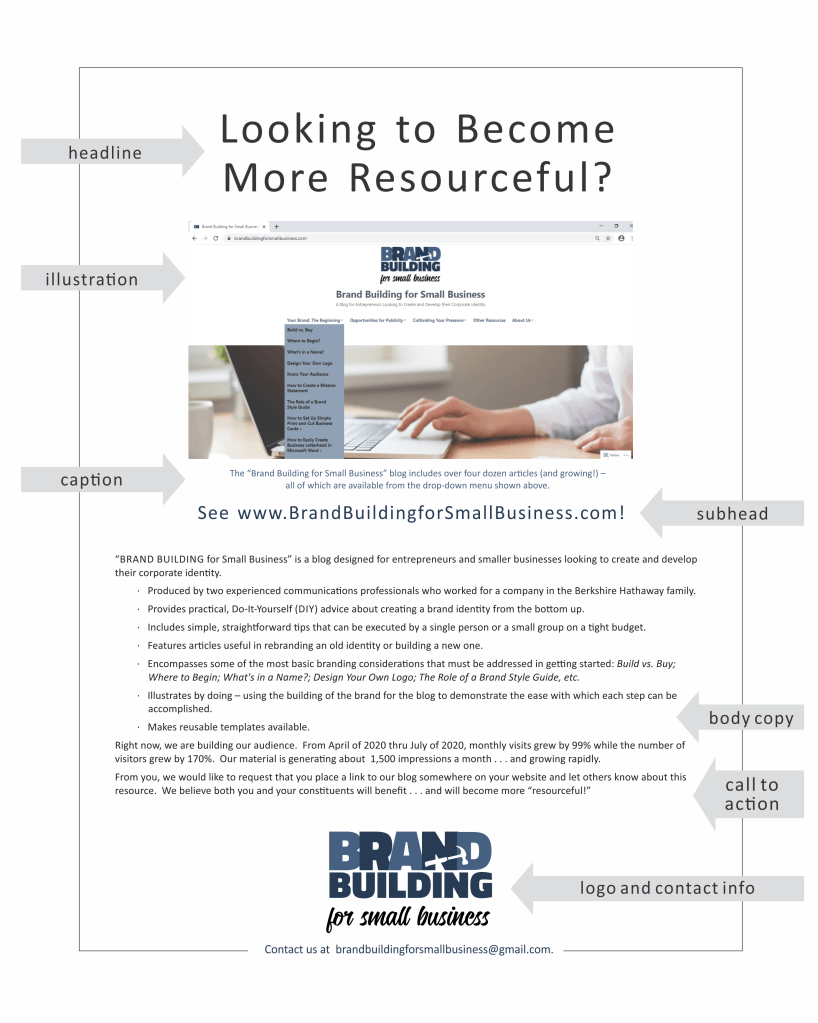
As the typical small business owner, you will often be the party wearing all of those hats!  Therefore, you may be comforted to know that most ad designs encompass a handful of typical elements, which – when known – will be helpful in creating your ad copy and deciding upon the ways in which these elements interact . . . and perhaps even enable you to determine the ones that must be eliminated on a specific occasion for a particular reason.

How does brand factor into this equation?

Well, advertising is one of the many ways in which you can promote your brand.  Conversely, your brand generally provides the vast majority of the content to be included in your ad copy while also defining the visual elements that get incorporated into the design.

The basic parts of an ad include:

  • Headline
  • Illustration
  • Caption (and/or Sub-Head)
  • Body Copy (including the Sales Pitch)
  • Contact Information, Logo, and Call to Action

That said, understand that the only real rule is that the art of creating a successful ad has no real rules, only exceptions.  While 90% of the ads I created probably involve most or all of the elements mentioned above, my favorite one broke all of those rules.  Specifically, I created a half page black-and-white ad done in reverse (white text on a black background) that basically included a single, huge, lowercase word (i.e., because) as a well as a logo and contact information.  While I could write volumes about the reasons I like that ad, I’ll simply explain that lots was communicated very simply in a manner that captured the attention of a person leafing through the publication.  While the piece did rely upon some prior brand presence to automatically communicate certain details to the reader upon seeing the company name, I also believe the ad helped define our style and attitude . . .  and, therefore, became part of the brand.

 The ad was (as I already mentioned) very much an exception.  The vast majority included the various traditional structural elements that I will now briefly describe.

Sample ad for our blog that highlights the basic elements. (I used CorelDraw to create this ad for reasons previously discussed in other articles; however, many other graphic arts programs will work equally well!!)

Headline

With the competition for attention very intense across all media, the first job of your ad is to be seen (not passed over), and your headline and illustration are probably the elements best suited to the job.  Three quarters of all my ad designs have started with a headline I thought was capable of grabbing our share of the readers’ attention.  (Yes, I’m tempted to list the top 10 headlines I’ve created that succeeded . . . but decided to spare you that exercise and move on to the next key element.)

Illustration

The photo or drawing included in your ad is obviously key to grabbing attention.  Some people – particularly graphic designers – would argue that the illustration is the most important factor. That said, the artwork can be essentially descriptive and show an attractive image of your product or service in action, OR the graphic can grab attention by being clever or arrestingly different in some way – perhaps even relying upon humor  (i.e., “Where’s the beef?”).

If you personally have artistic skills, this element of the ad can be great fun.  If, on the other hand, you are more of a writer or pure businessperson, you can still create a successful ad on your own – using photos or artwork available from some of those free sources already discussed in earlier blog articles.  (See FREE Pictures Are Also Worth a 1,000 Words (and Can Help Promote Your Brand)!

If you are going this route, be prepared to spend lots of time paging through stock images until you’ve found just the right one to make your point.  (Also, don’t forget that most phones now include cameras able to produce sufficiently high-res images that can be the key to capturing your product/service in action;  if you have the eye, the equipment is already in your pocket.)

Caption (and/or Sub-Head)

Your caption obviously relates to the illustration you’ve chosen and generally provides a key opportunity to introduce brand qualities most likely to result in a sale.  That said, you will no doubt find times when the caption is eliminated either because the artwork is self-explanatory or does not offer the opportunity to highlight your brand. If people are shown, the caption may be the best chance to provide identification and further humanize the brand while giving a face a name that might be memorable to all or a portion of your audience.

The ability to include sub-heads is obviously dependent to a large degree upon the size of the ad.  For a half page or less, chances are you will skip this element.  For larger sizes, your sub-head provides an extra opportunity to grab attention.  Or, perhaps the sub-head just gives you a chance to continue your major headline further down the page – pulling the reader into your content.

Body Copy (Including the Sale Pitch)

You use your body copy to describe your product or service to the audience, being sure to employ language that highlights those qualities that define your brand.  Frankly, repetition of that information in circumstances like advertising is one of the ways in which brand identity is created.  In selecting the words to include, you want the most sales worthy qualities of your brand and repeat them in every ad you create.  Also, be sure to use this space to highlight and explain any special promotions that might be happening at the time.

How many words should you use?  Frankly, long copy vs. short is one of the age-old debates in advertising among designers, business owners, experts, and amateurs.  You’ll find everyone has a firmly held opinion . . . and the jury is still split even among the luminaries in the field – all of whom are recognized as the best and most reliable source of information.

Frankly, I’m a word person . . . so I tend to think “more” has a better chance of being effective than “less.”  In support of this position, I’ll turn to David Ogilvy – one of the founding fathers of advertising – who was an advocate of long copy, especially for more complicated, technical, and expensive products.  He stated:  “All of my experiences say that for a great many products, long copy sells more than short.  I have failed only twice with long copy.”  (David Ogilvy – Ogilvy on Advertising.)

 My preference/bias duly noted, I’ll offer the following to balance my prejudices:

  • My favorite ad that I’ve created has (as already mentioned) basically one word (without further explanation) as the focus.
  • My blogging partner probably has a belief that (at least in comparison to me) less is more when talking about ad copy.
  • More of my ads probably ended up having less copy than I preferred because my bosses generally believed that more words than could be counted on 10 fingers were probably suffering from “wordiness.”

In the end, my advice is to include just the amount of language that seems right for a particular ad.  I believe each will be a bit different, and you will inevitably have a sense of the right quantity to make your point and pitch your product or service because – in the end — sales and reinforcing brand identity are the point of this exercise.

Contact Information, Logo, and Call to Action

The final elements of your ad are very basic ones that should never be forgotten.  Include your logo, address, phone, fax (WHAT’S THAT??!!??), e-mail, and/or web site.  (Exception:  If you are channeling all responses in a certain way, all other contact information can be excluded.)

You should also make some sort of statement that clearly tells your audience what to do next.  For example:

  • For more information, contact us at ____________________.
  • For more information, visit our web site at _______________________ and be sure to submit a customer service request form.
  • To order today, please __________________.
  • To speak with a live representative, ________________________.
  • Etc.

You get the idea.  Worth mentioning is that the nature of responding to any advertising and promotion should be determined in advance and used in all situations.  Perhaps, that process will involve setting up a special phone extension, a post-office box, or web landing page used exclusively for that purpose.  The advantage in taking such a systematic approach is better collection and assessment of data resulting from your efforts and immediate recognition of an inquiry coming from a sales lead that, therefore, enables a high level of customer service to help close a potential sale.

Branding and Your Overall Design

The elements discussed above are the ones at your disposal to mix and match in creating your ad.  When employing them, you must be absolutely certain to remain consistent with the rules described in your Style Guide, which will outline the fonts, colors, and perhaps even available types of illustration as well as highlighting key boilerplate language to be included.   Your ad must always conform to these rules while expressing the brand qualities you want to highlight as memorable and sales worthy. 

While much of the discussion in this article is applicable to both print and electronic advertising (especially electronic ads that basically mirror print equivalents), be aware that e-banner ads have typical very small sizes that create their own special challenge . . .  and call for a separate future article to discuss some of the techniques to be employed and pitfalls to be remembered.

Meanwhile, good luck and have fun.  Ads provide you with a great opportunity to explore your creativity and to benefit from customer responses/sales leads!