
Skip to content
Brand Building for Small Business

Brand Building for Small Business

A Blog for Entrepreneurs Looking to Create and Develop their Corporate Identity

  • Your Brand: The Beginning
    • Why Bother?
    • Build vs. Buy
    • Where to Begin?
    • What’s in a Name?
    • Design Your Own Logo
      • Don’t Let Them Mess with Your Logo
    • Know Your Audience
    • Vision Statement
    • Brand Style Guide
    • Choosing a Color
    • Business Cards
      • Microsoft Word
      • Corel Draw
    • Mission Statement
    • Business Letterhead
      • Microsoft Word – Instructions & Template
      • Microsoft Word – Video Tutorial
      • Corel Draw – Instructions & Template
    • Business Envelopes
    • Choosing Paper
    • Annual Brand Checkup
    • Side-by-Side Comparisons Can Be Helpful
    • Your Brand Manager
    • Role of Branding in Business Plans
  • Opportunities for Publicity
    • 10 Minute Branding
      • Ask a Customer (Just One) To Do a Review
      • Build a Contact Prospect List
      • Coffee Break!!
      • Conduct an Ongoing Three-a-Day Sales Campaign
      • Go Shopping!!
      • Press Release Generator – Sample Press Release on United Way Day of Caring [or Action] Involvement
      • Signage & Creating Branding
        • “Your Call Is Important To Us” (NOT!!)
        • Punny Signs
      • Sponsor a Community Team
    • Social Media
      • The Simplest Social Media Strategy
      • Get Your Business Started on Pinterest
      • How to Create a Facebook Page for Your Business
      • Social Media: One More Reason to Bother! (Betting on the Long Shot)
      • Creating a “Follow Us on Social Media” Sign
        • Microsoft Word
        • Corel Draw
      • Creating a Mail Merge Document for Direct Response Mailing
      • Branding Through Blogging
      • A “Legal-Approved” Free Collection of Social Media Icons
    • Social Influencers
      • How I Learned Social Influencers Rule the World
      • Approaching Social Influencers
      • Approaching Social Influencers: Sample Text
    • Reviews
      • Getting Reviews for Your Business
      • Review Request Sign
    • Direct Mail/Email
      • Role of Branding in Direct Mail/E-mail
    • Press Releases
      • Press Releases as Another Opportunity for Branding
      • Press Release Generator – Identifying Your Content
      • Press Release Generator – Sample Press Release Announcing a New Hire
      • Press Release Generator – Sample Press Release Announcing an Employee Promotion
      • Press Release to Introduce Ourselves as Part of National Small Business Week in May
    • Campaign (Re)Launches
      • The One That Got Away!
    • Small Bus Saturday
      • What Comes Between Black Friday and Cyber Monday?
    • Holidays
      • Holiday Cards
      • Free Holiday Card Template for Your Business
      • Holiday Branding
    • Charitable Contributions
    • October 27th:  National Blogger’s Day?
    • Bad Press
    • “Best of” Business Awards
    • National Small Business Week
  • Cultivating Your Presence
    • 10 Minute Branding
      • Brand Consistency
        • Always Have a Back-up on Hand
      • Monitoring Brand Mentions
        • When was the last time you googled yourself?
        • Make Google Alerts Work for Your Business
      • Protect Your Brand: Copyrights
        • Perform Regular Checks for Copyright Infringement
        • Stop Intellectual Property Thieves on Etsy
      • SEO
        • Make Sure Your Web Site is Included in Search Engines’ Index
        • Review Your Web Pages’ Titles
        • Review Your Web Pages’ Descriptions
        • Meta Keywords
      • Favicons (and a Favicon Generator)
      • A Match Made in Minutes
      • New Year Greetings
      • Order Pizza for Your Employees
      • Visit a Competitor’s Web Site
      • 2023 – Start a Fresh, New “To Do” List!!
      • Employee Reality Check
      • Ties That Bind (and Define)!!
      • Be Brand Proud; Sign Up Now!!
    • Design Resources
      • FREE Pictures Are Also Worth a 1,000 Words (and Can Help Promote Your Brand)!
      • Optimal Resolution for Optimal Output
      • How to Get the Best Fonts for Free
      • Finding the Right Font: A Review of the Best Available Font Viewers
      • A Few of My Favorite Fonts
      • Nicely Branded Displays Help Sell! (i.e., Branding and Your Trade-Show Booth)
    • Advertising
      • Role of Advertising in Successful Branding
      • Creating Ads that Communicate Your Brand
    • Web Design
      • Attention Small Business Owners: Yes, You Need a Web Site!
      • Web Design: Everyone has to Start Somewhere
      • A Simple SEO Hack from Neil Patel
      • SEO Resources
      • Landing Pages
    • Customer Service
      • Branding Through Customer Service
      • In Search of the Holy Grail (of Branding)
      • Clever Customer Service
    • Personal Branding
      • Personal Brand(ing) – Another Way to Build Your Small Business
      • Small Business vs. Entrepreneurship vs. “Influencer”: Which Best Describes You?
      • Personal Branding and the “Newspaper Test”
    • Crisis Management
      • Crises Management: Messages Sent Now Will Define You Forever
      • Weathering the Storm
      • Branding and the Pandemic
      • How to Market Your Small Business During Coronavirus Pandemic
      • Customer Service During Crises
      • Time to Rebrand?
      • Rebranding and the Cancel Culture
      • ZOOM!!
      • Considerations When Starting or Restarting a Brand
      • How to Protect Your Brand When You Receive Bad Publicity from Customers
    • Branding Calendar
    • Thank You Card
    • Happy Birthday Card
    • Political Branding
    • Copyright Protection
    • Motivation
      • Confidence
      • Dream Big
      • Getting Started
      • Moving Forward
      • Opportunity
      • Success
    • Today’s TIP
      • Another Way to Build Your Brand
      • Branding and the Role of Leadership
      • Bridge Building and National Small Business Week 2022
      • Celebrate
      • Embrace Responsive Branding
      • Fonts Matter
      • Give Thanks
      • A Good Brand
      • Invest in Your Brand
      • Keys to Branding
      • Listen to Your Customers
      • Montor Your Web Site Branding Over Time
      • Networking
      • Pride Month
      • Reputation is Everything
      • Request Testimonials
      • Role of Introspection
      • The Roles of Perspiration vs. Inspiration
      • Saying Thank You
      • Shaping Your Brand
      • Take a Break
      • The U.S.A. as a Brand
      • Volunteering
      • A Way to Welcome a Brand New Year
      • You Can Multiply Each Customer Contact X 11
      • Your Brand Story
      • Brand Recognition
  • About Us
    • Bob Thomas
    • Carole Mancuso
    • Current Approach to Branding
      • How to Build Your Brand 10 Minutes at a Time
      • Weeeeeeeeeeee’re Back . . .!
  • Other Resources

Tag: tips

Get Your Business Started on Pinterest

KNOW YOUR TARGET

My number one first suggestion to an individual looking to promote their business on any social media platform is to get to know your target.  If you’re looking to create a facebook business account and reflections of your first facebook profile picture trigger a ‘wow, look how young I was’ reaction, you can probably safely cross this item off the to-do list.  If you’ve got a sad, faceless, white silhouette or no account at all, your first step is to dive — head first — into the unknown realm and fully immerse yourself.  The definition for full immersion (or your threshold for comfort in the new environment) will vary by person, but I would recommend you spend AT LEAST a few hours over the course of a week or so bravely exploring.  While a great supplement, research cannot compare to real-life experience.

So I’m going to assume you have an individual account on Pinterest, and you know that a ‘pin’ is an image most often representing linked content, a ‘board’ is a stored collection of like pins, and the Pinterest site or app is often used as a visual search engine. 

WHO ELSE IS ON PINTEREST?

A closer look at Pinterest’s demographics (below) shows a more female tilt (though that tilt decreases in intensity every year) with other lesser represented demographics including individuals 65+ and people with income less than $30k.

WHY ARE THESE FOLKS ON PINTEREST?

The big topics traditionally associated with the platform are food and beauty/style.  If your business is focused on one of these categories, Pinterest is the perfect match for you. 

The impetus for me writing this particular article is that we are currently looking to promote our blog, Brand Building for Small Business, on Pinterest.  Since we’re not a sure-thing kind of fit for this outlet, I went looking to confirm my personal impression that DIY business topics do perform well.  Pinterest’s top 100 trends for 2019 fall into ten categories:
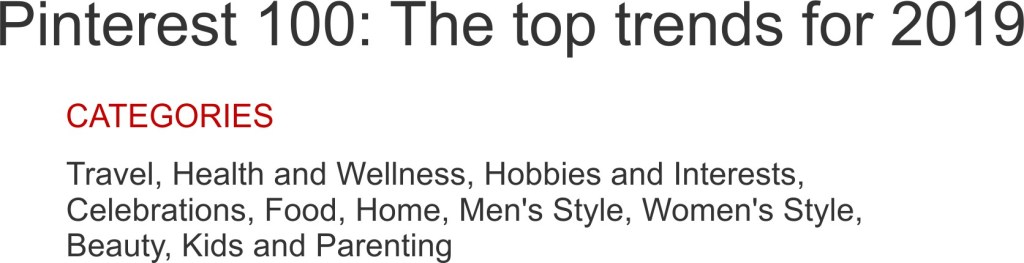
I hope your business is faring well here, because ours it still on the fence.  Actually, we may not have even approached the fence yet.  The top ten trends within each category are available on Pinterest’s web site.  Upon drilling down, I see we have some potential in the Hobbies and Interests category:  the first item listed is, “Do the hustle: People are turning their passions into profits—from canning to DJing to online tutoring. (Searches for side hustles at home +690%).”  Apparently, lots of small businesses are blooming, and these at-home entrepreneurs are turning to Pinterest.  I’m optimistic that your review of the top trends was equally encouraging.  This social media platform really has evolved significantly over the years, and I believe a large percentage of businesses can find a comfortable home in today’s Pinterest.

MAKE YOUR BUSINESS PINTERESTING (sorry, just had to . . . )

1.  Create Your Business Account

You can either add your business profile to your personal one (by clicking  in the top right corner, then “Add a free business profile,” and completing the following prompts) or you can create a profile independent of your personal account (log out of your personal account, go to pinterest.com/business/create/, fill in your email and password, click “Create account,” and answer the questions that follow).
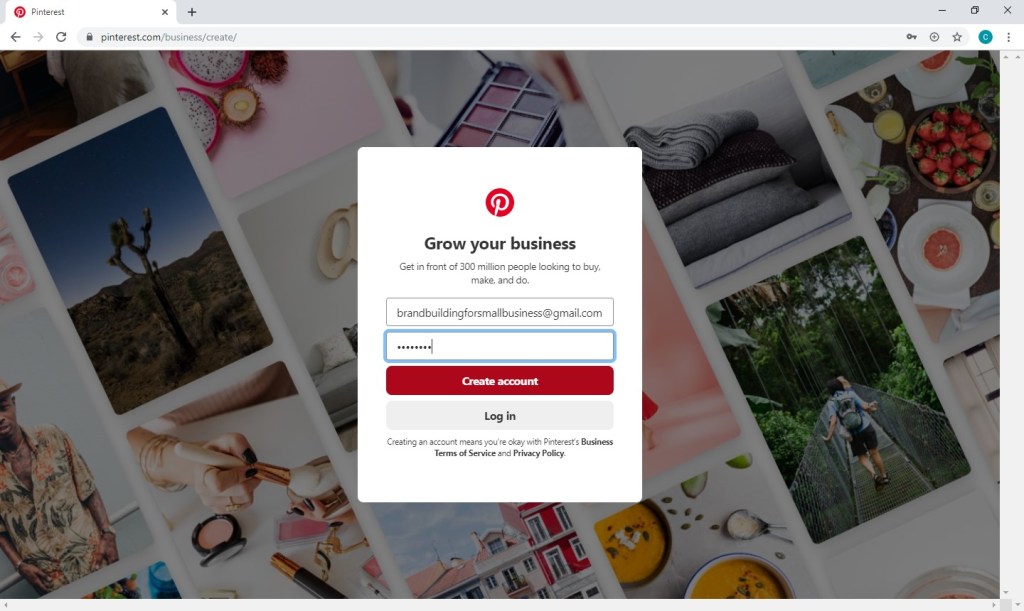
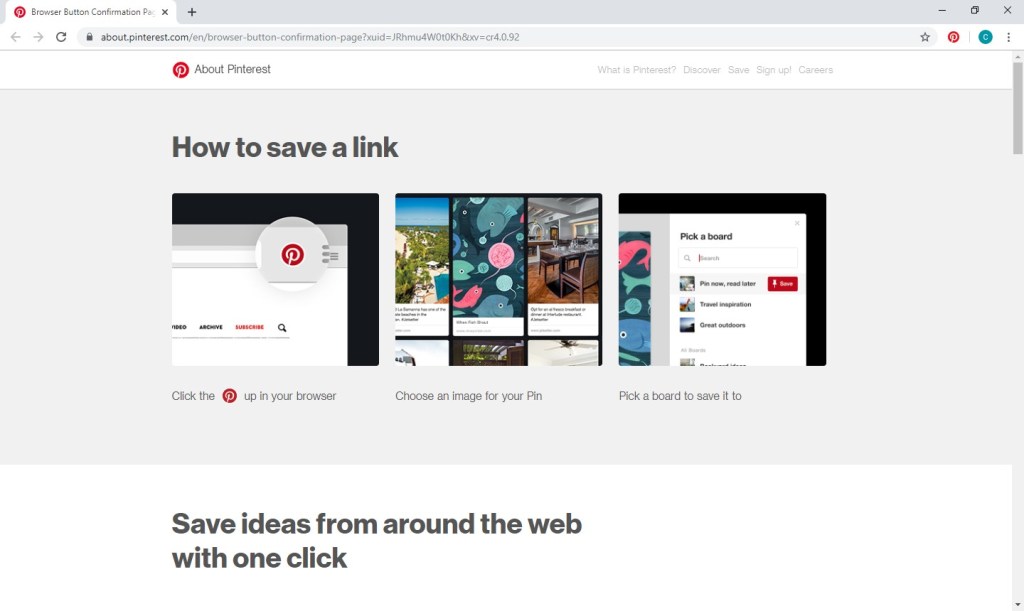
In that process, you’ll be asked whether you would like to add the Pinterest save button to your browser.  While certainly not a necessity, the button can ease your future pinning.
2.  Edit Your Profile

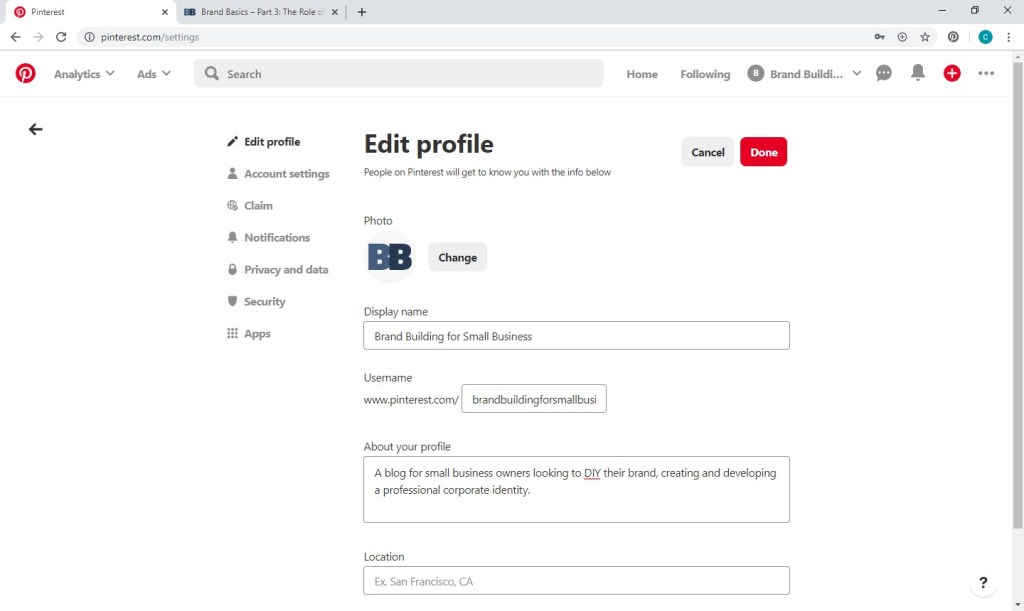
Click the pen to the right of your business name for your business account settings.  Your profile photo should be consistent with your brand, square, and at least 600 x 600 pixels.  In the About section, you have 160 characters to be as descriptive as possible while including keywords and phrases that your target audience might search.
3.  Create Your Boards

Next, you’ll want to decide how to structure your account.  If you’re a photographer, you might want to have boards for each type of photography you do (weddings, babies, etc.).  If you own a salon, you could create a board for each type of service you provide.  As a blog for small business branding, I’m going to create a board for each brand component we focus on (logo design, style guides, direct mail, etc.).

To begin, you’ll need to switch from your Business hub to your Profile.

From your profile page, select boards, and click the plus sign.
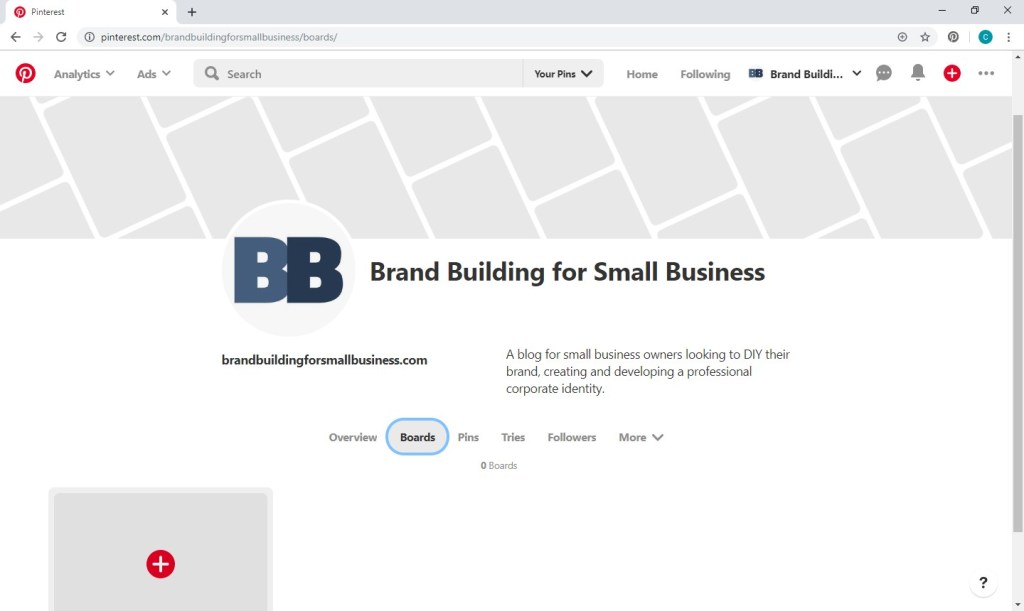
You’ll again want to be as descriptive as possible with your board names while keeping keywords in mind and limiting your character count to only 20.

Return to the boards page, hover over the name of your new board, and click the pencil icon to enter more details.  Enter a description, choose an appropriate category, and save your board. 

Repeat this process for as many boards as you’d like.

4. Get Pinning

Next, you’ll want to add some pins to your boards, which should include a mix of your products and services, related content that is new to Pinterest, and related content already on Pinterest. 

The easiest route of course is simply repinning, but you usually need new content (in addition to your products and services) to make your board worth following, though exceptions certainly exist.

If you chose to download the Pinterest save button to your browser when creating your account, you can simply hover over pictures you’d like to pin, and the Pinterest save button will appear at the top left of the picture, as you can see below on our home page.  While a great neutral image, nothing specific is communicated and would therefore be largely useless as a pin.  You want to use an image that is visually appealing and clearly conveys the viewer’s destination if he or she were to click.  Your logo is a nice addition but not a necessity.

Since no such image existed for my article on logo design, I needed to create one.  The image specs put out by Pinterest are:

  • File type: PNG or JPEG
  • Max file size: 32 MB
  • Aspect ratio: 2:3 or 1000 x 1500 pixels. Pins with an aspect ratio that’s greater than 2:3 might be cropped in people’s feeds.

So you want a high-quality, portrait image that includes a text overlay IF the picture isn’t self-explanatory.  (If photo editing isn’t one of your talents, check out 7 of the Best Mobile Apps to Add Text to Your Photos at TechMadeEasier.)

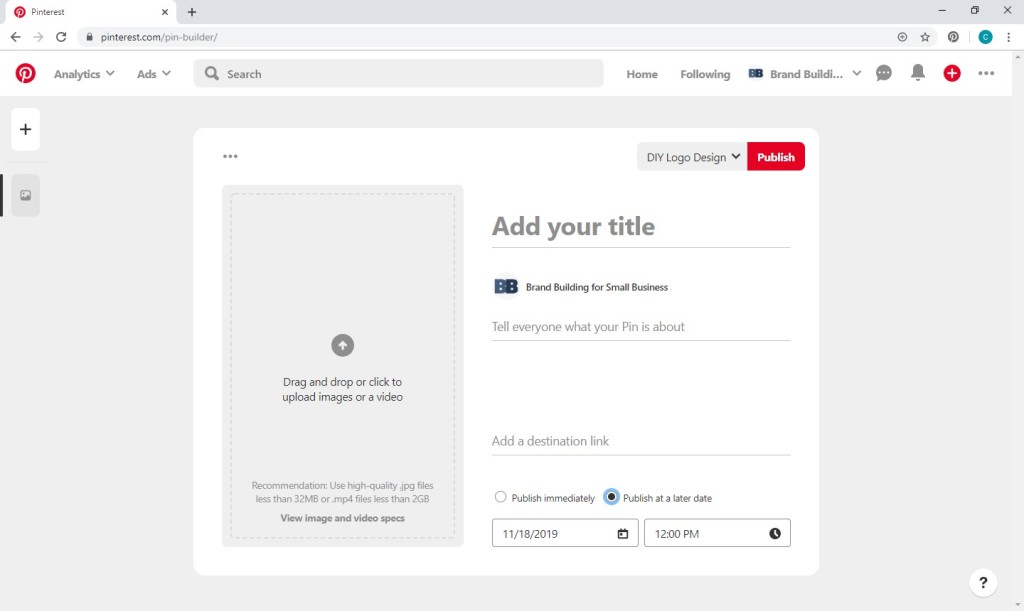
Once you’ve got your image and are ready to add your new pin, click on your applicable board, and click the plus sign at top left to “Create Pin”.

Upload your picture, add your title, explain your content, and include a destination link.  (Once again, be mindful of keywords people might search to find content like yours.)

Quick Note About Rich Pins:
With a business account on Pinterest, you have the ability to add greater depth to your pins for products, recipes, articles, and aps:
– Product pins include real-time pricing, availability, and purchase information.
– Recipe pins display ingredients, cooking times, and serving sizes.
– Article pins show a headline, the author, and a story description.
– Ap pins include an install button.
While these additions can be very helpful, rich pins do require some initial groundwork.  They function by displaying metadata associated with your content that’s included within the HTML of your website. For information on setup, see Pinterest’s Developers’ Overview on Rich Pins.

YOUR PINTEREST PLAN GOING FORWARD

Pinterest recommends you pin at least once per day during peak times (i.e., evenings and weekends).  You can also schedule pins if you’d prefer to get a large amount ready all at once.  To do so, just select “Publish at a later date” when creating your pins.  You can schedule as many as 30 pins up to two weeks in advance.
Happy pinning!  If you have any questions, leave a reply below. 

Carole Mancuso Building Blocks, Social Media 2 Comments November 21, 2019December 9, 2019 5 Minutes

Design Your Own Logo

Disclaimer:  While we only recommend products we know and love, we want to note we use affiliate links and may earn a commission for purchases made through those links.

Lots of businessowners question whether they’re creative or tech-savvy enough to create their own logo.  Unfortunately, I can’t tell you neither of those qualities are needed, but I can safely say they’re not needed in the abundance you probably imagine.

Things you do need to design your own logo:

  • A little creativity
  • A little tech savvy
  • A vector editing program (available for free)
  • Lots of fonts choices (available for free)
  • Lots of icon choices – IF you want a graphical component to your logo (available for very minimal cost; the icon used in our logo cost $2.99)

So where to start?

While graphic design isn’t my specific trade, I’ve been asked to create dozens of logos throughout my career.  Every time, I start by facing that same dreaded obstacle: the blank page.  I stare at it, thinking about what the logo should represent and the type of fonts, colors, and imagery to best suit that message. Meanwhile, a blank page relentlessly stares back.

While a tedious process, you should set your expectations for your logo before you pick up a pencil (or the mouse). 

Originally, logos were introduced as an aid to people who couldn’t read.  As a result, the earliest designs tended to be very literal. (For example, a shoemaker’s logo would inevitably show a shoe.)  Over time, the purpose of logos has evolved to become a broader reflection of brand but remains a key way of differentiating yourself in the marketplace. 

So what’s the personality of your company?  Is your business youthful and trendsetting?  Conservative and financially strong?  Fun and whimsical?  Product-focused and straightforward?  Some combination thereof?  This corporate identity (or brand) needs to be communicated in your logo – through your font(s), color(s), placement of words, and any graphics. 

If once you have a strong sense of your business “personality” in mind, your page is still unyielding in its never-ending canvas of white, go looking for some inspiration. . . .

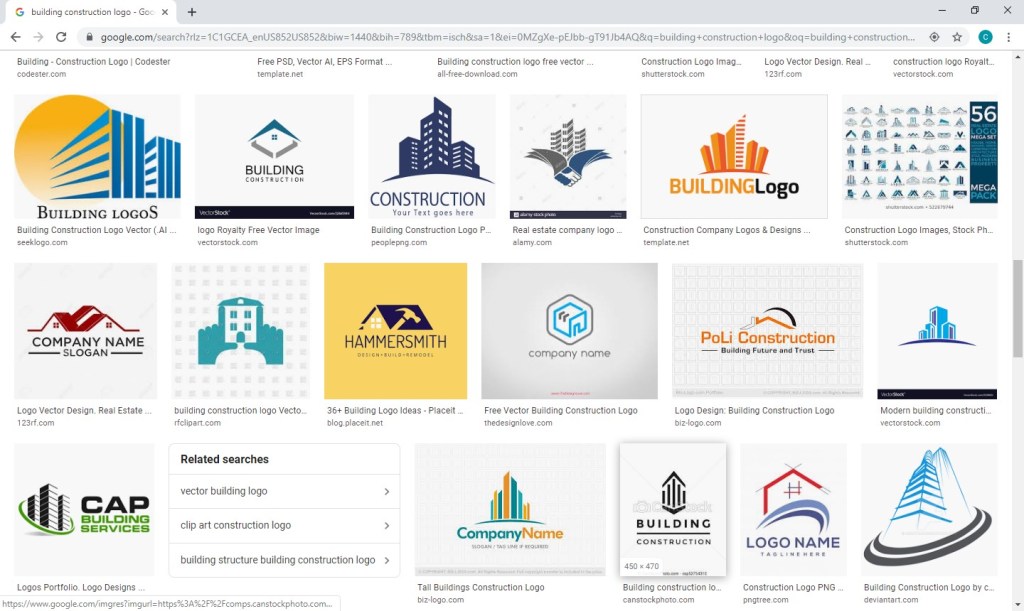
For the Brand Building for Small Business logo, I knew I wanted to try something graphical to literally represent the act of “building.”  I was initially picturing letters being nailed but knew that would be tricky to execute in a clear way.  So, I went to my go-to spot for inspiration:  google images.  I searched for “building logo,” hoping the results would be full of construction-type logos also looking to convey the literal act of “building.”  But no, Carole, searching “building logos” yields lots of logos of buildings.

. . . Should have foreseen that.  Instead, I searched for “building construction logos” and found more of what I had in mind.

A couple screens in, I found inspiration.

Looking at the Hammersmith logo (in navy and white on a yellow background), I love the way the hammer is a silhouette within the house and appears to be captured mid-swing.  I immediately knew I wanted to try a hammer silhouette, but I wanted the graphic to appear within the company name and not as part of a separate graphical element. 

A quick note on inspiration versus copyright infringement:  This is an area requiring caution.  Whereas you can use a silhouette of a hammer as seen in one logo in another, creating a logo for a construction company with a silhouette of a hammer in a navy house with white windows on a yellow background would most certainly earn you front-row seats to the case of them v. you.  An individual idea cannot be copyrighted; however, “a collection of ideas” makes a logo (or any other original work) unique and can be protected by law.  Tread carefully.

LOGO ICONS

So, where does one go for icons that could legally be used as part of a logo for minimal cost?  A number of options exist, but I like https://thenounproject.com/.  They have a large selection and charge nominal, one-time fees per icon.  I found the hammer for our logo for $2.99.

A number of choices were available. . . .

I selected a classic and simple hammer.

I then purchased and downloaded the file in PNG (bitmap image with a transparent background) and SVG (vector) formats.   (A separate article on Vector vs Bitmap file formats is planned.)

VECTOR/GRAPHICS SOFTWARE

Now what to do with your icon?  We use the vector and graphics editor, CorelDraw.  While the suite is powerful and much cheaper than your standard graphics package, the cost is still pretty steep in the $500 ballpark.  I read a few articles on free vector-editing programs, found Inkscape (https://inkscape.org/) to be highly recommended, and gave it a go.  The program seems to have the features needed to get the job done.  (And, they make a number of tutorials available, including one on the basic tools:  https://inkscape.org/en/doc/tutorials/basic/tutorial-basic.html.)

FONTS

An obvious first step when selecting a font to use for your logo is to scroll through the existing fonts on your computer to see whether anything catches your eye.  Remember that you’re not looking for the font that necessarily looks the best to you; rather, you’re looking for the one that best represents your business’s brand.  If you’ve picked out an icon at this point, you’ll also need to be mindful of the way a given font looks with your chosen icon.  You can have an icon and a font that both separately represent your brand perfectly but just don’t look good together.  Since I wanted to try including the hammer as a silhouette within the words for Brand Building for Small Business, I needed a really bold, thick font.  I gave Arial Black a try, knowing it’s the boldest font currently available on my computer, but I wasn’t really pleased with the result.

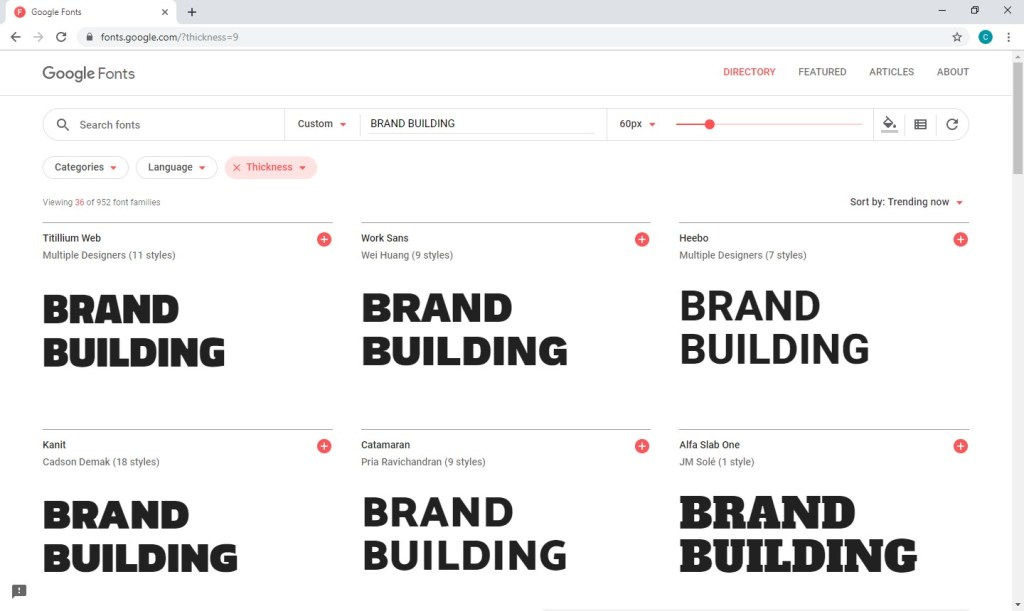
Thankfully, a source exists offering hundreds of (*free*) fonts in a searchable format that actually makes the process relatively easy.  With Google Fonts (https://fonts.google.com), I was able to type in my sample text, BRAND BUILDING, the size I wanted to preview, 60 px, and my desired font characteristic(s), increased thickness.

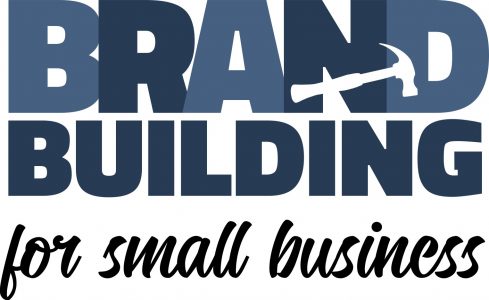
After much trial and error (downloading, installing, and trying dozens of fonts), I found Titillium Web Black and a contrasting script, Candelion Regular, to work in black and two shades of navy.

While I am VERY tempted to digress at this point and start talking about some of the many techniques that can be used to marry the fonts/words used in your logo to the images you’ve chosen . . . I keep reminding myself that level of detail is really better suited for another blog entry further down the road.  For now, I will stick to my original plan to keep this message broad but nevertheless offer a few . . .

CONSIDERATIONS

At some point, you may choose to print sales materials in grayscale or advertise in a print media in black and white.  You may want to have branded pens for your company (requiring a very, very small logo) or you may purchase a building on Times Square and want your logo proudly illuminated on top (requiring a very, very large logo).  Before you decide your design is a done deal, you should run a few tests.  Try changing your color scheme to grayscale as well as black and white and print a very small version (one half  inch on its biggest side should be sufficient) and a very large version (full page).  If all variations look ok, you’ve probably got a keeper.

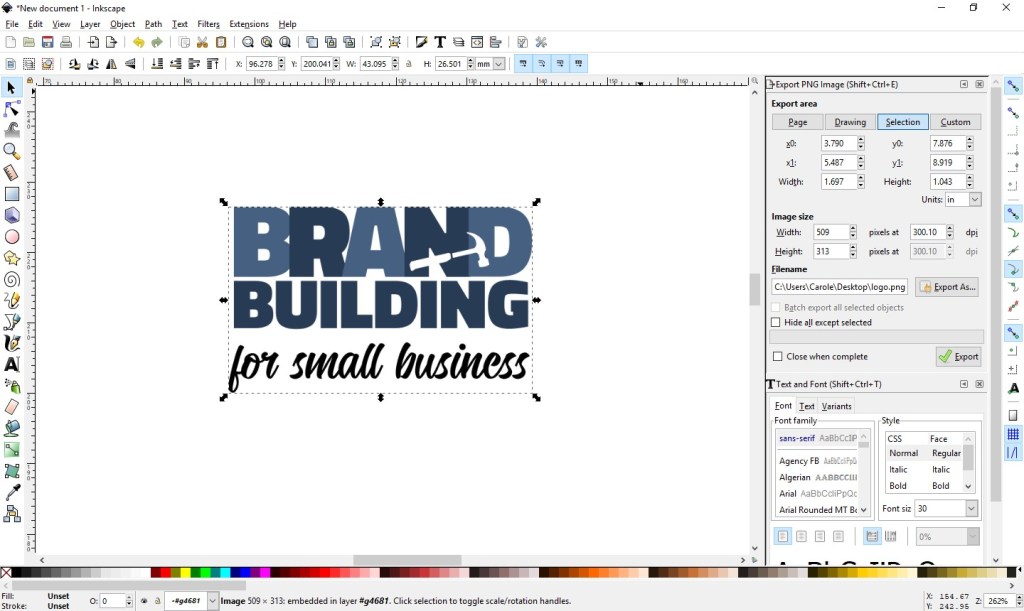
Export your new logo as a high-resolution transparent RGB PNG, which will work well in MOST (but not all) environments.  (Inkscape export settings are shown at right below.)

Once you’ve managed to get this far, you’ll want to protect your work.  Your logo should be registered as a trademark.  If you are not of a mind to involve your lawyer in the process, consider checking out various on-line alternatives and look into the steps involved in going the DIY route (for example: https://www.wikihow.com/Register-a-Trademark-Without-an-Attorney).

Next up . . . confirm your understanding of your business’s audience; read: Know Your Audience.

Carole Mancuso The Beginning 6 Comments September 8, 2019November 23, 2020 6 Minutes

Enter your email address to follow this blog and receive notifications of new posts by email.

Join 586 other subscribers

Enter your email address to follow this blog and receive notifications of new posts by email.

Join 586 other subscribers
Create a website or blog at WordPress.com
Privacy & Cookies: This site uses cookies. By continuing to use this website, you agree to their use.
To find out more, including how to control cookies, see here: Cookie Policy
  • Subscribe Subscribed
    • Brand Building for Small Business
    • Join 528 other subscribers
    • Already have a WordPress.com account? Log in now.
    • Brand Building for Small Business
    • Subscribe Subscribed
    • Sign up
    • Log in
    • Report this content
    • View site in Reader
    • Manage subscriptions
    • Collapse this bar
 

Loading Comments...