Ok. So maybe you do (and
maybe you don’t) have a sufficiently good understanding of just whom you think
that group is. If you do, consider this
posting a chance to quiz yourself to be sure.
A brand becomes memorable when the values being communicated
resonate with people. In other words,
the product, service, or company you present match the personal perception and
experiences of your customers.
Otherwise, your message becomes suspect and easily dismissed as just
another example of “sales hype(rbole).”
Therefore, an honest, clear-eyed self-awareness is critical. However, equally important is an understanding
of whom your audience really is.
In some cases, that group might be your customers. In others (such as this blog), your audience
is your readers.
Why does this matter? Why
do you really need a clear perception of the people on the receiving end of
your branding efforts?
The clearer your understanding, the more directly you can speak to their concerns. (Ex: If your audience is small businesses, you don’t offer branded sales strategies costing millions and millions of dollars; this group won’t have GEICO’s advertising budget!!)
You’ll pick language that identifies you as a peer and colleague, enhancing your credibility. (Ex: If your audience is other small businesses, then use of jargon is acceptable and perhaps even useful. Conversely, such words would be lost on a general retail audience.)
Demographic details help you present your message in the most meaningful possible way. (Ex: If your know your audience is young, you don’t expect them to remember circumstances from 40 years ago; if you know your audience likes sports, don‘t waste time drawing analogies to opera!)
In figuring out whom you are trying to reach, develop quick
profiles that you can keep handy as a reminder.
For instance, prepare a description that addresses items like the
following:
Age
Interests
Geographical location
Occupation or industry
Affiliations/affinity groups
Marital status
Income/earnings
Education
Hobbies
Gender
Etc.
Examining characteristics such as these can often yield a clearer picture (feeling free to add or subtract categories to match your specific circumstances). Then, you must begin incorporating this understanding into your branding efforts. However, a word of caution. Be sure to ask yourself whether you are being sufficiently honest with yourself to create an accurate portrait. In other words, are you right? Sometimes, forcing yourself to look beyond your immediate assumptions can lead you to consider other targeted niches that might expand the scope of your audience AND sales.
For instance, Carole and I went through such an exercise. While some obvious qualities kind of slap you in the face (i.e., our audience most certainly does include small businesses with an entrepreneurial bent!), we had to guess a bit about other qualities that might apply (such as sales savviness, technological literacy, size staff, etc.). However, most interesting to us was the realization that we had a whole other potential audience not originally targeted when we began this blog. Specifically, we realized that certain communications professionals (especially those young and inexperienced or perhaps still in college) might benefit most from our experience in learning how to get needed tasks accomplished.
Both of us could remember receiving requests on deadline that we
had absolutely no clue how to get started (much less completed). We can remember turning to the Internet and
asking, “Where can I find a free source for photos of giraffes to use in an ad
campaign?” or “What items are included in a survey used to determine the
audience of a product?”
(BTW—That later question – much to my surprise – just yielded a remarkably well-aligned answer: “Using Web Surveys to Determine Audience Characteristics . . . ; https://files.eric.ed.gov/fulltext/EJ1060290.pdf .)
In closing, never underestimate the value of very specifically
targeting your message to your audience.
However, intellectual honesty is critical. Make sure you know who your audience is . . .
and are not wishfully imagining that group is who you WANT your audience to
be. For instance, you may think your
product or service is perfectly aligned to those with unlimited funds and
discriminating taste when – in reality – you speak more clearly to those on a
very tight budget.
Toward that end, performing simple surveys, meeting with formal or
informal focus groups, and implementing other forms of research can only help
get a clear understanding while simultaneously being a reality check on
yourself.
As a small businessowner, I suspect many of you saw this headline
and asked, “What is a Brand Style Guide, and why bother when I have more
immediate needs that might generate income?”
“Stop!”
I can see you are about to close this page . . . and I want a shot
at keeping you reading. I’ll start by
answering those two questions.
A Brand Style Guide is a written statement that defines and
describes the way in which you present your business to the world. Typically, both the message and key elements
of the visual treatment are encompassed.
Many large companies have invested millions of dollars perfecting the brand image and the message that gets presented. Therefore, no one should be surprised that THEIR style guides are VERY detailed and address a wide variety of circumstances. For example, MacDonald’s is quite protective of their golden arches (see https://news.mcdonalds.com/press/multimedia-library/logos). For 50 more examples, check out https://www.canva.com/learn/50-meticulous-style-guides-every-startup-see-launching/. That said, many smaller businesses want the benefits of having a standardized message but do not see a need for a document that does more than address key elements of branding and style.
For our blog, we fall into that latter category. We recognize that we could benefit from articulating a few basic rules but don’t require a more elaborate guide. Perhaps in time, that other approach might be warranted . . . but not yet. Since we suspect many of you fall into this category, we’ll be devoting this blog entry to the creation of a small manual – our own! (Feel free to download and review a copy . . . and use ours as a template/starting point for your own.)
We began
by identifying the issues we wanted to cover:
Our mission and differentiating qualities (i.e., the synopsis of “Our Story”).
Our brand voice.
Our guidelines for use of our logo – attempting to make that icon our unique brand signature.
Our color palette.
The fonts used with our logo.
The types of photos and images selected.
Mission/Differentiating
Qualities
When Carole and I decided to start our blog on
marketing/communication strategies, we were determined to pass along useful
how-to information and instruction that might enable a small business owner to
have a highly evolved and very professional brand . . . while doing all of the
required work inhouse. Having been
practitioners in this field for decades, we knew the difficulties that could be
encountered in going DIY . . . as well as the very high cost of hiring third
parties to perform these tasks. For
example . . . just a few years ago, a company affiliated with my employer paid
$25,000 to have a style guide prepared for a new start up. Frankly, the product delivered did not
justify the cost.
So . . . think about the characteristics that set you apart. Those features are the heart and soul of your business plan and provide the critical backdrop needed to create your Brand Style Guide.
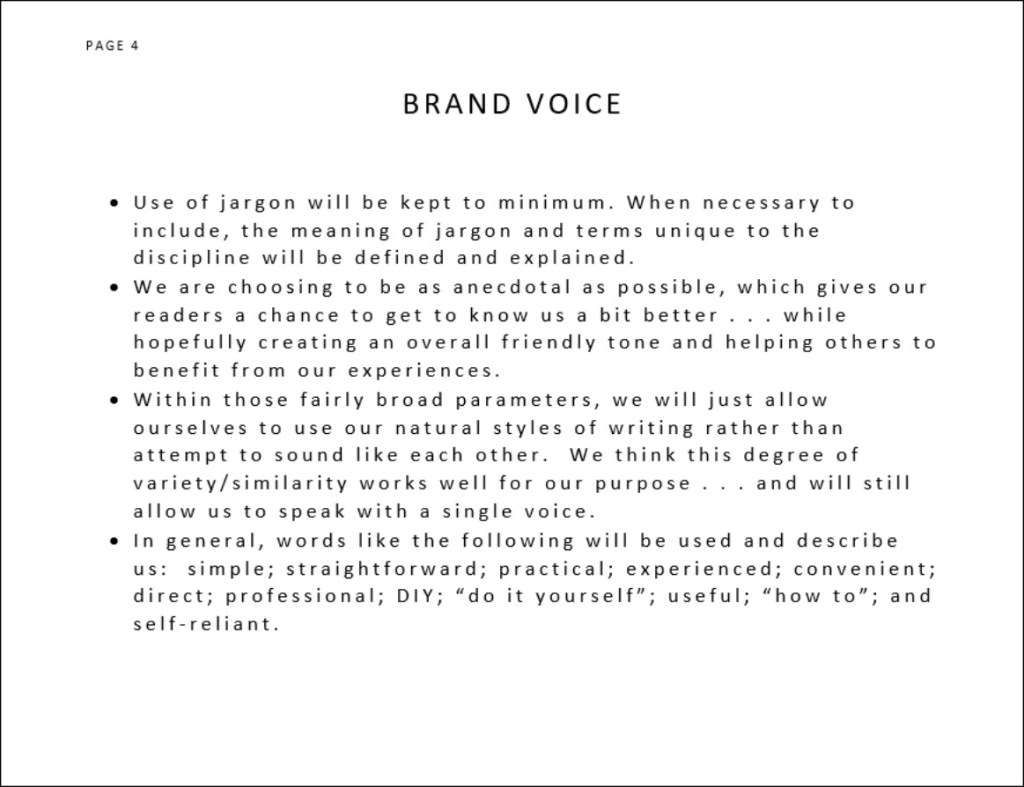
Page 4 of our Style Guide
Brand Voice
Are you traditional or avant garde? Friendly and very personal . . . or somewhat
distant and formal? When you are
expressing yourself, are you picturing an audience of fellow professionals . .
. or the general pubic? The way in which
you answer questions such as these determines the voice that will be identified
with your brand.
Carole and I naturally write with different styles. And yet, we did set some basic parameters
that will, we hope, create a single voice unique to our blog. Specifically, we determined that we would
keep our use of jargon to minimum OR (when necessary) be sure to define and
explain the meaning of terms. Similarly,
we are choosing to be as anecdotal as possible, which gives our readers a
chance to get to know us a bit better . . . while hopefully creating an overall
friendly tone and helping others to benefit from our experiences.
Within those fairly broad parameters, we figure we will just allow
ourselves to use our natural styles of writing rather than attempt to sound
like each other. We think this degree of
variety/similarity works well for our purpose . . . and hope you agree.
In general, words like the following speak with our voice: simple; straightforward; practical;
experienced; convenient; direct; professional; DIY; “do it yourself”; useful; “how to”; and self-reliant.
Use of Logo
Every logo creator hopes and intends for the graphic to become an
immediately identifiable symbol. Toward
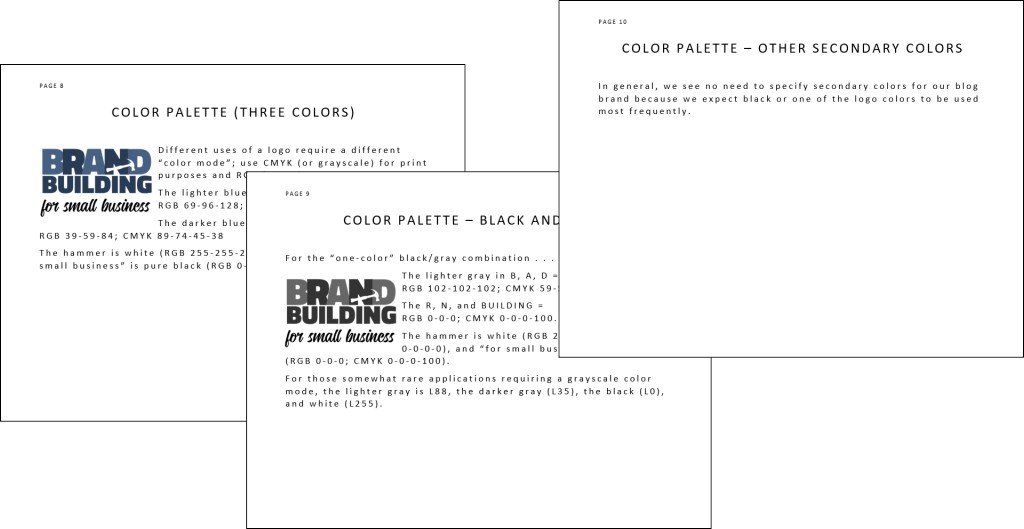
that end, consistent and frequent use of the exact image is necessary. Our basic logo for this blog is pictured to
the left. The primary variation to be
used both in print and online/onscreen is the three-color version shown at the
top. When only a single color is
available (either due to the medium used or cost-saving economics) the black
and gray version is permissible. A
single-color, black alternative has also been created for those select
occasions when the method used to reproduce the image will not handle gray
successfully. (Example – some
photocopying of forms.)
While we believe our logo is sufficiently scalable to become signage atop a building or an imprint on a golf ball . . . and all sizes in between, you need to always be sure the logo you are using has sufficient resolution (i.e., image data or tightly placed Dots Per Inch – DPI) and is being passed along in a file type suitable to the task.
Technical Note . . .
For onscreen use such as web pages, you typically want a resolution of 72 dpi in a file type such as a .jpg, .png, or .gif with an RGB (red-green-blue) color mode. While each of these file types can be successful, only the latter two support a transparent background (jpg’s add white in null spaces rather than allowing no color).
For print purposes (including most print advertisements), you typically want a resolution of 300 dpi rendered in a CMYK (cyan-magenta-yellow-black) color mode. While high resolution .jpg and .png files can also be used for print, other options become available, including more easily scalable .eps (Encapsulated PostScript) or pdf (Portable Document Format) files. If you are printing in one-color black (including the black/gray variation), you will want to use a grayscale color mode. (The logo can be reversed to feature white when used on a dark background.)
Too technical? Perhaps. However, the key to keeping your logo looking good at all times is to make sure the right kind of file has been used . . . and we wanted to acquaint you with some of the basic considerations that will be explored further in future blog entries – including preparation of a logo download page that can provide any third party the kind of source material needed to handle your logo correctly.
Interestingly, style guide pages on logos typically spend more
time and space enumerating “Don’ts” rather than spelling out the “Dos.” For Example:
DO NOT add, move, remove, replace, or
reposition any portion of the logo!! (With
one of our past corporate logos in particular that was very horizonal, vendors were
constantly trying to break the whole into pieces that got restacked vertically.)
DO NOT change any colors or fonts.
DO NOT stretch or distort the logo. Remember, you can never change just the horizontal
or just the vertical dimension without changing both. Doing so creates distortion. (Note: That’s the reason quick resizing in
graphic programs always uses diagonal motions.)
DO NOT remove elements of the logo.
(Example: We like our hammer; don’t fill
in the color!)
DO NOT place the logo on a busy or distracting
background.
DO NOT apply a logo or logotype color
variation to a background with insufficient contrast.
DO NOT create your own variations.
Every logo is custom designed; no other combinations are permitted. In those cases in which a logo has been trademarked, failure to use the exact versions registered can weaken or negate a legal position.
Note: We wanted to mention that our final logo also incorporates a clear box around the icon. We take this step to avoid any image material getting cut off during file handling, especially the rounded bottoms of letters or those with descenders.
Color Palette
As previously noted, different uses of a logo require a different “color mode” – a very tricky subject involving lots or esoteric technical information. Bottom line: use CMYK (or grayscale) for print and RGB for web use. Most graphic arts programs will give you the ability to switch back and forth between these modes. However, you will note that print and onscreen versions of the same color can vary somewhat, which is the reason these programs include elaborate methods of color correction. Rule of thumb – a CMYK color viewed on your computer will seldom reproduce in exactly the same way when printed. Getting these two to match is as much an art (tempered by experience) as a science. Nevertheless, use of the right color modes will almost always produce a result that is at least acceptable.
For example . . .
The lighter blue in our logo’s B, A, D = RGB 69-96-128; CMYK 81-60-31-10.
The darker blue in R, N, and BUILDING = RGB 39-59-84; CMYK 89-74-45-38.
The hammer is white (RGB 255-255-255; CMYK 0-0-0-0), and “for small business” is pure black (RGB 0-0-0; CMYK 0-0-0-100).
For those somewhat rare applications requiring a grayscale color mode, the lighter gray is L88, the darker gray is L35, the black is L0, and white is L255.
Once you
become familiar with expressing colors as formulas, you will be able to
communicate successfully with vendors such as commercial printers, graphic
artists, and other professionals. Until
then, we wanted you to be aware that these color systems exist (as well as a
variety of others such as Pantone/PMS, HEX, LAB, etc.) so you’ll be able to act
appropriately upon being told 0-0-0-0, and you’ll understand that 51-51-51 is
not a code for an “Area” in Roswell, New Mexico.
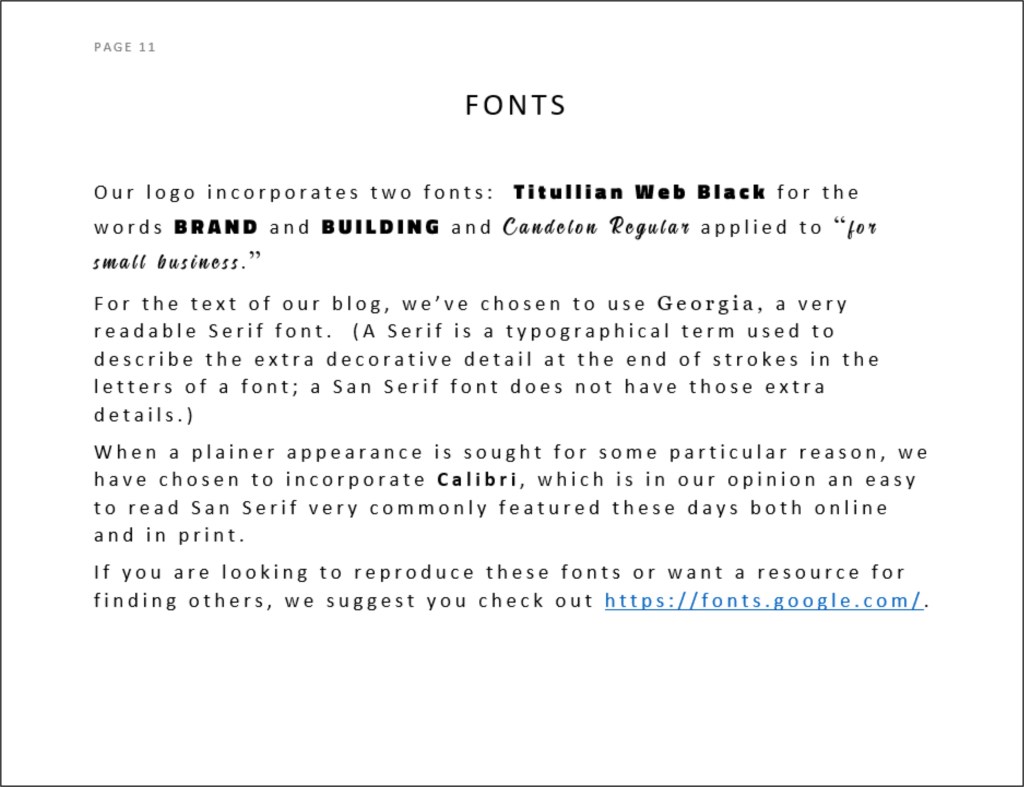
Fonts
Our logo incorporates two fonts: Titullian Web Black for the words BRAND and
BUILDING and Candelon Regular applied to “for small business.”
For the text of our blog, we’ve chosen to use Georgia.
If you are looking to reproduce these fonts or want a resource for finding others, we suggest you check out https://fonts.google.com/. Other alternatives exist, but we’ve found this one to be good and useful.
Photos/Other
Iconography
For our
blog, you’ve probably noticed that we elected to highlight our logo as the primary
imagery on the page – hopefully calling added attention to that item. Since we needed some other photo just to
properly balance the page, we selected neutral content that would recede into
the background and not compete.
Nevertheless,
we do anticipate periodically using a photo or other graphic element to enhance
the point being made and to add some visual interest. When making such choices, the following will
be some of our considerations:
Use
of people; generally speaking, faces make an image more interesting.
Demographic
diversity.
Positive
energy (Are the people smiling and happy?
Excited?).
Contemporary
(not necessarily young but avoiding elements, such as old cars or computers,
that date a picture).
Simplicity
(not too many elements and generally tending to closer focal points).
Compatible
colors.
Narrative
relevance; humor when possible.
By-lines/Tag
Lines
Many companies successfully incorporated a tag line into their brand identity. Ever hear the phrase “Breakfast of Champions” or perhaps “Betcha can’t eat just one”?
When building your brand, consider your options, remembering that a good tag line reflects a differentiating quality, reminds us about a key benefit, and imparts a positive feeling. If you do have or develop a tag line, be sure to specify any rules for usage in relation to your logo. (Very often, tag lines become part of the graphic.)
While we have not adopted a fixed
position or graphic treatment for our tag line, we have chosen the
language: “A Blog for Entrepreneurs
Looking to Create and Develop their Corporate Identity.”
Boilerplate
A short description of your product
or service will often be needed when sending out press releases, producing
sales literature, creating marketing ads, and even filling out forms. To ensure a consistent, properly branded
message, you should develop one or more variations of such a description. For us, one short paragraph seemed adequate
to get started:
“Produced by two experienced communication professionals, Brand Building for Small Business is a blog that aims to provide practical, do-it-yourself advice about creating a brand identity from the bottom up . . . and using that vehicle to help generate income streams. Expect simple, straightforward tips that can be executed by a single person or a small group on a very tight budget.”
Your Brand
Probably the
single most important rule for a Brand Style Guide is to use the rules
regularly, to incorporate the elements into your decision-making process, and
to not allow yourself too many exceptions . . . though some necessities will
certainly turn up.
Companies
that spend thousands of dollars getting a guide prepared for them have a
built-in incentive to dictate their use . . . while your motivation as a small
business for creating and sticking to your guide is less immediate – more of an
act of faith.
However,
your efforts can pay off. Successful
brands are those with elements that resonate with the audience . . . those that
are based in reality and communicate a truthful message in both spoken and
unspoken ways. So, be honest with
yourself in making your underlying branding decisions, and you’ll stand a very
good chance at building a great brand identity.
BTW . . .
Changing a brand is another story for the future. Whether small refinements are being introduced
or a more basic overhaul is underway, this task is a daunting one and is
another good reason for being careful in determining your initial brand
building efforts.
Disclaimer: While we only recommend products we know and love, we want to note we use affiliate links and may earn a commission for purchases made through those links.
Lots of businessowners question whether they’re creative or tech-savvy enough to create their own logo. Unfortunately, I can’t tell you neither of those qualities are needed, but I can safely say they’re not needed in the abundance you probably imagine.
Things you do need to design your own logo:
A little creativity
A little tech savvy
A vector editing program (available for free)
Lots of fonts choices (available for free)
Lots of icon choices – IFyou want a graphical component to your logo (available for very minimal cost; the icon used in our logo cost $2.99)
So where to start?
While graphic design isn’t my specific trade, I’ve been asked
to create dozens of logos throughout my career.
Every time, I start by facing that same dreaded obstacle: the blank
page. I stare at it, thinking about what
the logo should represent and the type of fonts, colors, and imagery to best
suit that message. Meanwhile, a blank page relentlessly stares back.
While a tedious process, you should set your expectations for your logo before you pick up a pencil (or the mouse).
Originally, logos were introduced as an aid to people who couldn’t read. As a result, the earliest designs tended to be very literal. (For example, a shoemaker’s logo would inevitably show a shoe.) Over time, the purpose of logos has evolved to become a broader reflection of brand but remains a key way of differentiating yourself in the marketplace.
So what’s the personality of your company? Is your business youthful and trendsetting? Conservative and financially strong? Fun and whimsical? Product-focused and straightforward? Some combination thereof? This corporate identity (or brand) needs to be communicated in your logo – through your font(s), color(s), placement of words, and any graphics.
If once you have a strong sense of your business “personality”
in mind, your page is still unyielding in its never-ending canvas of white, go
looking for some inspiration. . . .
For the Brand Building for Small Business logo, I
knew I wanted to try something graphical to literally represent the act of “building.” I was initially picturing letters being
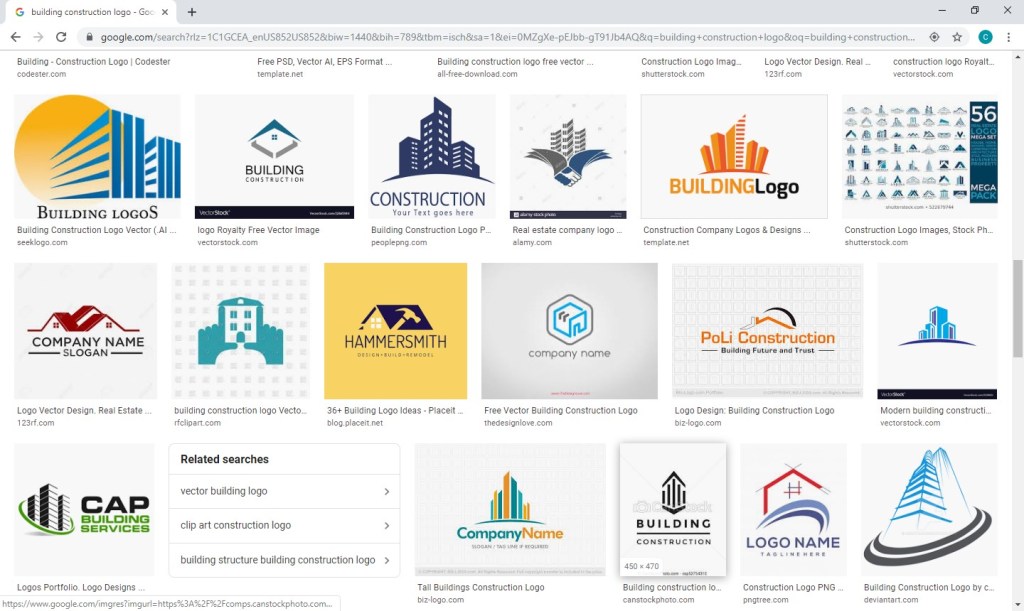
nailed but knew that would be tricky to execute in a clear way. So, I went to my go-to spot for inspiration: google images.
I searched for “building logo,” hoping the results would be full of
construction-type logos also looking to convey the literal act of “building.” But no, Carole, searching “building logos”
yields lots of logos of buildings.
. . . Should have foreseen that. Instead, I searched for “building construction logos” and found more of what I had in mind.
A couple screens in, I found inspiration.
Looking at the Hammersmith logo (in navy and white on a
yellow background), I love the way the hammer is a silhouette within the house
and appears to be captured mid-swing. I
immediately knew I wanted to try a hammer silhouette, but I wanted the graphic to
appear within the company name and not as part of a separate graphical
element.
A quick note on inspiration versus copyright infringement: This is an area requiring caution. Whereas you can use a silhouette of a hammer as seen in one logo in another, creating a logo for a construction company with a silhouette of a hammer in a navy house with white windows on a yellow background would most certainly earn you front-row seats to the case of them v. you. An individual idea cannot be copyrighted; however, “a collection of ideas” makes a logo (or any other original work) unique and can be protected by law. Tread carefully.
LOGO ICONS
So, where does one go for icons that could legally be used as part of a logo for minimal cost? A number of options exist, but I like https://thenounproject.com/. They have a large selection and charge nominal, one-time fees per icon. I found the hammer for our logo for $2.99.
A number of choices were available. . . .
I selected a classic and simple hammer.
I then purchased and downloaded the file in PNG (bitmap
image with a transparent background) and SVG (vector) formats. (A
separate article on Vector vs Bitmap file formats is planned.)
VECTOR/GRAPHICS SOFTWARE
Now what to do with your icon? We use the vector and graphics editor, CorelDraw. While the suite is powerful and much cheaper than your standard graphics package, the cost is still pretty steep in the $500 ballpark. I read a few articles on free vector-editing programs, found Inkscape (https://inkscape.org/) to be highly recommended, and gave it a go. The program seems to have the features needed to get the job done. (And, they make a number of tutorials available, including one on the basic tools: https://inkscape.org/en/doc/tutorials/basic/tutorial-basic.html.)
FONTS
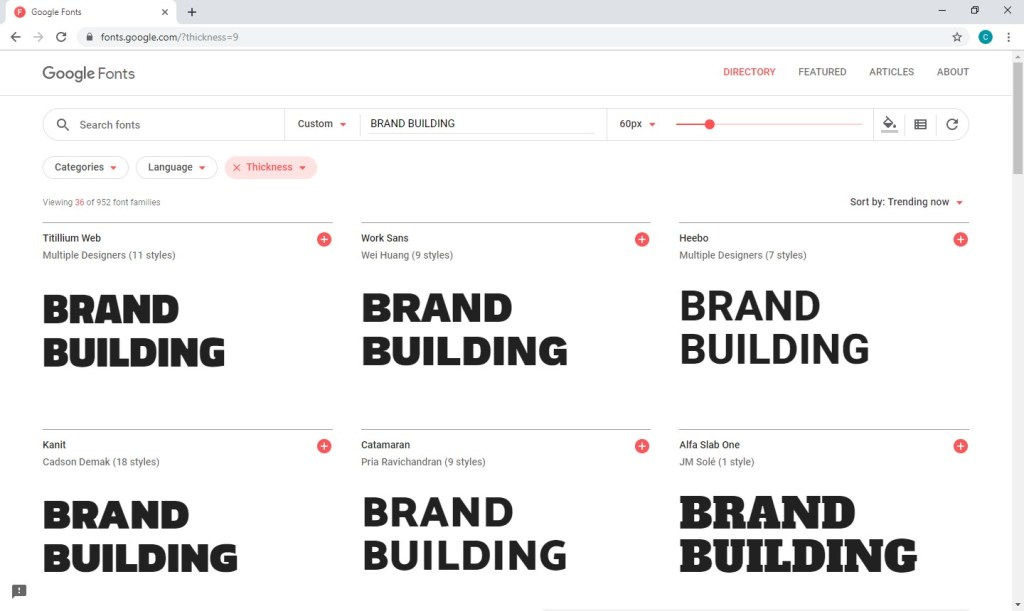
An obvious first step when selecting a font to use for your logo is to scroll through the existing fonts on your computer to see whether anything catches your eye. Remember that you’re not looking for the font that necessarily looks the best to you; rather, you’re looking for the one that best represents your business’s brand. If you’ve picked out an icon at this point, you’ll also need to be mindful of the way a given font looks with your chosen icon. You can have an icon and a font that both separately represent your brand perfectly but just don’t look good together. Since I wanted to try including the hammer as a silhouette within the words for Brand Building for Small Business, I needed a really bold, thick font. I gave Arial Black a try, knowing it’s the boldest font currently available on my computer, but I wasn’t really pleased with the result.
Thankfully, a source exists offering hundreds of (*free*) fonts in a searchable format that actually makes the process relatively easy. With Google Fonts (https://fonts.google.com), I was able to type in my sample text, BRAND BUILDING, the size I wanted to preview, 60 px, and my desired font characteristic(s), increased thickness.
After much trial and error (downloading, installing, and trying dozens of fonts), I found Titillium Web Black and a contrasting script, Candelion Regular, to work in black and two shades of navy.
While I am VERY tempted to digress at this point and start talking about some of the many techniques that can be used to marry the fonts/words used in your logo to the images you’ve chosen . . . I keep reminding myself that level of detail is really better suited for another blog entry further down the road. For now, I will stick to my original plan to keep this message broad but nevertheless offer a few . . .
CONSIDERATIONS
At some point, you may choose to print sales materials in grayscale or advertise in a print media in black and white. You may want to have branded pens for your company (requiring a very, very small logo) or you may purchase a building on Times Square and want your logo proudly illuminated on top (requiring a very, very large logo). Before you decide your design is a done deal, you should run a few tests. Try changing your color scheme to grayscale as well as black and white and print a very small version (one half inch on its biggest side should be sufficient) and a very large version (full page). If all variations look ok, you’ve probably got a keeper.
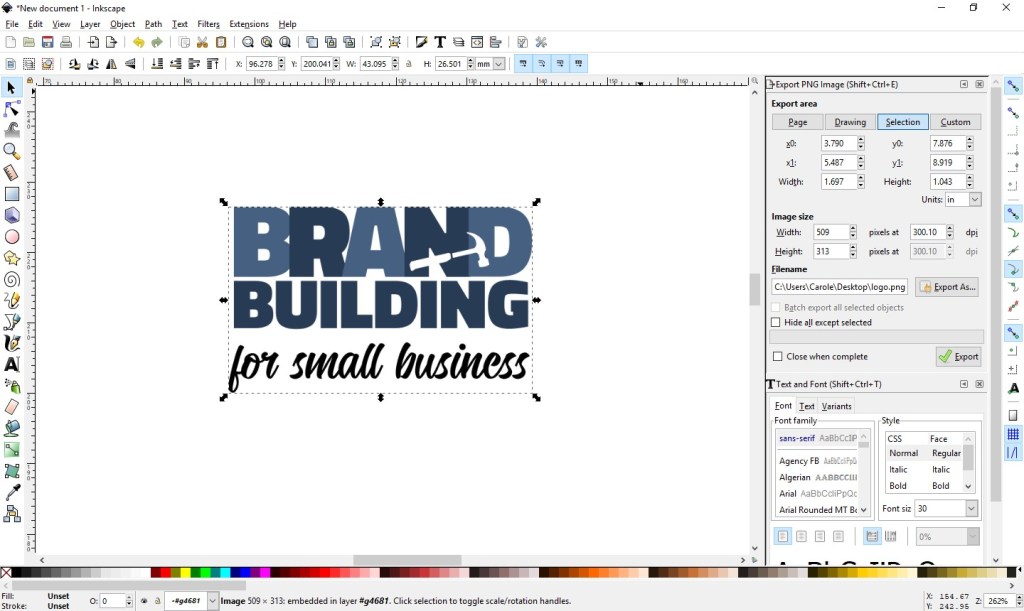
Export your new logo as a high-resolution transparent RGB PNG, which will work well in MOST (but not all) environments. (Inkscape export settings are shown at right below.)
Once you’ve managed to get this far, you’ll want to protect your work. Your logo should be registered as a trademark. If you are not of a mind to involve your lawyer in the process, consider checking out various on-line alternatives and look into the steps involved in going the DIY route (for example: https://www.wikihow.com/Register-a-Trademark-Without-an-Attorney).
Next up . . . confirm your understanding of your business’s audience; read: Know Your Audience.
Picking a name is the easiest
task you face when starting a new business and developing your brand, right?
Wrong!!
While you might expect this
step to be a “no brainer,” the path to success is fraught with countless
obstacles standing in your way – a lack of creativity being the least of your
worries.
During our years in the
corporate world, Carole and I had numerous opportunities to name companies and
products . . . and over time were asked to use a variety of strategies from the
hire of a highly paid consultant to a company-wide naming contest. When you have 500 employees allowed to make
multiple submissions, you quickly get a pool of 2,500 alternatives to choose
among. So, you’d assume that at least one of those entrants would be a
winner. Sadly, such was not our
experience.
Ultimately, we have learned to
keep the task as simple as possible AND to avoid the confusion caused by tooooo
many opinions. Since we recently went
through such an exercise in naming our blog, I will offer this very fresh example
to illustrate some of the hard-earned lessons (AND SHORTCUTS) we have learned.
Aside: BTW, do you like the name? (We’d love to hear from you.)
Three Criteria that Must Be
Met
Be memorable and preferably short. (Some people, including me, believe the best names reflect the content or value of the product or service in a self-explanatory way.)
Be available. (Sound too basic to list? After playing this game a few times, you’ll be shocked at the number of names already taken – especially the good ones!) When another party has already planted their intellectual-properties stake in the ground by starting the registration process, might as well give up and turn your attention elsewhere.
Has an accompanying Internet domain name/address that’s easy to use and even easier to remember.
While a number of other matters certainly need to be considered in picking a name (reproducibility, color, flexibility in size, etc., etc., etc. – including the visual potential of the words chosen in developing a logo and other supporting materials), these items will more appropriately be discussed in Parts 2 and 3 of Branding Basics, which address logo design and the creation of a style sheet.
Brainstorming (Developing an
Initial Pool of Names)
With these three criteria
providing a VERY basic framework for the process, Carole and I gave ourselves
the assignment of each coming up with five suggested names. To get started on my end . . . I wrote down
EVERY name imaginable – good/bad/indifferent – ranging from such selections as “Spread
the Word” to “Communicate – A Practical Guide.”
When developing this first list, you need to force yourself to be
uninhibited and must be willing to be “Dumb” because that’s all part of the
process. However, you and your team
usually get a few good laughs in return.
Next, I narrowed my list down
to the required five and sent them off to Carole. She did likewise, and we voted on our
favorites. One name that didn’t make the
cut was “Brand Building . . . to Help Sell DIY.” While neither of us selected that option,
Carole said, “What about just Brand Building?”
Liking the short version and
both of us being suckers for alliteration, we decided to take that option
through the next steps.
Domain Name/Internet Address
Sooooo . . . we had a
candidate, but would we be able to secure a name that would help us transact
business?
To check, go to a site like www.godaddy.com. Upon searching the availability of our name, we learned that www.brandbuilding.com was not available . . . but we also saw that the name could be purchased for $19,000!
To us, that meant we were on
the right track – the name was popular enough to command a steep price (a good
sign). However, unwilling (or
psychologically incapable) of investing that much money, we began considering
different variations and ultimately landed on “Brand Building for Small
Business.” Since we had already
determined that we’d use WordPress to host our blog, we did spend the very
reasonable amount of money to secure that platform.
Is our chosen name
perfect? Being a little longer than the
ideal, probably not. However, we believe
the strengths outweigh the weaknesses.
In our experience, many perfectly acceptable product and/or company
names can’t be used because a reasonable accompanying Internet name/address is
not available. We think our choice
passes a number of key tests.
However, one avenue that can always be considered is a unique but generic name that has no obvious ties to your product or service . . . but sounds neat and is memorable. EX: Apple or Google. The benefits of this approach are minimal competition for domains (potentially), very small likelihood of copyright issues arising, and a name that will “fit” whatever your company grows up to be.
Intellectual Property Rights
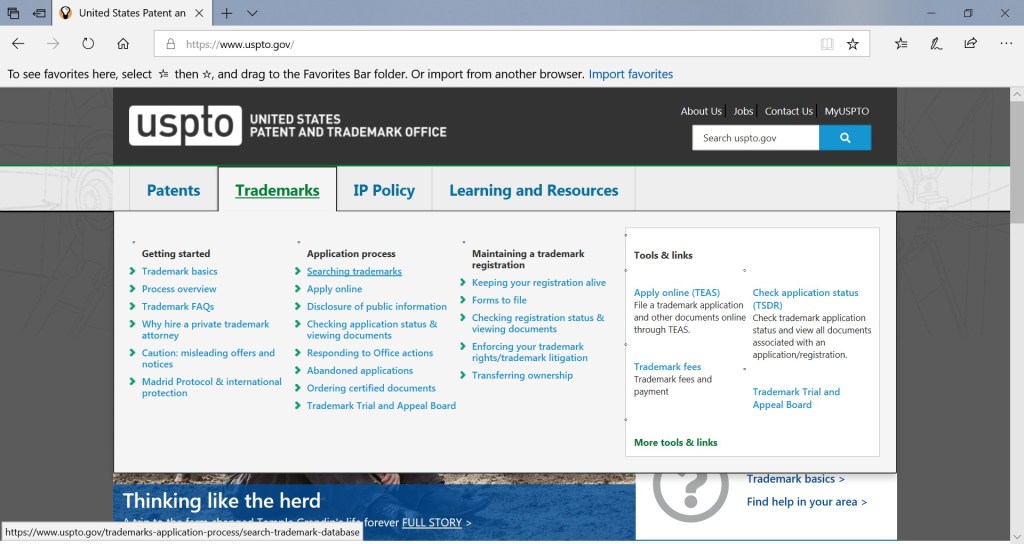
For a quick preliminary test of intellectual property rights, go to the web site of the U.S. Patents and Trademark Office: https://www.uspto.gov/. This official government app allows you to enter a name and see all of the possible similar variations that are (or have been) in use.
In our case, we found no exact matches but a few that had some similarity. In such cases, you have to determine whether the address owner operates within the same industry and whether our use of the name could cause any confusion within the marketplace. (For a more exact and reliable explanation of the legal ramifications, consult your attorney.)
In the end, we felt we were seeing a fairly common use of Brand Building as a conceptual term . . . but not necessarily a name for a competing product. Therefore, we decided to move forward. However, be aware that names and other intellectual properties have significant value, so challenges can occur – Carole and I have experienced them ourselves in the corporate world – on both the giving and receiving end.
Next Up
Having gone through these exercises, we have our name and a key building block for our brand.
BTW—some form of testing of your chosen name is always a good idea. Such a process can be as simple as informally asking the opinions of friends and colleagues . . . or can be a formal study involving a demographically correct group of participants. In the end, a good name will ultimately resonate with the experience of the audience – making the name easier to remember.
Was that what I thought it was . . . my first sale?!? I vividly remember the thrill and excitement
I felt that evening. I basked in hugs
from my husband and kids, texted my close friends and family, and uncorked the
champagne (well, sparkling Moscato actually; it was only a $12 sale after all).
Fast forward one year ahead when the profit from my sales
was about half my full-time income, and I was equally thrilled and excited at
the idea of quitting my day job to pursue my business full time. I couldn’t wait to be able to choose the way
I dedicated my work hours, to have creative freedom, to balance my work
schedule with my home life however I saw fit, to be directly responsible for my
earnings . . . my list could go on and on.
The entrepreneurial allure was holy grail level for me.
Once I gave my three weeks’ notice (which my former boss and
now blog partner masterfully managed to extend into three months’ notice), I
was officially on cloud nine.
Fast forward once again to my first day “unemployed” and me staring
at my computer screen. I had so many new
designs I was looking forward to creating and so many ideas for new
products. My mouse and my keyboard and I
forged ahead at full speed.
* * *
Up until that point, I had spent the entirety of my career in marketing communications. I studied organizational communications and marketing for my undergrad and graduate degrees, I taught college public relations courses, and I worked for almost 15 years in the corporate world as an important contributor of a national, billion-dollar brand.
The first item on my new business to-do list – in bold
print – should have been to create a marketing plan.
In reality, that’s not even close to what happened. Why? In
writing this all down, I actually needed a couple minutes to decide exactly why,
and I think it’s the more immediate sense of urgency you get when your business
is responsible for your livelihood. You
want to focus on the areas of your company that are as tangible as your
mortgage payments . . . and groceries . . . and kids’ back-to-school
clothes. I effectually went into
survival mode. Efforts producing and
sustaining immediate profits were crucial while time for endeavors reaping
long-term dividends felt like a luxury.
Don’t get me wrong. I had put in place certain basic brand fundamentals from the beginning. Long before my first sale, I had decided on a name and colors, secured a web site address, and created a logo. I even had a pretty clear sense of the qualities that would differentiate my company from others. However, the idea of taking my brand basics and then creating and executing a blueprint for building a strong and successful brand WHILE running my business was completely and utterly overwhelming to me.
* * *
Well, as they say, the journey of a thousand miles begins
with a single step. Once my survival
instinct numbed a bit, I decided to take one single step. I addressed one new activity per week. Since I still had very little “free time” in
my business AND had no real marketing plan, I didn’t give myself any
constraints on the duration or direction of my efforts; just the quantity – I
just needed to do one brand building task per week.
So one week, I created an Instagram account for my business;
another, I researched local venues to get my brand name out in my community; still
another, I researched blogs that I could partner with to promote my brand,
etc., etc., etc. In essence, I did what
I could/when I could, knowing that as long as these activities reflected my
brand basics, my business would reap long-term benefits.
Over time, I mastered my one-a-week goal, and I built on
that momentum – once a week, I now had to do one maintenance branding task
(writing a blog posting, attending a local “expo/show,” posting content on my social
media platforms, etc.) in addition to my one brand building task
(researching, expanding into new venues/platforms, etc.).
If this is starting to sound like a lot, take a breath. There’s no need to get bogged down with specifics at this point. We’ll cover them all as we go, and we’ll help you get your system into place. We’ll focus on the areas we think are most beneficial to start with first, and we’ll teach you how to execute those initial steps; then, we’ll focus on building that brand – one task at a time. Soon, you’ll find that your successes will justify the time you invest, making the process much easier.
* * *
Next up – What’s in a Name? . . . The first in a series focusing on the initial steps in building your brand.
Identifying, refining, AND communicating your business’s brand can be the most important step you take in marketing (and selling!) your product and/or services. Whether you are picking a name or color to represent you or creating a web site, sales literature, ads, letterhead, packaging, etc. (this list goes on and on), each decision you make and action you take will help build your brand (i.e., fix an impression in people’s minds about who you are and what you do — hopefully in a memorable and desirable way).
All too often, small businesses neglect this opportunity to send a strong message to the public and view each of these communications as separate and distinct (rather than as opportunities to reinforce an overarching brand).
The first lesson that must be
learned and practiced by a small business is to treat branding as a set of
golden rules applied to all activities.
Once you accept this basic premise (which extends to operational
decisions as well as those of sales), you must decide whether to build your
brand yourself . . . or buy that expertise from a professional such as an advertising
agency.
Build
vs. Buy
Before venturing further, you
need to understand the bias of the author of this blog.
When my son was in elementary
school, the Teenage Mutant Ninja Turtles ruled the day via a television show,
movies, comic books, extensive lines of merchandise, etc. Consequently, turtle costumes were huge style
setters for Halloween . . . and sure to create a strong impression among the
child’s peers. While dozens of variations
could be purchased inexpensively, I chose to personally transform my son to become
the 5th turtle (aka Caravaggio) – with a shell made out of cardboard
and all! Similarly, I’ve spackled walls
and gotten rid of computer viruses myself rather than automatically turning to
an expert practitioner. This instinct
has sometimes proven cost effective and (as in the case of the turtle)
sometimes not. However, I’ve always
ended up acquiring a useful skill that later paid dividends and inevitably end
up with a more original product, which is generally useful in branding. By building, you get to control your own fate
and the timing of each activity . . .
and often DO end up saving a lot of money!
10 Good Reasons to Consider Building, Not Buying
Better control – You know your product and customers better than anyone as well as the image you want to communicate. You can spend many expensive hours trying to transfer that knowledge to a vendor . . . and never quite get to where you need to be.
Faster response to opportunity – Sometimes, opportunities disappear quickly. You can miss the boat while waiting for a third party to be ready, to fully understand the moment, and to craft the right message tailored to the right audience.
No language barrier – Every industry has an accompanying unique language and jargon. Teaching this language to the uninitiated can be a slow, imperfect process. If a task is executed without full command of the industry’s verbiage, your customer will immediately sense a fraud . . . and not trust the information being communicated.
More flexible strategic planning – You control the schedule and the range of activities that seem most likely to be effective . . . rather than having someone create a campaign around THEIR areas of expertise and resources.
Trial and error – Since you are in control, you can quickly abandon unsuccessful strategies and try new ones rather than seeing a losing campaign through to the bitter end. Very often, you can tell early whether or not an activity is resonating with your audience.
Cost savings – Third-party expertise does not come cheaply . . . and you pay for their learning curve as well as their finished product. When you take a DIY approach, your time is your major investment.
Better use of data – The effectiveness of every brand-based activity should be measured. You are in the best position to implement the systematic collection of data and ensure that your operations are adjusted as needed to reflect the insights you gain.
You develop expertise – While you may not be an expert at every activity you try, you will eventually become one (much like the process of building equity in your house). Whenever you develop a new core competency, spin-off business opportunities might present themselves.
You stay abreast of technology – Brand building always involves some degree of mastery over technology (at least as an end user). While this benefit might also seem scary to some people, we all know that we must have a reasonable grasp of current technology to survive . . . and this venue offers a fairly low-risk chance to learn more.
You can have fun – Making that ninja turtle costume was a whole lot more enjoyable (and yielded a whole lot more laughs) than running to the local store . . . and ended up creating a more memorable experience.
5 Reasons to Consider Buying (Rem: I already disclosed my bias)
Third
Parties (ad agencies; web site developers; etc.) DO Provide Expertise – Even
if you elect to become a DIY builder, you might require third-party expertise
for specific tasks until you can learn how to do those tasks yourself.
Objectivity –
Sometimes, you can be too close to your product and audience to see them
clearly; third parties offer a fresh point of view.
Completeness – Vendors
provide a level of assurance that you will not overlook a very basic and
necessary consideration.
Uniformity
of Quality – Use of a practitioner that
regularly delivers certain activities to the world assures a basic level of
quality is maintained.
You
Learn – When you hire a third party,
you always learn some valuable lessons from them.
While “Build” and “Buy” have
been presented as mostly separate either/or options, DO know that a
mix-and-match approach is possible (and sometimes even advisable) as you acquire
the necessary skills and knowledge to DIY.
That said, this blog is generally
devoted to practical tips addressing a wide variety of common activities that
help end users who want to be hands-on in Brand Building for their Small
Business.







 Brand Building for Small Business