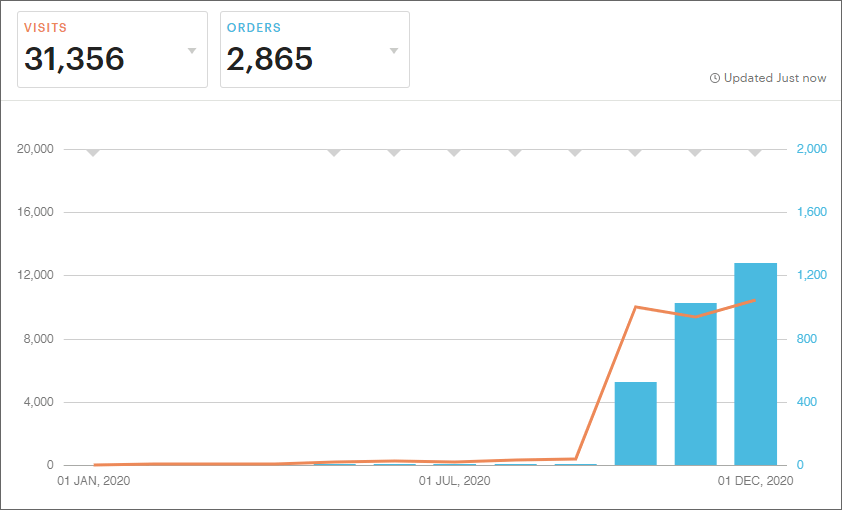
It was a normal Tuesday evening a few days before Halloween. I was answering customers’ questions on my computer, and I heard the usual “cha ching” sound, letting me know I had a sale. I went to my purchases page and saw a vanilla extract label template was sold, and I sent the customer the customary thank you message that includes some basic instructions. Then, I heard the “cha ching” again and experienced a little deja vu, since the order was for the same product. Moments later, one “cha ching” interrupted another, creating an odd “cha cha ching” sound. All purchases were for the same product. At this point, I’m thinking to myself, ‘I don’t feel like I’ve had a lot of sales for that item before.’ A quick look at my product statistics confirmed that — since release — that item had only one or two sales per week. Interrupting my research, “cha ching.”
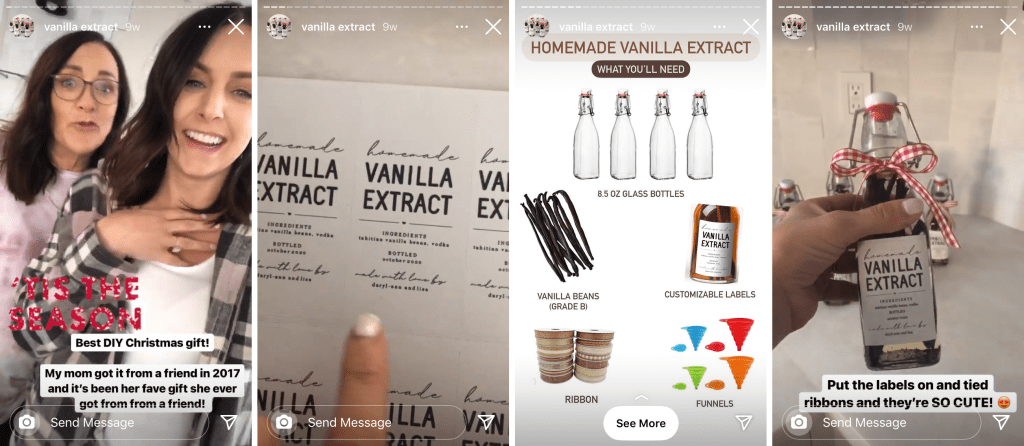
I started receiving questions about the item as well, and so I responded with answers to their questions along with a question of my own: “How did you hear about this item?” I learned that a social influencer on Instagram posted a video about making your own vanilla extract and included my label template.
I checked out her page (Daryl-Ann Denner at instagram.com/darylanndenner) and saw that she had over 600,000 followers (at that time; now her tally is getting close to 800,000!). I found the video and watched as Daryl-Ann and her mother (a very likable duo) show how to make vanilla extract and talk about my labels in the process.
I have to admit, I felt a bit starstruck. I acknowledged the silliness; a product of mine was shown on someone else’s Instagram page; big deal. Enter perspective. Still, this person had over 600,000 followers, and she included me in her little world. And in her world, when Daryl-Ann Denner says vanilla extract is a “Best DIY Christmas Gift,” her followers listen. In that first 24-hour period, there would be over 300 “cha chings” for vanilla extract labels. Since then, the total count has grown to 2,829 orders at the time of this writing (October 27th through December 29th). The total sales since originally releasing the item on January 1st, 2020 is 2,865, so a whopping 36 sales had occurred in the ten months prior to the product being featured.
I don’t believe any advertising could have yielded anything close to these results. So, that’s how I learned that – as the title of this post suggests – social influencers rule the world . . . or at least the small piece of the world in which they reign.
So how, as small business owners, do we benefit from this recognition? Obviously, I would love to replicate this success. And sure, it would be wonderful for another social influencer to simply stumble upon one of my products and decide to feature it, but I don’t think I’m lucky enough for lightning to just strike twice. I also don’t know if I have the ability to compel lightning . . . but I’m definitely going to try. I will be spending a good chunk of time researching and doing some trial and error of my own on the best ways to approach social influencers. If I come up with a winning combination, you will be the first to know! Stay tuned!
The camera zooms in . . . as the couple begins a long-delayed (at least two hours) passionate kiss.
The movie ends – HAPPILY, of course – with the pair united just in time for the Christmas holiday but clearly destined to live happily ever after.
For millions of people, December (which now starts on November 1st) means decorations, presents, Santa Claus, reindeer, AND Hallmark!! The company has become (through years of careful brand building effort) inextricably associated with the warmth, cheerfulness, and good feelings of Christmas – not a bad set of qualities to have linked with your name and your brand. In fact, so many people have found so much comfort from Hallmark Christmas movies, the company tried to ease the burden of the 2020 pandemic by providing around-the-clock Christmas fare outside the season during a period of heightened restrictions on normal, daily activities.
Clearly, Hallmark is a company that has learned an important truth – linking your brand to a holiday and feelings associated with that time can be a useful tool in your branding arsenal.
Other successful examples?
Do you happen to know someone who is a Dunkin’ spiced pumpkin latte fanatic? (While not exactly tied to a specific holiday, the annual reintroduction of this special is invariably associated with the feelings of fall . . . and Halloween . . . and Thanksgiving.)
The Cadbury Candy company makes special Easter eggs, taking advantage of the natural and favorite tie-ins between Easter, the bunny, and candy.
Hershey (and the company’s signature kisses) are a Valentine’s Day tradition.
To some degree, you have to rely upon luck – recognizing an early connection to a holiday that you see has potential and can build upon. However, some basic steps can be taken.
Most holidays have some familiar sentiments and iconography associated with them. Try making a list of those attributes and a list of the attributes and iconography already associated with your brand. A sufficient number of matches between the two lists suggests you may have a likely candidate for brand building. Starting with some basis for the connection (which is the point of this exercise) should increase your likelihood of success and reduce the amount of time required. Once you have a candidate, some of the activities that can be used to build the connection between your brand and the holiday are:
Become involved with the community during that time of the year. Linking yourself to charitable causes helps build goodwill and links your product or service to an activity associated with the season.
Plan to conduct your periods of heightened sales and marketing activities in conjunction with the holiday, including advertising and special promotions (budget permitting).
Do slight variations of your visual branding that encompass those of the holiday without sacrificing the continuity of your basic elements.
By consistently promoting the ties between you and your chosen holiday over time, you can gradually build a brand identity that assumes some of the characteristics of that celebration. (Even Hallmark’s special relationship with Christmas did not happen overnight!!)
Don’t Overlook Opportunities Presented by Lesser-Known Holidays
While you were certainly aware that Christmas and Hannukah were linked to December, were you also aware that these additional special observances existed?
National Tie Month
National Write a Business Plan Month
Bingo Month
Write a Friend Month
Above and beyond those monthly celebrations, you have special days (examples cited below are from 2020):
Giving Tuesday, December 1
International Day of Persons with Disabilities, December 3
Cookie Day, December 4
Volunteer Day, December 5
Aviation Day, December 7
Pearl Harbor Remembrance Day, December 7
Start of Hanukkah, December 10
Human Rights Day, December 10
International Mountain Day, December 11
Green Monday, December 14
Wright Brothers Day, December 17
Winter Solstice, December 21
Festivus, December 23
Christmas Eve, December 24
Christmas, December 25
National Thank You Note Day, December 26
Boxing Day (Canada), December 26
Start of Kwanzaa, December 26
No Interruptions Day, December 27
Tick Tock Day, December 29
Bacon Day, December 30
Make Up Your Mind Day, December 31
New Year’s Eve, December 31
(As I sit and write this draft, I now realize I should be planning my International Mountain Day Celebration!!)
Dozens of such occasions occur throughout the year that could provide special marketing opportunities for small businesses. For a complete list, see Anita Campbell’s article in Small Business Trends“Huge List of National Holidays for Marketing in a Small Business”; you just might find a number of events already exist that are inherently symbiotic with your operations.
Regardless of whether you decide the time is right for you to act on the advice in today’s article, my blogging partner and I would like to wish you a safe and happy holiday season, being sure to tune into a Hallmark Christmas movie or two while filling out your Hallmark Christmas cards to send to family and friends . . . to show you care.
What does this picture of a red elephant mean to you?
Conservatism.
Preservationists.
Wealth.
Less government intervention (i.e., small government).
Donald Trump and George Bush.
The Republican Party.
. . . and perhaps more?
How about the blue donkey?
Liberalism.
Change.
Labor.
Government-funded programs (i.e., big government).
Barack Obama and Joe Biden.
The Democratic Party.
. . . etc.?
In other words, simply seeing these logos immediately brings to mind a wide range of adjectives and accompanying images . . . as well as an emotional response! That said, we recently had an opportunity to witness the practice (and impact) of this very successful branding in action during the American presidential and legislative elections.
Frankly, we waited until the election was over (and the votes had been counted) to avoid getting lost in endless partisan digression over details when our reason for bringing up the matter is to highlight these examples of powerful branding while the specifics were still front and center in people’s minds.
In politics, branding is sometimes the only basis upon which individuals vote (and brand loyalty plays a huge role). Since the issues tend to be numerous, complex, frequently boring, and very often as clear as advanced calculus or nuclear physics, people tend to rely upon simplified measures that allow them to cast a vote that will – they feel – provide a shortcut to their approximate philosophical position. When a Republican or Democrat votes along party lines, that choice generally assures that certain basic qualities will be present and criteria met by the candidate. For their part, politicians benefit by closely aligning themselves with their chosen brand . . . rather than get lost in platform details.
In general, the most successful politicians not only align themselves closely with their party’s brand but also manage to enhance that foundation with a strong personal brand through use of campaign slogans, colors, and spokespeople-influencers who, in turn, lend their personal brand to the candidate’s.
Questioning whether a campaign slogan really makes a difference? Then, check out these seven examples that appeared among the “Top 15 Presidential Campaign Slogans” identified by Martin Kelly (updated February 21, 2018):
Don’t Swap Horses in Midstream
“This presidential campaign slogan was successfully used two times while America was in the depths of war. In 1864, Abraham Lincoln used it during the American Civil War. In 1944, Franklin D. Roosevelt won his fourth term using this slogan during World War II.”
All the Way With LBJ
“In 1964, Lyndon B. Johnson used this slogan to successfully win the presidency against Barry Goldwater with over 90% of the electoral votes.”
Are You Better Off Than You Were Four Years Ago?
“This slogan was used by Ronald Reagan in his 1976 bid for the presidency against incumbent Jimmy Carter.”
Happy Days Are Here Again
“In 1932, Franklin Roosevelt adopted the song, ‘Happy Days Are Here Again’ sung by Lou Levin. America was in the depths of the Great Depression and the song was chosen as a foil to candidate Herbert Hoover’s leadership when the depression began.”
Give Em Hell, Harry
“Both a nickname and a slogan, this was used to help bring Harry Truman to victory over Thomas E. Dewey in the 1948 election. The Chicago Daily Tribune erroneously printed ‘Dewey Defeats Truman’ based on exit polls the night before.”
I Like Ike
“The quintessentially likeable hero of World War II, Dwight D. Eisenhower, rose handily to the presidency in 1952 with this slogan proudly displayed on supporters’ buttons across the nation. Some continued the slogan when he ran again in 1956, changing it to ‘I Still Like Ike.’”
Change We Can Believe In
“Barack Obama led his party to victory in the 2008 presidential election with this slogan often simply reduced to one word: Change. It mainly referred to changing presidential policies after eight years with George W. Bush as president.”
In addition to the slogans identified by Kelly above, another recent example would be Donald Trump’s “Make America Great Again” slogan (MAGA) modified to “Keep America Great” for re-election. An expert brander, Donald Trump produced a wide range of paraphernalia bearing the phrase . . . and used the words to incite supporters at rallies.
Clearly, catchy statements such as these have been used to define the brand of a candidacy and get voters to identify with the candidate’s cause – tapping into existing associated emotion. Certain songs have also been employed for branding purposes. In fact, the artists – recognizing the power of branding – have sometimes ordered campaigns they did not support to stop using the tune – obtaining legal “cease and desist” intervention.
So, what is the lesson to be learned about branding from the masterful uses employed by politicians?
Branding is the best – and often only – way to simplify complex content for a consumer audience in a way that attaches an emotional response and builds a sense of allegiance to a product. Furthermore, political branding must (as always) be executed consistently and across all media from billboards to speeches to commercials to ads to pamphlets and flyers to promotional items and more. The further a brand can be simplified and identified via a short phrase, use of a color, a few bars of a song – the better!
Small businesses can learn much by mimicking the example (however seemingly unsophisticated) of their local politicians building a base of support . . . a constituency. Frankly, they tend to know their audience well and have found an effective way of appealing to them . . . and those people all represent your existing and potential customers.
Ever wonder about the origin of the American political symbols – the elephant and the donkey? The first appearances of both symbols are credited to the artist Thomas Nast for Harper’s Weekly during the late 1800’s. (Frankly, some of his cartoons were “Nasty.”)
Last year, we published a Small Business Saturday article that provided an overview of the history of the event as well as the potential importance, offering a glimpse at some of the strategies that could be used by small businesses to link this celebration to their brand.
That was last year, which now seems like a decade ago!
Over 50 million confirmed Covid-19 global cases later, including over 10 million in the United States (see data), most small businesses have had to face incredible challenges as many countries closed down their economies in order to slow the progress of the pandemic.
While a truly unfortunate number of smaller operations have now permanently closed their doors, we need to take a moment this Small Business Saturday to celebrate the survivors . . . and support them in whatever means are available to us.
Expanded Internet activities. Free delivery. New products (maybe even including personal protective gear). Go Fund Me initiatives. Special Governmental programs. All of these strategies and so many more have been essential to the continued existence of the survivors.
While statistics clearly indicate that a second wave of the pandemic is upon us and caution that the upcoming holidays will require us to practice some self-restraint, we feel confident that small businesses will survive while still managing to practice governmental safety standards. Hopefully, by Small Business Saturday 2021 on November 27th, one or more vaccines will have been released and administered to a sufficiently large number of people to put this pandemic behind us for once and for all.
In the meantime, we will not use this article to do more than serve as a cheerleader for small businesses (including that of my blogging partner – Instant Invitation). Instead, we will invite you to reread our story from last year and to check out some other valuable repositories of information and strategies.
Nicolas Straut, a contributing writer at Fundera, has put together an overview of Small Business Saturday:
Similarly, American Express, which founded the day and holds the registered trademark, makes a wide variety of useful resources available, including a Shop Small campaign:
Nestled between Black Friday (a tradition which also appears to be undergoing transformations during this time of social distancing) and Cyber Monday, which continues to grow in size and significance, the role and importance of Small Business Saturday cannot be lost.
Disclaimer: While we only recommend products we know and love, we want to note we use affiliate links and may earn a commission for purchases made through those links.
If you’re one of our loyal readers, you know we are big fans of the Corel Draw Graphics Suite, so we wanted to let you know about Corel’s Black Friday sale currently in effect. The Draw Suite is now available for $100 off ($399 from $499), and four bonus items are included for free (ParticleShop, ParticleShop Brush Pack Bundle, Painter Essentials 7, and WinZip 24 Standard).
Corel Draw is not one of those products that’s perpetually on sale, so right now is a great time to buy if you’re in the market for a graphics package.
As we’ve said in a number of our articles: if you’re a graphic designer by trade, Corel Draw is probably not your graphics editor of choice. If you’re a small business owner without a lot of graphic design experience who is choosing to do branding in-house, Corel Draw is a great choice. You can address all your web and print graphics needs and produce sophisticated, high-end products . . . for a fraction of the price of the typical designer preference, Adobe. (These days, most Adobe products are only available via subscription, and their special Black Friday price for their annual subscription paid monthly is $39.99 – $479.88 for the year . . . to be paid year after year for as long as you would like access to their products. For some people, paying that amount for the Adobe Suite is an ongoing invaluable investment. For others – like us, it’s like buying a Ferrari to take your kids back and forth to school.)
I first encountered the term “personal brand” over a decade ago. At the time, I worked with an individual who could always be counted upon to incorporate the latest “buzz words” and concepts into his daily interactions. The two of us were meeting with our boss at the time, and he made a passing reference to the personal brand I had established for myself, which included certain work habits we had been discussing in general terms. After the meeting (and getting over my initial reaction of, “Huh?!”), I went back to my desk and started running some Internet searches to better understand the way in which working long hours, caring about grammar, and having a certain overall love of words had created a so-called personal brand for myself that apparently led other employees to expect to see those qualities in me even before I was formally introduced to them.
What did my search results yield?
Note: If this article is seeming familiar, you are right. We published the same piece under a different headline recently (see the original). We are republishing under a different one as part of a test to see which approach attracts the most attention. Feel free to offer any comments at the end of this story.
My co-workers were right. A person can, indeed, consciously and/or unconsciously create “personal brand” qualities by regularly professing belief in those values and trying to support those words with accompanying actions on a regular basis.
In this instance, I was very fortunate because I was not the least bit uncomfortable with my so-called brand profile, which (while hardly very charismatic or exciting) was nevertheless useful in an occupational environment and had me liking the description well enough to try my best to sustain this image over time.
The lesson to be learned from this message?
Whether you are aware or not, you may already have a personal brand. If you do, learn what the brand is. If you are content with the brand you discover, find ways to reinforce that image in people’s minds. If you are not happy with the perception of you, begin to plot a strategy to create a more desirable personal brand.
Just remember – as is the case with all branding – the one you attempt to create must resonate with others and be consistent with their experience of you. Otherwise, the brand won’t be “sticky” enough to last.
Official Definitions(as found on personalbrand.com)
Personal Brand: “A personal brand is a widely-recognized and largely-uniform perception or impression of an individual based on their experience, expertise, competencies, actions and/or achievements within a community, industry, and/or marketplace at large.”
Personal Branding: “The conscious and intentional effort to create and influence public perception of an individual by positioning them as an authority in their industry, elevating their credibility, and differentiating themselves from the competition to ultimately advance their career, increase their circle of influence, and have a larger impact.”
BTW – Yes, I know the above definitions have some grammatical agreement issues, but using a direct quote means you reproduce as is. (However, I’m including this thought to show you one of the ways in which I can reinforce my personal brand, which includes being a bit of a grammarian!!)
Why Bother? What Can a Personal Brand Do for Your Small Business?
When someone is closely identified with a company, the personal brand of that individual and the brand of the business tend to interact and merge.
For example . . .
When I hear the name of the international corporate conglomerate Berkshire Hathaway, I see the face of Warren Buffett, not any of the names and logos of the hundreds of companies owned by the parent. Consequently, Berkshire’s brand has become – at least in part – synonymous with the personal brand of Mr. Buffett (a no-nonsense image based on facts and accomplishments, a brand willing to live by results . . . not expectations, a brand that embodies basic fundamental values, and a brand that is not swayed by transient fads).
Just check out the web site at www.berkshirehathaway.com. Simple. Basic. Not self-Important. Relying upon substance, not style to win audience.
Need another example?
Apple and Steve Jobs. If Microsoft and Bill Gates define the mainstream, Apple and Jobs were the contrarians that carved out a place – in part – by excelling at qualities not associated with the mainstream, including personal style and individual ease of use. In other words, Jobs’ personality merged with Apple’s identity.
Consider the small businesses you have known. I suspect that many (if not most) of these companies have a brand that reflects many of the same qualities as the owner. Therefore, efforts to build your company’s brand can be enhanced by attempts to establish your own personal brand.
How Can You Go About Building Your Personal Brand?
You start by making sure you live the qualities you want associated with you personally. Otherwise, the brand won’t resonate and won’t stick. Then, you can consider taking some very conscious actions to cement your brand:
Embrace networking. Use every opportunity to meet people and introduce yourself and your brand.
Grow your online presence. Use blogs, forums, and social media (such as LinkedIn, Twitter, Facebook, and Instagram) to create a voice and personality for your brand.
Ask for recommendations. Testimonials are a great way of creating trust and enhancing the authenticity of your brand.
Get featured in the media. Position yourself as an expert in your field and make yourself available to reporters. Over time, more and more will turn to you for comments.
Participate in forums, conferences, and events that feature your area of expertise. Personal contacts of this kind will get your name and face out and into the public eye.
Remember, you must live your brand consistently and practice these strategies regularly. Some people even find the act of creating personal vision and mission statements to be useful. Regardless, your goal is to create an identity that will stay associated with you over time, though you should make sure your personal brand continues to evolve and change as the world does.
Bottom line – A Quote from Pia Silva
“With so much content and so many small businesses popping up online, a brand that connects to a person’s face is much easier to trust faster. It takes less time and effort to build a relationship with a personal brand as compared to a business brand.”
You can work to provide the best customer experience imaginable – sealing a rainbow and a hug with your perfect product in its perfect packaging – and you will still have the occasional unhappy customer. Sometimes, the issue is simply bad timing . . . a perfect storm in your customer’s life that culminates with your product underperforming in some perceived way (that’s more often a result of the person’s current frame of mind than actual underperformance). Sometimes, the fit isn’t a good one; the product or service isn’t what the individual expected (possibly even because he or she didn’t pay enough attention to the sales pitch or product specs prior to purchase). Regardless, one day you will be on the receiving end of bad publicity from an unhappy customer, and you’ll want to know the best way to handle the situation. Below are some different approaches with the selection of the right one dependent upon the specific circumstances of the bad press.
Sometimes, no response is the best response.
I have had a really hard time with this one in the past. It’s just so against my nature to not share my point of view. However, this approach can be the right choice when . . .
The customer discredits themself in the process . . . either by sounding a little crazy, exhibiting below average intelligence, or complaining about something that clearly isn’t the product’s fault. In other words, if your average person would read the quote, review, or feedback from the individual and not be convinced (for whatever reason) that your product was at fault, then just walk away. Your work is done. No input needed.
You have the potential to do more harm than good. Whenever you receive bad publicity, take a step back and try to look at the big picture. Does this negative press have the potential to negatively affect sales? If so, by how much? For how long? If the potential fallout is minimal, walk away. Count your losses and call it a day. Another important variable . . . how angry does this customer seem to be? When helping my son with his science homework recently, I was reminded by Newton that all actions have an equal and opposite reaction. If you counter your opposition, the chance always exists that they will find another way to strike back (especially if you’re dealing with one of those customers in the midst of that perfect storm in their life).
Turn an unhappy customer into a happy one.
This route is my favorite. When you see a problem that has a solution, strive for resolution. Regardless of whether you saw the complaint on facebook, on yelp, or in your local newspaper, the approach is largely the same. Reach out to the customer, let the person know you saw their issue, apologize for the misunderstanding (usually one exists in these situations), and try to remedy the problem. Upon reaching happy conclusion, I never ask for the individual to undo their negative press. Simply apologize, fix the problem, and thank the person for giving you the opportunity to do so. The majority of the time, the person will not only undo the negative, he or she will rave about your customer service. However, do be prepared for the small minority of people who have had their issue resolved and do not undo their bad publicity. In those cases, you then need to decide whether the potential fallout is bad enough that you need to take further action. If so, read on.
Mitigate the damage.
Sometimes, your customer’s problem is unsolvable (or he/she is unmoved by your solution) AND the associated publicity does have the potential to substantially impact your business. In those cases, you need to act, BUT always approach these situations with great caution. If you choose to respond by providing a quote to the reporter doing the story or as a direct response in a public venue (facebook, yelp or other review web site, your product web page, etc.), be sure to do the following:
First and foremost, be respectful. Do not speak at all negatively about the person or situation. If you do, readers will empathize with the customer. They will picture buying your product, having a problem, and being spoken to in that same negative manner.
Apologize . . . carefully. Despite whether you feel you’re at fault, your customer feels he or she has been wronged in some way. You have a public victim. That said, you’re probably not looking to claim full culpability either, so choose your words carefully. Apologize: for the misunderstanding, for the terrible experience that’s been endured, etc. Don’t say, “I apologize that my product was the cause of a terrible experience for you.” The difference is subtle but important.
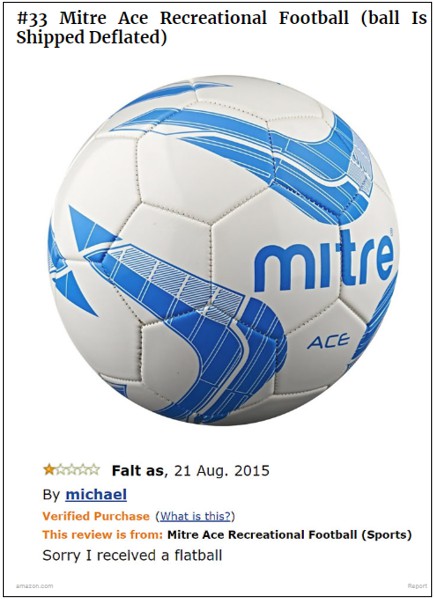
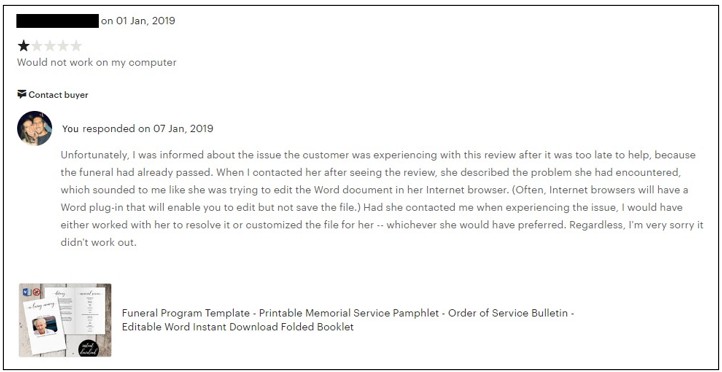
Address the situation directly. This is the time to share your side of things. Nicely explain the issue from your perspective. Your goal is for a potential customer to hear both sides and agree with you . . . or at least feel your fault is limited enough that they would still patronize your business. I dug up two examples for you of 1-star reviews I’ve received that I felt warranted a response.
Focus on increasing your positive publicity. Work to counteract the negative message that was conveyed. For example, if a customer’s complaint of faulty workmanship on her home got media attention, try to get press coverage on all the beautiful work your company has done. That could mean applying for some recognition in your field (annual awards, etc.), which could then be promoted. Another route would be to introduce a new guarantee on your workmanship, which could be publicized. If you’ve done a job that was unique or special in some way, you could try to pitch the story to a reporter as a feature. In my line of work, when a product gets a negative review that needs to be addressed, I send messages to other customers who have purchased the same product, asking if they would be willing to share their experience. During this pandemic (while sales were at their worst for me), I needed to take this step. Here was my message:
Hi there. I would like to personally thank you once again for your purchase. During these hard times in particular, the fact that you are purchasing products from small businesses means so much — to me and my family. So please accept my sincerest thanks.
An additional step that is very meaningful is leaving a review. IF you have the time available AND you were happy with your purchase, I would greatly appreciate you taking a few minutes to write a positive review for the product. I think people often don’t realize how important an impact their voice can have — especially for a small business.
If you didn’t end up loving your purchase, please respond to this message and let me know. I can either help you troubleshoot or I can personalize your product for you (if applicable), and I can work to improve the product for future customers.
Thank you!!!
In conclusion, I sincerely hope you never have negative press. (For a good article on proactive prevention, check out Great Customer Service is a Zero Cost Strategy by Business Management Blog.) For the unfortunate though likely day that you do encounter an unhappy (and vocal) customer, I hope this article makes you feel a little more prepared. Have any questions or comments? We’d love to hear from you. Scroll down to “Leave a Reply.”
You’ve been inspired. You produced a magnificent design accompanied by meaningful words . . . so you expect to be able to create an epiphanic moment for your audience, right?
Unfortunately, all too often the answer is “wrong” because something went awry in the final stages of production – a bad print job, a poorly executed poster, a botched banner on the day of the trade show, etc.
An old cliché says that the path to a successful project is 10% inspiration and 90% perspiration (including the required follow through). In my experience, that saying has a lot of truth.
One of the most common causes of a job to get really screwed up in the very last stages is the incorrect handling of images – specifically, providing images that have an incorrect resolution to reproduce properly or maybe (as in the case above) a disproportionately sized image.
I’m pretty sure everyone has encountered requests from a vendor for either “high res” or “low res” photos. Unfortunately, such requests are seldom accompanied by an explanation of what that means.
Resolution
For the sake of this article, the images being discussed are all “bitmap” files such as jpg’s, png’s, gif’s etc. All of these have a similar construction and are the most common file types used. We’ll save a discussion of vectors (the other common method of construction) for another day . . . and will eventually devote an entire article to eps (encapsulated postscript) files.
That said, I’ve sat debating the amount of time and space to devote to trying to explain the concept of resolution . . . and have decided to keep explanation to a minimum. Much has already been written by sources far more technically expert than me (feel free to google the term and check out the first 25 pages of highly technical search results)!
Instead, my focus will be to discuss the right resolution for various types of output. However, you DO need to know that image size (as measured in terms like inches or pixels) and resolution are related, mutually dependent concepts. Meaning – you can’t just increase the physical dimension without the resolution (ability to reproduce detail) also being affected. If you try to make a picture bigger, the resolution will get lower and – go low enough – and the image will be blurry because of the extent of the detail lost – messing up your masterpiece!
Resampling (Fancy Word for Resizing) – Basic Rule of Thumb
Note: While the example mentioned below will be expressed in terms of Corel Draw, all graphic arts packages will have similar features. If you’re a graphic designer by trade, Corel Draw may not be your graphics editor of choice. If you’re a small business owner without a lot of graphic design experience choosing to do your branding in-house, Corel Draw is a great choice. You can pretty much address all your web and print graphics needs for a faction of the price of the typical designer preference, Adobe. Currently, I am using Corel Draw 16. As long as you have a version in that same vicinity, your view should look pretty similar.
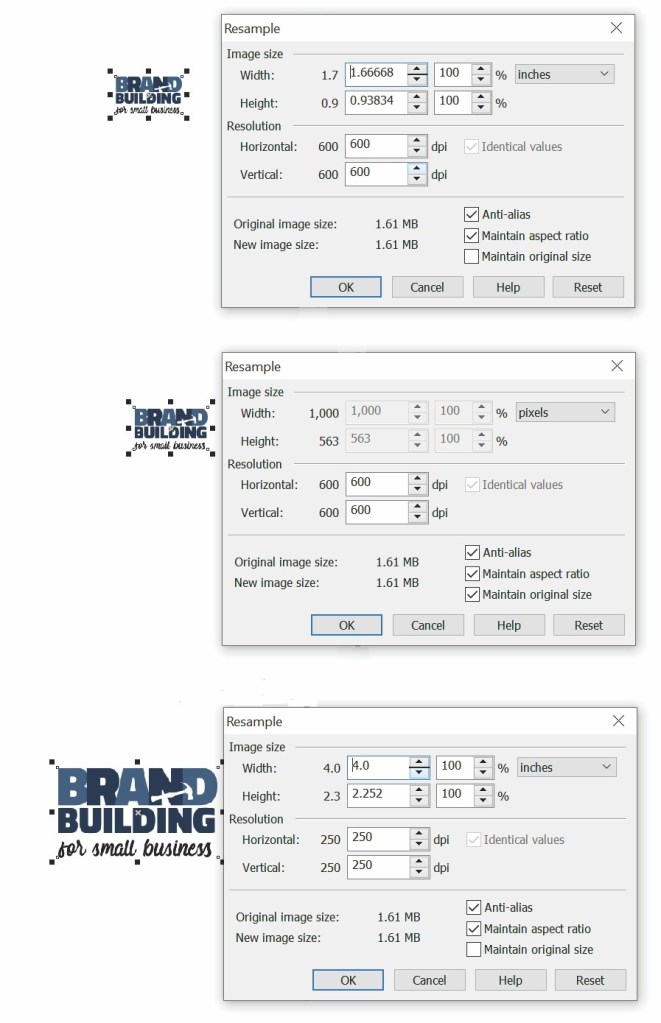
Start by setting the size (the width and length) to the required dimension, being sure to keep boxes checked for “maintain original size” and “maintain aspect ratio.”
If you have those boxes checked, set the larger dimension you need (could be either width or length) to the desired amount . . . and changes will occur.
The dimension you did NOT alter will change to reflect the adjustment made to the larger one, and you may find that secondary measure is either longer or shorter than the amount required. If longer, you can generally crop the image to the amount needed. If shorter, you may have to find a different image (or go through a complicated process of adding more material to the picture. For example, you might be able to successfully add some sky on a fairly cloud-free day to make the height of an image big enough. However, chances are you should just keep looking for an alternative picture.
Next, you need to look at your resolution. When you checked the box to “maintain size,” that meant any adjustment made to the width or length would increase or decrease your resolution.
Often, jobs and, therefore, output devices have different resolution requirements. Below are some of the common ones you might encounter. (All are based on having the correct physical dimension of length and width.)
If you’ve set the length and width to the physical size needed and resolution dips below those amounts cited above for the job you are completing, you have a problem. The image may ultimately appear distorted (even when the on-screen version looks fine). If the resolution ends up being greater than required, the extra image data will simply be ignored, but the performance of the equipment will suffer. You can either leave as is or “down sample” – uncheck the “maintain size” box and adjust the resolution downward to the amount required, leaving the physical dimensions the same. (Note: When down sampling, you sometimes might want to slightly sharpen your image.)
“Up sampling” involves increasing a resolution to a desired amount by just unchecking the maintain size box and entering the number. This process isn’t typically recommended (though at some point you will probably try and will see for yourself the very mixed, dissatisfying results).
All professional graphic arts applications will have tools such as those described above that will allow you to correctly adjust the size and resolution to the needs of the situation. If you are using an app that lacks these tools, you might be looking for trouble and should consider switching to a different program to complete this task.
Remember . . .
While I’ve offered a highly simplified explanation of one way to accomplish common sizing/resolution tasks, you should be able to use this approach to assure the desired quality output without having to delve deeply into all of the underlying theories and permutations. If someone should say, I know a different way, that person probably does know a perfectly acceptable alternative . . . so don’t go betting a quarter that he or she is wrong.
Resizing the Old-Fashioned Way (For those who like equations . . . )
If you have an image that you want to resize to a specific dimension, you can – while maintaining the original size – (1) change inches (i.e., 1.7) to pixels (i.e., 1000) and (2) divide that number by the desired dimension (i.e. 4 inches). The result (3) is the amount you should enter as your resolution (i.e., 250).
As previously discussed, you then have to determine whether that value is sufficient to produce the desire product.
Whether you are in the early stages of marketing, promoting, and advertising a new business or are about to reintroduce yourself to the world (a necessity that could be created by a variety of circumstances ranging from a great new product or service to a need to come back in a somewhat altered form from a national pandemic), a typical group of activities are usually considered:
Advertising via online and/or print publications
Press releases announcing your presence and/or highlighting a change
Direct mail/e-mail to existing and/or prospective customers
Social media postings to highlight important details and communicate news
Special events
To reach out to the largest possible audience in a coordinated way with a consistent message and visual component, basic branding practices are key. As you embark upon your campaign, we suggest you read the following blog entries . . . and keep checking back as we post new material on topics such as: building your own ads; properly preparing artwork for various print and online media outlets; understanding the role and use of paid search and ad words as an advertising tool; etc.
When read together, the articles shown below provide a branding tutorial relevant to marketing campaigns. (By the way, we are always interested in hearing from you and will carefully consider special requests to cover specific topics; either use the form at the bottom of this page to deliver your message or send us an e-mail at brandbuildingforsmallbusiness@gmail.com.)
BEFORE YOU BEGIN YOUR MARKETING OR ADVERTISING EFFORTS, take the time to create/review a style guide that puts into writing the most basic rules that must be observed to properly build the visual elements of your new campaign.
Note: Helpful downloadable tools/templates are included.
Your marketing/advertising campaign is almost certainly going to involve a variety of multi-media components – many of which are already included on our sample Branding Activity Calendar that could also be used to coordinate the various elements you’ve incorporated into your promotional campaign. (The template we’ve provided allows you to add the specific activities associated with your effort.)
Why does branding matter when your current focus is to launch your new sales campaign? Why get distracted by the time, effort, and resources needed to make sure your advertising and marketing efforts reflect your chosen branding? This article (as well as the one below) answers that question!
These articles provide tips on finding some of the DIY (Do-It-Yourself) tools needed to build your own ads and other marketing and promotional materials.
These pieces discuss the content and crafting of your direct mail message (including the document to be mailed/emailed) as well as the mechanics of obtaining your list and building your database of recipients.
These blog entries discuss the topics, voice, audience, format, and outlets to utilize in incorporating press releases into your marketing activities. Samples are provided.
The following articles cover various aspects of building a social media presence – from creating profiles on platforms such as Facebook and Pinterest to strategies used to identify appropriate content. As an added bonus, we provide tools helpful in promoting your social media accounts, including templates. (Last but not least, we address tools for requesting customer reviews so you won’t forget the importance of that aspect of social media.)
Branding involves far more than just creating a few recognizable visual elements. Customer Service is always at the heart of your brand. Taking a close look at this time helps identify those branding qualities that will resonate with your audience and are, therefore, worth promoting. Then, be sure to take all of the necessary steps to ensure that your customer service systems are properly tuned to support the front end of your sales efforts. Once you are successful, remember the value of repeat customers by immediately thanking them for their business.







 Brand Building for Small Business