SEO or Search Engine Optimization, in a nutshell, helps your web site be found online. The quantity and quality of your web content greatly affects your success. Unfortunately, the formula isn’t that easy (quantity + quality = top search ranking). Many behind-the-scenes factors are involved, including page load time, meta data, backlinks, etc.
I found a wonderful cheat sheet – well, more like a cheat guide – that breaks down the most important on-page SEO elements and gives in-depth information on improving each.
According to NP Digital Co-Founder Neil Patel, the most essential in-page areas to pay attention to are:
1. Site Speed;
2. Meta Tags;
3. Content That Drives Search Traffic;
4. Crawlability; and
5. Mobile-Friendliness (or Responsiveness).
If you think your web site may benefit from some tweaks or even a complete overhaul in any of these areas, check out the On-Page SEO Cheat Sheet.
Previously, good reviews might help a potential customer decide whether to purchase your product or service . . . once you’ve already done the hard work of getting that individual in the door (real or virtual). Now with web sites and apps dedicated to company reviews, they can actually be a form publicity . . . serving as the driver that leads the potential customer to your doorstep. So . . . how do you get reviews? If you already have an established business and customer base, sure, reviews will just happen. And they will help you get more customers, which will land you more reviews, and so on. However, if you’re at the beginning stage of your journey, getting a large number of good reviews may be a little more challenging. In that case, you can take a few steps to help speed the process along. . . .
1. Get your company listed on review web sites.
If your company isn’t already listed on Yelp (or whatever the review site is for your industry), your happy customer probably isn’t going to go to the trouble to add you . . . so lay the appropriate groundwork in advance. Make sure you know which review web sites your customers go to and add your company along with as much additional information as you can (pictures, address, phone number, etc.).
2. Ask your customers for a review.
I believe the most effective way to convince a happy customer to go the extra mile for your business is to personally take the time to ask for a review. If asking in person isn’t possible and you have other contact information, send an e-mail or a text. Be sincere and straightforward.
3. Ask again.
You don’t want to make yourself a bother, but one follow-up is completely appropriate. Your happy customer could have had every intention of posting a review for you and simply forgot; a simple follow-up could make all the difference. If, on the other hand, your customer never intended to write a review, ignoring two of your attempts probably won’t be too traumatic for them.
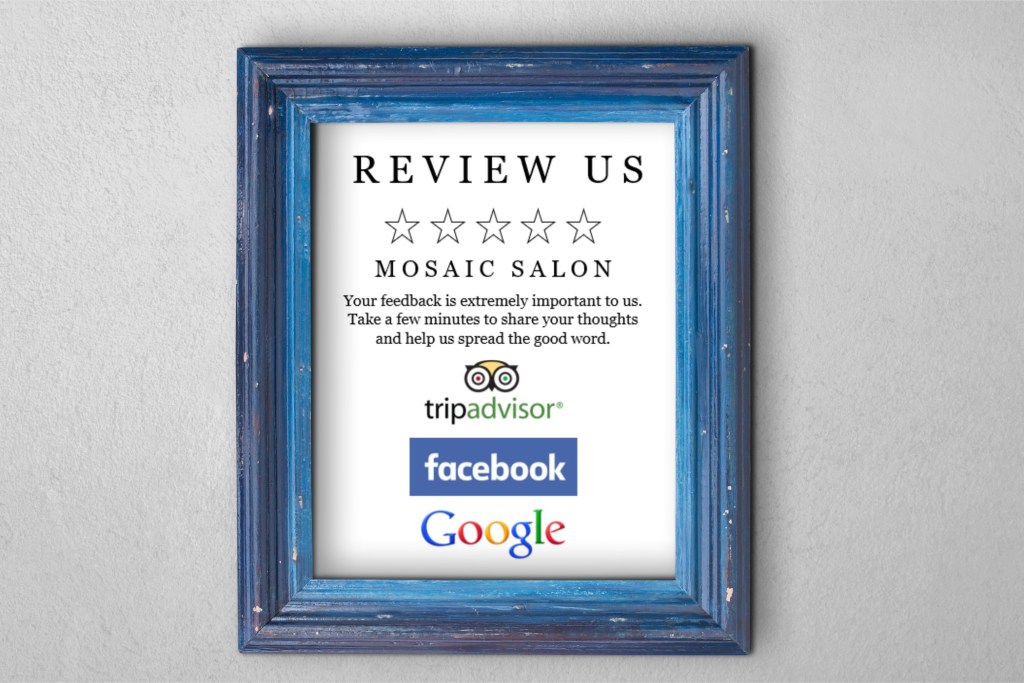
4. Display a sign.
A personal request isn’t always feasible. For those occasions, a sign placed in a prominent area (possibly next to your register) that makes the request visually can be a good idea. (See: Creating a Review Request Sign in Microsoft Word)
5. Include a request with your product.
Another option for a less personal request is a physical note included with your product – the more you can make the request stand out, the better your chances of getting your customers’ attention. (See: Clever Customer Service)
6. Reply to existing reviews.
Some review venues enable you, as the owner, to respond to reviews. You can thank the customer for their kind words or you can try to explain or apologize for less-than-stellar feedback. Sometimes, your visible presence will encourage other customers to share their thoughts.
7. Offer an incentive.
You can always sweeten the pot a little by offering a dollar amount or percentage off on a future purchase as a thank you for a review, which could help with repeat sales as well.
8. Offer a product sampling.
If all else fails, you may need to be willing to give away your product or service for free in order to get your initial reviews. You can either utilize a company to supervise the process, you can informally reach out to people you know, or you can post the offer on social media.
9. Be review worthy.
This one is entirely open to interpretation and can be tailored to represent your unique brand . . . whether you ship your product with a free bonus item, offer an appealing gift wrapping for free, or send a thoughtful thank you note after a purchase, try to do something that makes your company and product stand out from the crowd a bit and inspires customers to rave about their experience.
How can I easily increase traffic to my website for free?
Start your page with a question and immediately provide an answer in one sentence.
(Like above.)
Then, you can provide more information underneath. . . .
According to NP Digital Co-Founder Neil Patel, 14% of internet searches are phrased as a question. When starting your page with a question and answer, time spent on that page will decrease by over 20% (because people are able to find the information they need quicker); however, your rankings and traffic will go up.
To illustrate how this tip would be applicable for another small business, let’s use a painting company as an example. (Why a painting company, you ask? No good reason; just the first business type that popped into my head. Anyway. . . .)
If a painting company wanted to devote one of their web pages to pricing, they could start the page with a very commonly asked question like . . . “How much does it cost to paint a room?” and answer clearly while acknowledging every room is different. For example: “A 12×12’ room typically costs about $600 to be painted, though a number of different factors can affect that price.” Then, they could go into more specifics about their cost structure in subsequent paragraphs/lists.
Can you think of a scenario on your web site that might benefit from this trick? Share your thoughts in the comments below!






 Brand Building for Small Business