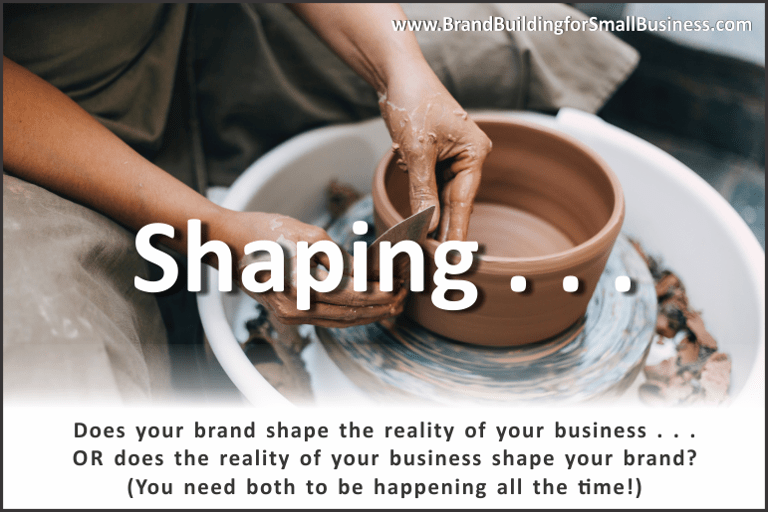
Today’s TIP: Shaping Your Brand
Brand Building for Small Business
A Blog for Entrepreneurs Looking to Create and Develop their Corporate Identity
So . . . you’ve sat down to write your press release . . . and you’re stuck getting started.
In an earlier article, we discussed Press Releases as Another Opportunity for Branding. Specifically, we addressed some of the basic criteria needed to produce a successful PR piece, including discussions about: Topics, Voice, Audience, Outlets, Format, Quotes and Photos, and Post-Submission Follow-up. In a second article, we wrote a Press Release to Introduce Ourselves as Part of National Small Business Week (in 2020).
Nevertheless, we realize that many of you may still be sitting staring at a blank page after having crumpled up a dozen failed efforts.

In this article, I’m hoping to help you get started writing by encouraging you to identify and assemble the content you need to include to attract the attention of the media and (ultimately) your audience . . . while successfully communicating your message about your brand.
First, ask yourself whether your proposed topic is of general interest to the public and not simply a self-serving grab for attention. If you are convinced you have the right kind of subject (i.e., a message that’s unique and has a potential impact upon others), then you need to gather up the specific details to include.
The 5 W’s (Who, What, When, Where, and Why . . . PLUS How)
Answer each of these questions in terms of your press release.
Who
Identify those individuals and/or organizations who are involved . . . as well as people likely to be affected by the outcome. As you perform this step, consider possible prospects to provide you with a quote. (In the case of a groundbreaking or Grand Opening, the “who” might be the founder of the business. Or, perhaps the “who” is the individual behind a new product or key enhancement . . . as well as the consumers likely to benefit. In the case of an employee being featured to acknowledge an award?, the “who” would be the recipient and maybe the judges (assuming they are well-known public figures).
What
This description should address the unique and special nature of the topic being publicized. For an employee feature, the “what” might be the winner of an “Employee of the Month” contest and a discussion of the habits and accomplishments being recognized. In other cases, your “what” could be the description of a new product or service, announcement of a Grand Opening or Employee Recognition Day, or perhaps the explanation of an award won by you.
When
The date and time associated with your topic should always be included. While this piece of information is very obvious in some cases such as a Grand Opening, others might be a bit more ambiguous such as the anticipated date a new product or service will be introduced. Occasionally, your “when” could be a timeframe such as “income tax season” or “early this summer,” etc.
Where
“Where” identifies the location in which the topic under discussion is taking place. In a press release, inclusion of an actual address might be appropriate, but a more general reference such as “at the corporate headquarters” or “in Washington” or “at the satellite location of the store” would suffice to provide the reader with adequate context.
Why
This piece of information in very important because you are highlighting “why” the press release matters. In some cases, the “why” gives you the opportunity to outline the criteria for an award while explaining the reason you were chosen as winner – one of the rare opportunities to be totally self-congratulatory in an acceptable objective way. “Why” might be your opportunity to explain the reason a new product or enhancement matters to consumers. “Why” could be the reason an “Employee of the Year” plaque is given, which offers you an opportunity to expand upon your company’s brand while highlighting the ways in which the recognized person embodies those desired characteristics . . . while also calling attention to the ways in which the consumer benefits.
How
“How” (like “why”) often gives you a bit more opportunity to expand upon the branding of your business. This information can range from “how” the winner of an award was determined to “how” a company has elected to participate in some national holiday such as Small Business Week. In crafting this piece of information, remain very sensitive to opportunities to highlight the company’s brand characteristics and the way those qualities made the “how” possible.
So, You Have Your 5 W’s . . .
So, you’ve dutifully filled in the blanks for each of those categories. (Please note that we have provided a Word template with each of these components laid out to help make that process easier.) Next, actually write down the two or three quotes you plan to use. At least one of those sources will typically be from a high-ranking company official and the other should be a person with some recognizable expertise in the subject. Similarly, one of the quotes should be devoted to the main theme of the press release while the other can merely mention the topic while making remarks that reinforce the general branding of the company. If you can get a consumer to make a statement, that content can be very effective. Government officials can also be useful, especially for items like awards and Grand Openings.
Next, locate or create any needed photographic artwork, being sure to supply an appropriate caption and perhaps citation. If you do not have the necessary images, you can take the pictures.
The final preliminary content to highlight in this collection of information is the “branding boilerplate” language you want to include. For instance, we chose the following message for our blog:
“Produced by two experienced communication professionals, Brand Building for Small Business is a blog that aims to provide practical, do-it-yourself advice about creating a brand identity from the bottom up. Expect, simple, straightforward tips that can be executed by a single person or a small group on a very tight budget.”
As a result, we try to incorporate at least the substance of this message (if not the exact words) into any press release, knowing such content is the most likely to get cut by an editor.
Finding Your Lead . . . and Shuffling Content in Order of Importance
Now that you have assembled all of your content, you must begin to incorporate the elements into a cohesive story. The first step is to identify your lead. Specifically, read through the 5 W’s you’ve collected and decide which one is the most important.
For instance, “what” and “who” would probably be the elements you introduce first for an employee press release with “when” and “where” being secondary. For example . . .
“The ABC company recently named Mrs. Mary Smith (your “who”) the “Employee of the month” (your “what”). She will receive her official reward on June 14th (your “when”) at the annual company meeting at the ABC corporate headquarters (your “where”). She is being recognized for outstanding customer service (“why”), which reflects ABC’s philosophy of putting the customer first (using this portion of the “why” to tie back very directly to the company’s branding statement).
Once this lead is in place, I’d include a paragraph of biographical detail about Mary’s background and history with ABC. I’d add a quote from Mary about being surprised and honored as well as another from her supervisor about the reasons Mary is worthy and reflects those qualities that are part of the ABC brand. Information about past recipients might also be included.
Finally, I’d explain the process of selecting the Employee of the Month (the “how” in this case), which could create a further branding opportunity by indicating the choice was made by fellow employees or perhaps the company’s customers.
Then, I would insert a paragraph that describes ABC and highlights some of the company’s accomplishments. Within this section, I’d include the quote from the high-ranking company official that is pretty much exclusively about the organization. (The inclusion of this statement will probably increase the chances of the company information surviving the final cut.) Very often, a paragraph such as this one would reflect your company’s boilerplate. If not, I’d incorporate that as part of my closing.
For this particular story, I’d be sure to include a photo of Mary and/or the award ceremony as well as photos of other quoted parties and perhaps an image of the ABC corporate headquarters (assuming the place is closely associated with the company and perhaps a bit iconic).
As I hope this one example above suggests, each collection of details will have an intrinsic order of importance that hopefully makes the progression of the press release both obvious and easy to write. For instance, “what,” “when,” and “where” would probably be the lead of a “Grand Opening” with “who” being used to mention the dignitaries expected to attend. “Why” would almost certainly incorporate some statement about customer convenience that would provide a point of entry into a recap about branding. An image of the new location would be essential.
For a press release about a new product, “what” and “when” would probably provide the essence of your lead with “who” being secondary unless a specific individual was instrumental in developing the new product. Once again, “why” would provide an opportunity to expound upon branding and the ways in which customer needs were being better served. The “how” in this case could talk about the process of development and perhaps incorporate some discussion about the ways in which customer feedback came into play.
As you can see, the 5 W’s are pretty much a part of any press release you’d choose to create. By using these elements to gather and organize your content, your narrative will be half written – you’ll just need to figure out the correct order for presenting the information for maximum effect. Generally speaking, most press releases will be less than 500 words, so taking this approach should be very useful in getting you close to a finished product.
To make sure no information is overlooked, we’ve created a template listing all the important components from this post to help you put together your content. You will ALWAYS have some details to plug into each section. Once gathered, the ultimate order will most often become fairly obvious.
Note: In a future article, we plan to create examples of simple common press releases such as the kinds mentioned in this article (i.e., Grand Opening, New Product Rollout, Employee of the Month Award, etc.).
These days, every small business needs to find a suitable spot to launch an Internet site on the web. You may think you are exempt because you:
If this description fits you, I can understand that you might feel the web is unnecessary, but you are wrong.

Web Sites Come in a Variety of Sizes . . . and Can Be Complex or Simple
First, let me point out that contemporary web sites encompass a broad spectrum from the highly sophisticated ones that allow you to accomplish all aspects of a sale from presentation of the product/service to payment and follow-up . . . to the simplest variations that exist primarily to establish an on-line presence.
Recently, the WordPress Newsletter published a story about “Building Single-Page Web Sites on WordPress.com.” Frankly, seeing this article got me thinking that the time had come to post an entry on web sites for our blog because the development of your on-line presence creates an important vehicle for branding . . . while positioning you (should you someday choose) to consider taking advantage of Internet Sales.
As the pandemic of 2020 has taught us, small businesses must be prepared to adapt to changing circumstances, and on-line operations can provide a very useful alternative. Assuming you are not ready to (or do not need to) take that plunge, having the beginnings of a web site can only help create that flexibility if and when the day arrives . . . and you’ll already be establishing some history that can be helpful at a later date.
Convinced . . . ? Not Yet . . . ?
Frankly, most consumers fully expect every small business to have at least a basic Internet presence . . . and become suspicious about the solvency and reputation of a company that does not. At a minimum, you can simply put together a small web site that could have your:
Remember, this first on-line impression will start to set the tone for your brand in people’s minds . . . so choose meaningful content indicative of whom you are!
How Do I Get Started?
WordPress can actually provide many tools for developing web sites of all kinds and degrees of complexity. If you are just starting out, you really should check out that article mentioned earlier. However, lots of alternatives exist.
Consider using an existing simple template. Many web hosting services and software packages provide a wide variety of perfectly acceptable ones that are easy to use and appear fairly customized once your content and images have been added and fonts, colors, etc. have been adjusted to reflect those already chosen for your brand. Also, those same sources frequently provide widgets (i.e., application programs that can be easily incorporated to handle basic tasks like forms or searches) that you might want to include on your simple site.
Still a bit too hands-on for your taste and comfort zone (even though the camera on your cell phone can be used to generate all of the artwork needed)?
Consider hiring a local vendor or even a college student to give you a hand . . . but don’t allow yourself to accept any excuse for inaction!
In building a basic web site that incorporates the items mentioned earlier in this article, you:
Don’t Be Intimidated!
I was involved in building my first web site over 30 years go. The world wide web was a relatively new phenomenon, and the Internet was just graduating from the world of Archie and Gopher servers at colleges used to give users a way of communicating.
Frankly, I was too dumb and the process was too new to me to be as intimidated as I should have been though – over time – I learned better . . . and grew suitably threatened by the task of developing a good, highly visible web presence. (Besides, getting intimidated is always much easier as demands and expectations grow more sophisticated.)
While our early efforts were just “brochureware” and were hardly an important source for sales or the delivery of services, we accomplished some very important goals that served us well over time. We positioned our company as one of the first to embrace the Internet, helping to create a brand that incorporated technical sophistication as part of our calling card. As more and more operations embraced technology, became involved in web-based sales, began featuring on-line processing and service, and adopted paperless operations, this branding was extremely useful in defining our company as an innovative leader across several decades.
Remember, all beginnings lack polish so don’t be intimidated. Regardless, your early efforts are sure to embarrass you at a later date. (Need proof? Just take a trip via the Internet Archive “Wayback Machine” in about five or ten years to see some of your early versions and compare them to the current.
So, take a chance and take a plunge into the web but be sure to always keep your eyes focused ahead when defining your brand. Try to incorporate who you are now but also who you want and expect to be tomorrow. Your dreams and aspirations are as much a part of whom you are today as any current limitations that you plan to overcome along the way.
Note: We plan to address higher-end, more complicated web sites in future articles.

If you haven’t considered starting your own company blog, you should, because that vehicle can be extremely useful in developing and promoting your brand.

Specifically, a blog:
Plus . . . you get to build new accompanying skills learned while managing your blog.
With so many potential benefits, what is the possible downside?
Full disclosure – the company that I worked for across many years never did start an official company blog during my tenure, though I was certainly a proponent and made the suggestion several times. That said, I understood the reluctance – with the main obstacle being the potential drain on resources. To be successful, a blog requires regular content; you have to assume many hours of talent will be spent:
Furthermore . . .
If you elect to highlight the efforts and contributions of key employees and make them part of your brand, any loss of talent to other companies (for example, an employee leaves your business to work for the competition) is magnified and becomes even more potentially damaging to your success.
The Bottom Line: To Blog or Not To Blog – That is the Question
While I understand the possible downside, I suspect the risk of committing to a blog might be greater for large established companies than small ones. If you have the necessary patience and commitment . . . as well as the required communications skills, I believe a blog can be a very useful tool in building and maintaining your brand identity. While you will certainly be devoting key resources, the content you create can provide many ancillary benefits, including support of your marketing, social media, and web development activities (among others). Just know that, like every other worthwhile endeavor – any payback is in direct proportion to the time, effort, and talent invested!
Disclaimer: While we only recommend products we know and love, we want to note we use affiliate links and may earn a commission for purchases made through those links.

About Corel Draw: If you’re a graphic designer by trade, Corel Draw may not be your graphics editor of choice. If you’re a small business owner without a lot of graphic design experience choosing to do your branding in-house, Corel Draw is a great choice. You can pretty much address all your web and print graphics needs for a fraction of the price of the typical designer preference, Adobe. Since you’ve landed on this page in your travels, you probably already know that. If, however, buying a copy has been on your to do list for a while, there’s no time like the present. You can buy yours here and support this blog in the process.
A Quick Note About Versions: I’m using Corel Draw 18. As long as you’re using a version in that same vicinity (i.e., 16, 17, 19, or 20), your view should look pretty similar to the screenshots included throughout these directions.
You can have yours ready to use in about ten minutes, assuming, of course, you’ve already made the hard decisions about your brand identity and:
(If not, we encourage you to read Design Your Own Logo and The Role of a Brand Style Guide first.)
Now, on to the process . . . .
1. Launch Corel Draw and click the “New Document” button on the Welcome Screen. Set the document to 8.5” wide by 11” high, CMYK color mode, and 300 dpi; click “OK.”

Then, you’ll want to prepare the document a bit. First, click on the “Snap To” dropdown towards the top of the page; check Document Grid, Guidelines, Objects, and Page; then, click the “X” to close the dropdown.

Next, add Guidelines to create your margins by clicking on the ruler (just above your workspace) and dragging the cursor from the ruler towards your page. You’ll see a highlighted dotted line will appear and will continuously “snap” into certain placements while moving. (The word “grid” will appear over the line at those snap points; since you chose to “snap to” the document grid, the guideline will snap at each quarter inch on the page.) We want to set the guidelines to create a 1/2″ margin on the page, so let go of your guideline at the second snap on the page. For the bottom, let go of the guideline two snaps from the bottom of the page. Do the same for the left and right. Add one more vertical guideline to the center of the page at 4 1/4″.

2. Then, insert your logo into the document. From the File menu, choose “Import,” navigate to your logo, select the file, press “Import,” and click within your document to place the logo file.
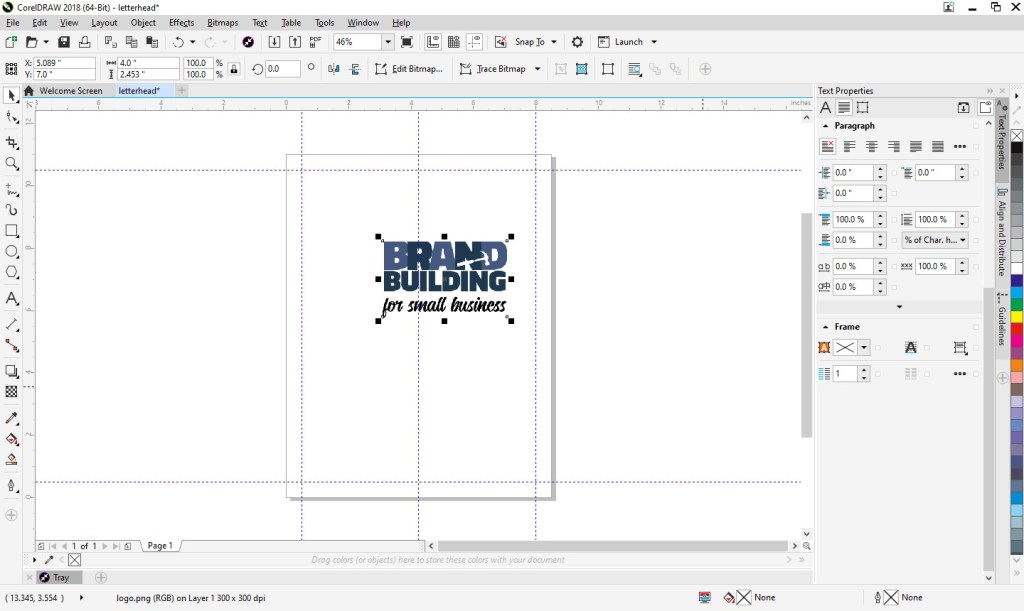
You’ll probably need to adjust the sizing of your logo. If so, just click on a corner of the image and drag diagonally to increase or decrease the size as needed. (If you drag other than diagonally, you’ll resize your logo disproportionately.)
Next, move your logo so that the top of the image is aligned with your top guideline and the center of the image is aligned with the center guideline.
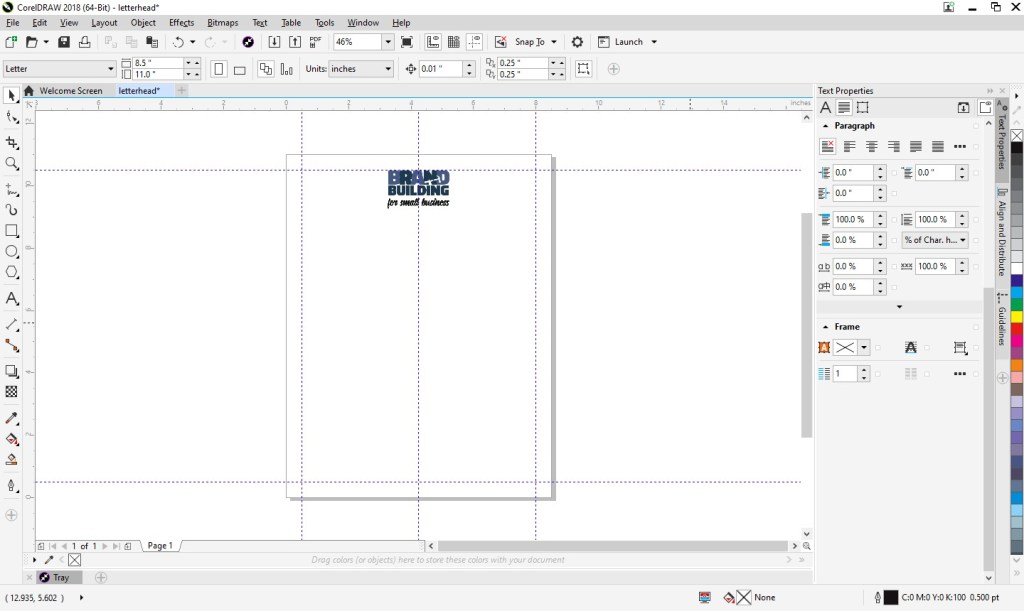
3. Next, you can add your footer. At left, you’ll see an A, which is the text tool. Click on that and create a square at the bottom of the page within the margins.

With the text box selected, set the font properties at the top of the page. (I went with Calibri in size 11 Centered.) At this point, zooming in on the text box is helpful. Click the magnifying glass at left (which is your zoom tool) and click on the text box.
In the footer, you can include your company name (or omit if you’d like since your company name is most likely already in your logo), your tag line (don’t waste any opportunities to educate people about your business), your web site address, email, address, phone number, etc.
You can begin typing by simply clicking into your text box. If you find you need to increase the size of your text box, click the top center handle and drag upwards as needed.
I included our business name, tag line, and web address; I also added some dashes above the web address for visual separation.

Next, zoom back out to the full page view by clicking on the magnifying glass and then selecting the “zoom to page” button at the top of the page.

Create another text box for your body copy. Click the A text tool and draw your box in between your logo and footer and within your left and right margins.

Set the font properties. (I went with Calibri Light in size 10).
And you’re done! You can now save your template future use. Go to File > “Save;” then, navigate to your desired location, name your file something that will be clear to you in the future (like “letterhead”), and click “Save.”
Feel free to download and use our letterhead as a starting point.
IF you would prefer someone else do the creating and the printing for you (and the end product show up at your door step), we have a route available for you, too. Click here to personalize and purchase this letterhead on Zazzle.
If you have any questions, just ask us below!
As I write this article, a New Year has just begun . . . bringing a much-welcomed fresh start.
We all hope (and optimistically expect) that 2021 will be a much better, more normal year for all of us – including small businesses that suffered such hardships during 2020. For them (our primary audience), I offer my best wishes for a strong start as well as a suggestion for an additional New Year’s resolution: performance of a simple “annual brand checkup” to identify and make any needed adjustments.

Please note that I have chosen the word “checkup” very carefully to suggest a simple self-help exercise – not a complete “brand audit” that can be highly structured, very time consuming, and quite expensive when third parties are utilized. As a quick DIY alternative that can, therefore, be accomplished much more frequently, the 5 Steps of a Brand Wellness Checkup include the following:
Remember, the point of this exercise is to make sure that at least once a year you stop and revisit your most basic branding decisions and their implementation. By doing so annually, you can make sure you do not unwittingly drift off course . . . and can make minor adjustments to right yourself before a major, potentially difficult, and expensive overhaul is required. (To learn more about activities associated with the items mentioned above, visit our menu item labeled “Your Brand: The Beginning” or visit this page.)
While most New Year’s Resolutions are abandoned by February, this goal is one that can and should be done as early as possible at the start of the year.
Good luck . . . and keep thinking positive thoughts about 2021 and beyond.
It was a normal Tuesday evening a few days before Halloween. I was answering customers’ questions on my computer, and I heard the usual “cha ching” sound, letting me know I had a sale. I went to my purchases page and saw a vanilla extract label template was sold, and I sent the customer the customary thank you message that includes some basic instructions. Then, I heard the “cha ching” again and experienced a little deja vu, since the order was for the same product. Moments later, one “cha ching” interrupted another, creating an odd “cha cha ching” sound. All purchases were for the same product. At this point, I’m thinking to myself, ‘I don’t feel like I’ve had a lot of sales for that item before.’ A quick look at my product statistics confirmed that — since release — that item had only one or two sales per week. Interrupting my research, “cha ching.”
I started receiving questions about the item as well, and so I responded with answers to their questions along with a question of my own: “How did you hear about this item?” I learned that a social influencer on Instagram posted a video about making your own vanilla extract and included my label template.
I checked out her page (Daryl-Ann Denner at instagram.com/darylanndenner) and saw that she had over 600,000 followers (at that time; now her tally is getting close to 800,000!). I found the video and watched as Daryl-Ann and her mother (a very likable duo) show how to make vanilla extract and talk about my labels in the process.
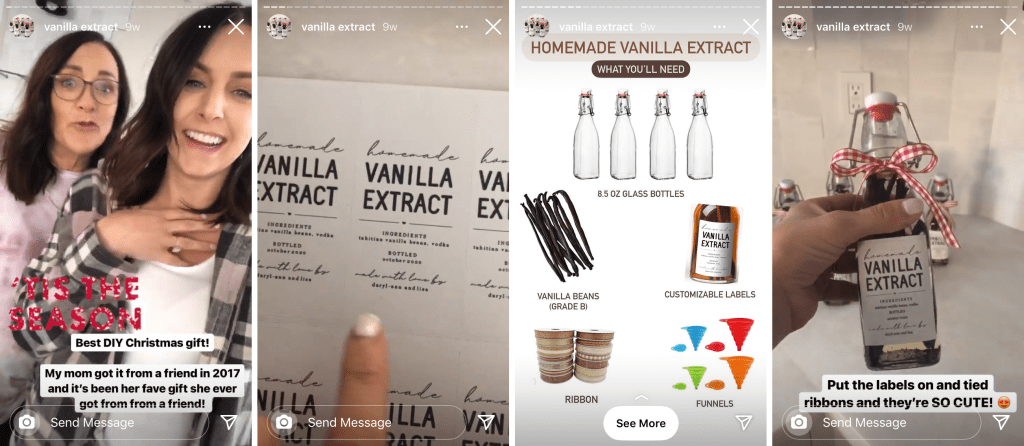
I have to admit, I felt a bit starstruck. I acknowledged the silliness; a product of mine was shown on someone else’s Instagram page; big deal. Enter perspective. Still, this person had over 600,000 followers, and she included me in her little world. And in her world, when Daryl-Ann Denner says vanilla extract is a “Best DIY Christmas Gift,” her followers listen. In that first 24-hour period, there would be over 300 “cha chings” for vanilla extract labels. Since then, the total count has grown to 2,829 orders at the time of this writing (October 27th through December 29th). The total sales since originally releasing the item on January 1st, 2020 is 2,865, so a whopping 36 sales had occurred in the ten months prior to the product being featured.
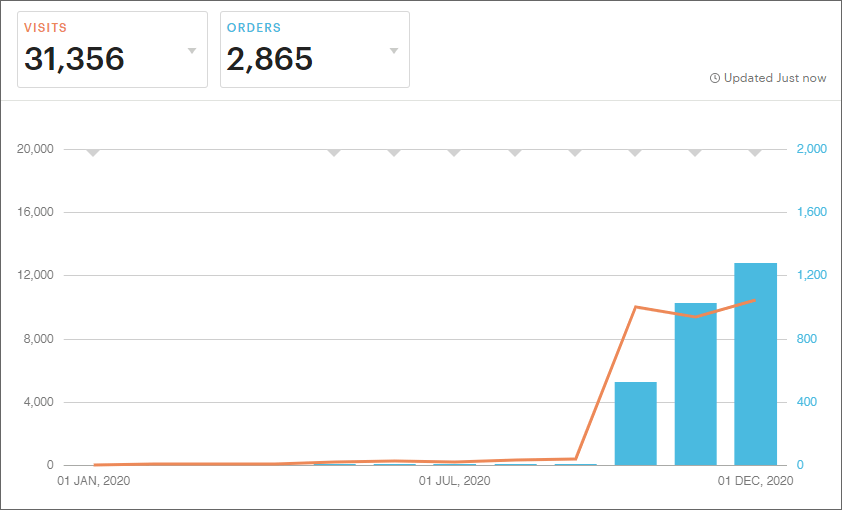
I don’t believe any advertising could have yielded anything close to these results. So, that’s how I learned that – as the title of this post suggests – social influencers rule the world . . . or at least the small piece of the world in which they reign.
So how, as small business owners, do we benefit from this recognition? Obviously, I would love to replicate this success. And sure, it would be wonderful for another social influencer to simply stumble upon one of my products and decide to feature it, but I don’t think I’m lucky enough for lightning to just strike twice. I also don’t know if I have the ability to compel lightning . . . but I’m definitely going to try. I will be spending a good chunk of time researching and doing some trial and error of my own on the best ways to approach social influencers. If I come up with a winning combination, you will be the first to know! Stay tuned!
The snow starts to fall.
The camera zooms in . . . as the couple begins a long-delayed (at least two hours) passionate kiss.
The movie ends – HAPPILY, of course – with the pair united just in time for the Christmas holiday but clearly destined to live happily ever after.

For millions of people, December (which now starts on November 1st) means decorations, presents, Santa Claus, reindeer, AND Hallmark!! The company has become (through years of careful brand building effort) inextricably associated with the warmth, cheerfulness, and good feelings of Christmas – not a bad set of qualities to have linked with your name and your brand. In fact, so many people have found so much comfort from Hallmark Christmas movies, the company tried to ease the burden of the 2020 pandemic by providing around-the-clock Christmas fare outside the season during a period of heightened restrictions on normal, daily activities.
Clearly, Hallmark is a company that has learned an important truth – linking your brand to a holiday and feelings associated with that time can be a useful tool in your branding arsenal.
Other successful examples?
Other examples abound. (If interested, read “How 5 Leading Brands Embraced The Holiday Season” OR perhaps about “Five Food Brands That Own Christmas”.) Frankly, the list could go on and on, and I’m sure you can easily find a dozen examples of your own.
So . . . How Do You Make a Holiday Brand Happen?
To some degree, you have to rely upon luck – recognizing an early connection to a holiday that you see has potential and can build upon. However, some basic steps can be taken.
Most holidays have some familiar sentiments and iconography associated with them. Try making a list of those attributes and a list of the attributes and iconography already associated with your brand. A sufficient number of matches between the two lists suggests you may have a likely candidate for brand building. Starting with some basis for the connection (which is the point of this exercise) should increase your likelihood of success and reduce the amount of time required. Once you have a candidate, some of the activities that can be used to build the connection between your brand and the holiday are:
By consistently promoting the ties between you and your chosen holiday over time, you can gradually build a brand identity that assumes some of the characteristics of that celebration. (Even Hallmark’s special relationship with Christmas did not happen overnight!!)
Looking for more suggestions, see “5 Branding Tips for the Holidays” by Debbie Laskey for the Digital Branding Institute.
Don’t Overlook Opportunities Presented by Lesser-Known Holidays
While you were certainly aware that Christmas and Hannukah were linked to December, were you also aware that these additional special observances existed?
Above and beyond those monthly celebrations, you have special days (examples cited below are from 2020):
(As I sit and write this draft, I now realize I should be planning my International Mountain Day Celebration!!)
Dozens of such occasions occur throughout the year that could provide special marketing opportunities for small businesses. For a complete list, see Anita Campbell’s article in Small Business Trends “Huge List of National Holidays for Marketing in a Small Business”; you just might find a number of events already exist that are inherently symbiotic with your operations.
Regardless of whether you decide the time is right for you to act on the advice in today’s article, my blogging partner and I would like to wish you a safe and happy holiday season, being sure to tune into a Hallmark Christmas movie or two while filling out your Hallmark Christmas cards to send to family and friends . . . to show you care.

I recently had the pleasure of doing a guest blog for MiddleMe about humorous branding fails. With the world still suffering in the midst of a pandemic, I figured we could all probably benefit from a little break for humor . . . with some lessons on avoiding “branding fails” infused along the way. You can check it out here: https://middleme.net/2020/11/16/learning-from-others-mistakes-humorous-branding-fails-and-important-takeaways-by-carole-mancuso/
And you may want to take a few moments to peruse the rest of the site while you’re there . . . lots of interesting and worthwhile articles.
Happy reading!
 Brand Building for Small Business