Where to Begin? Once you’ve made the decision for your business that you are going to build your brand from the ground up, you may find yourself a bit overwhelmed. I certainly did. In this post, I reflect on the beginning of my journey as I learned to focus on branding even while in survival mode.
What’s in a Name? This piece examines some of the considerations in selecting the right name for a well-branded operation.
Design Your Own Logo This tutorial provides a very hands-on approach to building your logo. Whether you are considering a totally new design or simply looking to adjust, adapt, and tweak an existing one, these tips (including where to find needed tools) should prove useful.
Know Your Audience A very basic but essential part of any branding exercise should be to make sure you know your audience and choose branding elements that properly reflect their characteristics. This article reviews some of the basics for you to consider.
How to Create a Mission Statement Need a little inspiration for crafting that ever-so-important message? This post includes a couple dozen great examples along with an exercise that breaks down the components of a good mission statement to help you develop yours.
The Role of a Brand Style Guide Once you have completed each of the above activities BUT BEFORE YOU BEGIN BUILDING BASIC TOOLS LIKE BUSINESS CARDS OR LETTERHEAD OR INCORPORATING THE ELEMENTS INTO MARKETING OR ADVERTISING EFFORTS, take the time to create a style guide that puts into writing the most basic rules that must be observed to properly build the visual element of your new brand.
How to Set Up Simple Print-and-Cut Business Cards Start with a blank Word document and develop business cards that are print-ready in only ten steps . . . this “how to” guides the way for you. A Corel Draw tutorial is available as well.
How to Easily Create Business Letterhead As integral as business cards and even easier to develop, letterhead created in Microsoft Word is presented as Instructions with Template Included and a Video Tutorial. Instructions and a template are available for Corel Draw as well.
Note: Many helpful downloadable tools/templates are provided to add extra value to the pieces described above.
Disclaimer: While we only recommend products we know and love, we want to note we use affiliate links and may earn a commission for purchases made through those links.
Lots of businessowners question whether they’re creative or tech-savvy enough to create their own logo. Unfortunately, I can’t tell you neither of those qualities are needed, but I can safely say they’re not needed in the abundance you probably imagine.
Things you do need to design your own logo:
A little creativity
A little tech savvy
A vector editing program (available for free)
Lots of fonts choices (available for free)
Lots of icon choices – IFyou want a graphical component to your logo (available for very minimal cost; the icon used in our logo cost $2.99)
So where to start?
While graphic design isn’t my specific trade, I’ve been asked
to create dozens of logos throughout my career.
Every time, I start by facing that same dreaded obstacle: the blank
page. I stare at it, thinking about what
the logo should represent and the type of fonts, colors, and imagery to best
suit that message. Meanwhile, a blank page relentlessly stares back.
While a tedious process, you should set your expectations for your logo before you pick up a pencil (or the mouse).
Originally, logos were introduced as an aid to people who couldn’t read. As a result, the earliest designs tended to be very literal. (For example, a shoemaker’s logo would inevitably show a shoe.) Over time, the purpose of logos has evolved to become a broader reflection of brand but remains a key way of differentiating yourself in the marketplace.
So what’s the personality of your company? Is your business youthful and trendsetting? Conservative and financially strong? Fun and whimsical? Product-focused and straightforward? Some combination thereof? This corporate identity (or brand) needs to be communicated in your logo – through your font(s), color(s), placement of words, and any graphics.
If once you have a strong sense of your business “personality”
in mind, your page is still unyielding in its never-ending canvas of white, go
looking for some inspiration. . . .
For the Brand Building for Small Business logo, I
knew I wanted to try something graphical to literally represent the act of “building.” I was initially picturing letters being
nailed but knew that would be tricky to execute in a clear way. So, I went to my go-to spot for inspiration: google images.
I searched for “building logo,” hoping the results would be full of
construction-type logos also looking to convey the literal act of “building.” But no, Carole, searching “building logos”
yields lots of logos of buildings.
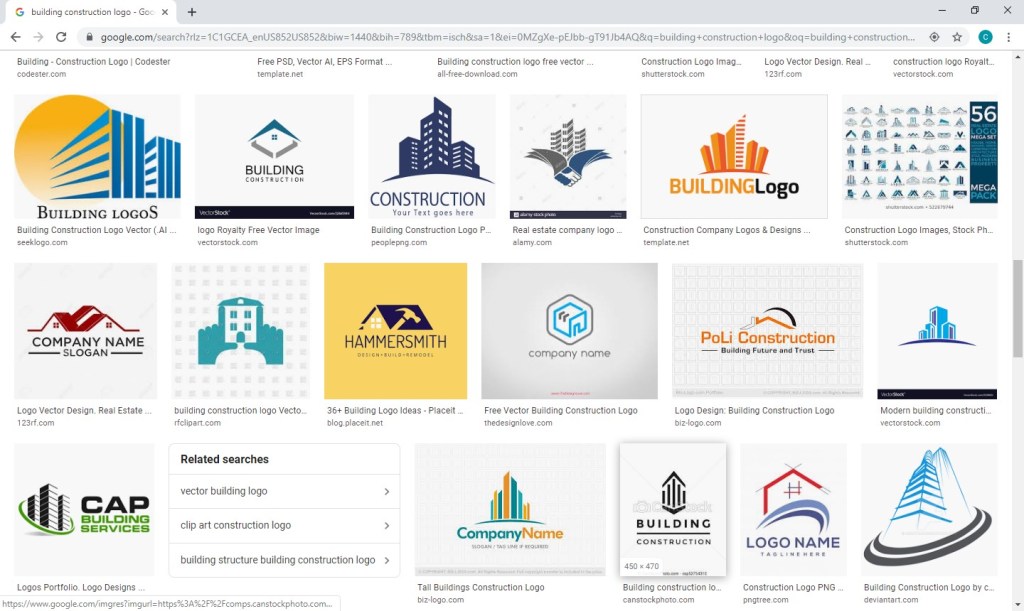
. . . Should have foreseen that. Instead, I searched for “building construction logos” and found more of what I had in mind.
A couple screens in, I found inspiration.
Looking at the Hammersmith logo (in navy and white on a
yellow background), I love the way the hammer is a silhouette within the house
and appears to be captured mid-swing. I
immediately knew I wanted to try a hammer silhouette, but I wanted the graphic to
appear within the company name and not as part of a separate graphical
element.
A quick note on inspiration versus copyright infringement: This is an area requiring caution. Whereas you can use a silhouette of a hammer as seen in one logo in another, creating a logo for a construction company with a silhouette of a hammer in a navy house with white windows on a yellow background would most certainly earn you front-row seats to the case of them v. you. An individual idea cannot be copyrighted; however, “a collection of ideas” makes a logo (or any other original work) unique and can be protected by law. Tread carefully.
LOGO ICONS
So, where does one go for icons that could legally be used as part of a logo for minimal cost? A number of options exist, but I like https://thenounproject.com/. They have a large selection and charge nominal, one-time fees per icon. I found the hammer for our logo for $2.99.
A number of choices were available. . . .
I selected a classic and simple hammer.
I then purchased and downloaded the file in PNG (bitmap
image with a transparent background) and SVG (vector) formats. (A
separate article on Vector vs Bitmap file formats is planned.)
VECTOR/GRAPHICS SOFTWARE
Now what to do with your icon? We use the vector and graphics editor, CorelDraw. While the suite is powerful and much cheaper than your standard graphics package, the cost is still pretty steep in the $500 ballpark. I read a few articles on free vector-editing programs, found Inkscape (https://inkscape.org/) to be highly recommended, and gave it a go. The program seems to have the features needed to get the job done. (And, they make a number of tutorials available, including one on the basic tools: https://inkscape.org/en/doc/tutorials/basic/tutorial-basic.html.)
FONTS
An obvious first step when selecting a font to use for your logo is to scroll through the existing fonts on your computer to see whether anything catches your eye. Remember that you’re not looking for the font that necessarily looks the best to you; rather, you’re looking for the one that best represents your business’s brand. If you’ve picked out an icon at this point, you’ll also need to be mindful of the way a given font looks with your chosen icon. You can have an icon and a font that both separately represent your brand perfectly but just don’t look good together. Since I wanted to try including the hammer as a silhouette within the words for Brand Building for Small Business, I needed a really bold, thick font. I gave Arial Black a try, knowing it’s the boldest font currently available on my computer, but I wasn’t really pleased with the result.
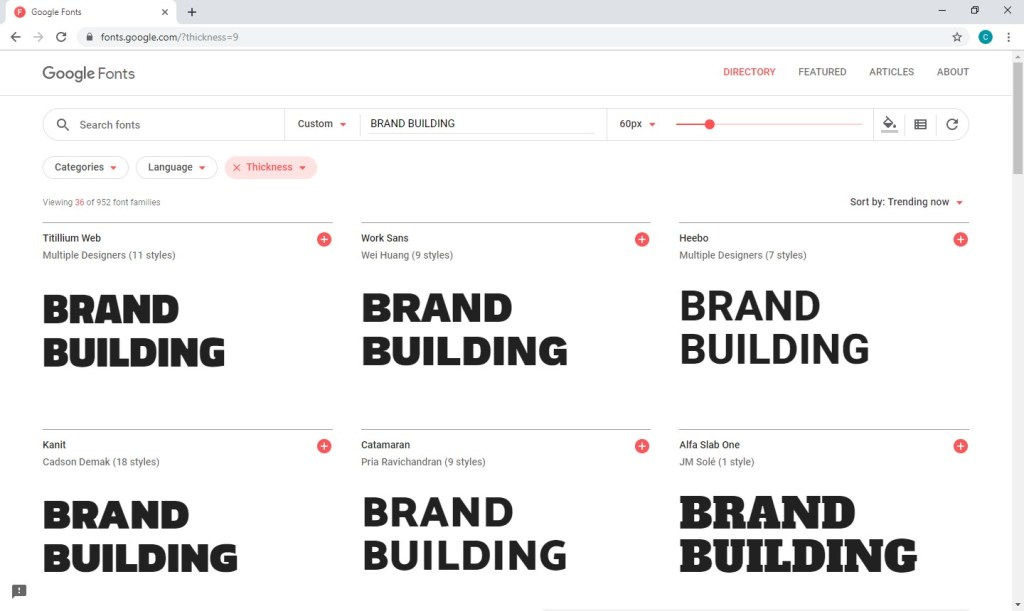
Thankfully, a source exists offering hundreds of (*free*) fonts in a searchable format that actually makes the process relatively easy. With Google Fonts (https://fonts.google.com), I was able to type in my sample text, BRAND BUILDING, the size I wanted to preview, 60 px, and my desired font characteristic(s), increased thickness.
After much trial and error (downloading, installing, and trying dozens of fonts), I found Titillium Web Black and a contrasting script, Candelion Regular, to work in black and two shades of navy.
While I am VERY tempted to digress at this point and start talking about some of the many techniques that can be used to marry the fonts/words used in your logo to the images you’ve chosen . . . I keep reminding myself that level of detail is really better suited for another blog entry further down the road. For now, I will stick to my original plan to keep this message broad but nevertheless offer a few . . .
CONSIDERATIONS
At some point, you may choose to print sales materials in grayscale or advertise in a print media in black and white. You may want to have branded pens for your company (requiring a very, very small logo) or you may purchase a building on Times Square and want your logo proudly illuminated on top (requiring a very, very large logo). Before you decide your design is a done deal, you should run a few tests. Try changing your color scheme to grayscale as well as black and white and print a very small version (one half inch on its biggest side should be sufficient) and a very large version (full page). If all variations look ok, you’ve probably got a keeper.
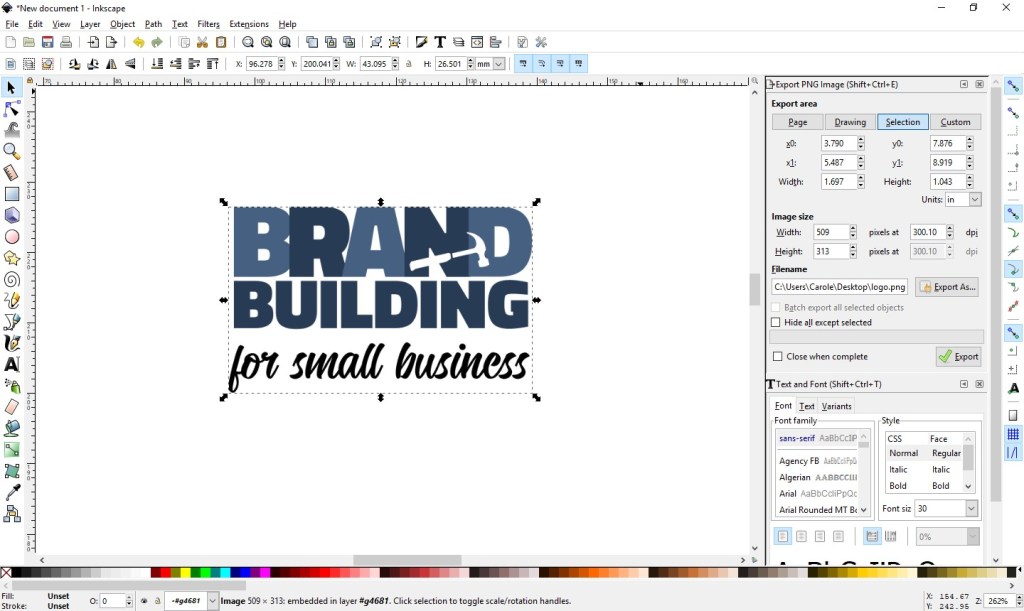
Export your new logo as a high-resolution transparent RGB PNG, which will work well in MOST (but not all) environments. (Inkscape export settings are shown at right below.)
Once you’ve managed to get this far, you’ll want to protect your work. Your logo should be registered as a trademark. If you are not of a mind to involve your lawyer in the process, consider checking out various on-line alternatives and look into the steps involved in going the DIY route (for example: https://www.wikihow.com/Register-a-Trademark-Without-an-Attorney).
Next up . . . confirm your understanding of your business’s audience; read: Know Your Audience.
Was that what I thought it was . . . my first sale?!? I vividly remember the thrill and excitement
I felt that evening. I basked in hugs
from my husband and kids, texted my close friends and family, and uncorked the
champagne (well, sparkling Moscato actually; it was only a $12 sale after all).
Fast forward one year ahead when the profit from my sales
was about half my full-time income, and I was equally thrilled and excited at
the idea of quitting my day job to pursue my business full time. I couldn’t wait to be able to choose the way
I dedicated my work hours, to have creative freedom, to balance my work
schedule with my home life however I saw fit, to be directly responsible for my
earnings . . . my list could go on and on.
The entrepreneurial allure was holy grail level for me.
Once I gave my three weeks’ notice (which my former boss and
now blog partner masterfully managed to extend into three months’ notice), I
was officially on cloud nine.
Fast forward once again to my first day “unemployed” and me staring
at my computer screen. I had so many new
designs I was looking forward to creating and so many ideas for new
products. My mouse and my keyboard and I
forged ahead at full speed.
* * *
Up until that point, I had spent the entirety of my career in marketing communications. I studied organizational communications and marketing for my undergrad and graduate degrees, I taught college public relations courses, and I worked for almost 15 years in the corporate world as an important contributor of a national, billion-dollar brand.
The first item on my new business to-do list – in bold
print – should have been to create a marketing plan.
In reality, that’s not even close to what happened. Why? In
writing this all down, I actually needed a couple minutes to decide exactly why,
and I think it’s the more immediate sense of urgency you get when your business
is responsible for your livelihood. You
want to focus on the areas of your company that are as tangible as your
mortgage payments . . . and groceries . . . and kids’ back-to-school
clothes. I effectually went into
survival mode. Efforts producing and
sustaining immediate profits were crucial while time for endeavors reaping
long-term dividends felt like a luxury.
Don’t get me wrong. I had put in place certain basic brand fundamentals from the beginning. Long before my first sale, I had decided on a name and colors, secured a web site address, and created a logo. I even had a pretty clear sense of the qualities that would differentiate my company from others. However, the idea of taking my brand basics and then creating and executing a blueprint for building a strong and successful brand WHILE running my business was completely and utterly overwhelming to me.
* * *
Well, as they say, the journey of a thousand miles begins
with a single step. Once my survival
instinct numbed a bit, I decided to take one single step. I addressed one new activity per week. Since I still had very little “free time” in
my business AND had no real marketing plan, I didn’t give myself any
constraints on the duration or direction of my efforts; just the quantity – I
just needed to do one brand building task per week.
So one week, I created an Instagram account for my business;
another, I researched local venues to get my brand name out in my community; still
another, I researched blogs that I could partner with to promote my brand,
etc., etc., etc. In essence, I did what
I could/when I could, knowing that as long as these activities reflected my
brand basics, my business would reap long-term benefits.
Over time, I mastered my one-a-week goal, and I built on
that momentum – once a week, I now had to do one maintenance branding task
(writing a blog posting, attending a local “expo/show,” posting content on my social
media platforms, etc.) in addition to my one brand building task
(researching, expanding into new venues/platforms, etc.).
If this is starting to sound like a lot, take a breath. There’s no need to get bogged down with specifics at this point. We’ll cover them all as we go, and we’ll help you get your system into place. We’ll focus on the areas we think are most beneficial to start with first, and we’ll teach you how to execute those initial steps; then, we’ll focus on building that brand – one task at a time. Soon, you’ll find that your successes will justify the time you invest, making the process much easier.
* * *
Next up – What’s in a Name? . . . The first in a series focusing on the initial steps in building your brand.





 Brand Building for Small Business