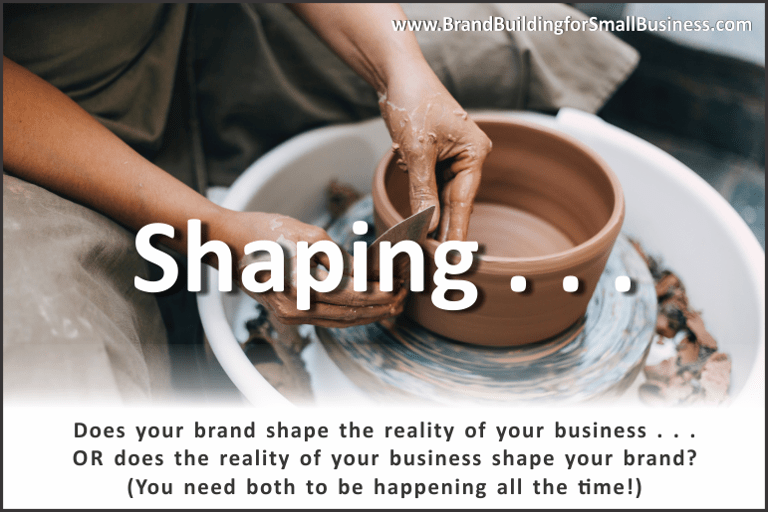
Today’s TIP: Shaping Your Brand
Brand Building for Small Business
A Blog for Entrepreneurs Looking to Create and Develop their Corporate Identity
So . . . you’ve sat down to write your press release . . . and you’re stuck getting started.
In an earlier article, we discussed Press Releases as Another Opportunity for Branding. Specifically, we addressed some of the basic criteria needed to produce a successful PR piece, including discussions about: Topics, Voice, Audience, Outlets, Format, Quotes and Photos, and Post-Submission Follow-up. In a second article, we wrote a Press Release to Introduce Ourselves as Part of National Small Business Week (in 2020).
Nevertheless, we realize that many of you may still be sitting staring at a blank page after having crumpled up a dozen failed efforts.

In this article, I’m hoping to help you get started writing by encouraging you to identify and assemble the content you need to include to attract the attention of the media and (ultimately) your audience . . . while successfully communicating your message about your brand.
First, ask yourself whether your proposed topic is of general interest to the public and not simply a self-serving grab for attention. If you are convinced you have the right kind of subject (i.e., a message that’s unique and has a potential impact upon others), then you need to gather up the specific details to include.
The 5 W’s (Who, What, When, Where, and Why . . . PLUS How)
Answer each of these questions in terms of your press release.
Who
Identify those individuals and/or organizations who are involved . . . as well as people likely to be affected by the outcome. As you perform this step, consider possible prospects to provide you with a quote. (In the case of a groundbreaking or Grand Opening, the “who” might be the founder of the business. Or, perhaps the “who” is the individual behind a new product or key enhancement . . . as well as the consumers likely to benefit. In the case of an employee being featured to acknowledge an award?, the “who” would be the recipient and maybe the judges (assuming they are well-known public figures).
What
This description should address the unique and special nature of the topic being publicized. For an employee feature, the “what” might be the winner of an “Employee of the Month” contest and a discussion of the habits and accomplishments being recognized. In other cases, your “what” could be the description of a new product or service, announcement of a Grand Opening or Employee Recognition Day, or perhaps the explanation of an award won by you.
When
The date and time associated with your topic should always be included. While this piece of information is very obvious in some cases such as a Grand Opening, others might be a bit more ambiguous such as the anticipated date a new product or service will be introduced. Occasionally, your “when” could be a timeframe such as “income tax season” or “early this summer,” etc.
Where
“Where” identifies the location in which the topic under discussion is taking place. In a press release, inclusion of an actual address might be appropriate, but a more general reference such as “at the corporate headquarters” or “in Washington” or “at the satellite location of the store” would suffice to provide the reader with adequate context.
Why
This piece of information in very important because you are highlighting “why” the press release matters. In some cases, the “why” gives you the opportunity to outline the criteria for an award while explaining the reason you were chosen as winner – one of the rare opportunities to be totally self-congratulatory in an acceptable objective way. “Why” might be your opportunity to explain the reason a new product or enhancement matters to consumers. “Why” could be the reason an “Employee of the Year” plaque is given, which offers you an opportunity to expand upon your company’s brand while highlighting the ways in which the recognized person embodies those desired characteristics . . . while also calling attention to the ways in which the consumer benefits.
How
“How” (like “why”) often gives you a bit more opportunity to expand upon the branding of your business. This information can range from “how” the winner of an award was determined to “how” a company has elected to participate in some national holiday such as Small Business Week. In crafting this piece of information, remain very sensitive to opportunities to highlight the company’s brand characteristics and the way those qualities made the “how” possible.
So, You Have Your 5 W’s . . .
So, you’ve dutifully filled in the blanks for each of those categories. (Please note that we have provided a Word template with each of these components laid out to help make that process easier.) Next, actually write down the two or three quotes you plan to use. At least one of those sources will typically be from a high-ranking company official and the other should be a person with some recognizable expertise in the subject. Similarly, one of the quotes should be devoted to the main theme of the press release while the other can merely mention the topic while making remarks that reinforce the general branding of the company. If you can get a consumer to make a statement, that content can be very effective. Government officials can also be useful, especially for items like awards and Grand Openings.
Next, locate or create any needed photographic artwork, being sure to supply an appropriate caption and perhaps citation. If you do not have the necessary images, you can take the pictures.
The final preliminary content to highlight in this collection of information is the “branding boilerplate” language you want to include. For instance, we chose the following message for our blog:
“Produced by two experienced communication professionals, Brand Building for Small Business is a blog that aims to provide practical, do-it-yourself advice about creating a brand identity from the bottom up. Expect, simple, straightforward tips that can be executed by a single person or a small group on a very tight budget.”
As a result, we try to incorporate at least the substance of this message (if not the exact words) into any press release, knowing such content is the most likely to get cut by an editor.
Finding Your Lead . . . and Shuffling Content in Order of Importance
Now that you have assembled all of your content, you must begin to incorporate the elements into a cohesive story. The first step is to identify your lead. Specifically, read through the 5 W’s you’ve collected and decide which one is the most important.
For instance, “what” and “who” would probably be the elements you introduce first for an employee press release with “when” and “where” being secondary. For example . . .
“The ABC company recently named Mrs. Mary Smith (your “who”) the “Employee of the month” (your “what”). She will receive her official reward on June 14th (your “when”) at the annual company meeting at the ABC corporate headquarters (your “where”). She is being recognized for outstanding customer service (“why”), which reflects ABC’s philosophy of putting the customer first (using this portion of the “why” to tie back very directly to the company’s branding statement).
Once this lead is in place, I’d include a paragraph of biographical detail about Mary’s background and history with ABC. I’d add a quote from Mary about being surprised and honored as well as another from her supervisor about the reasons Mary is worthy and reflects those qualities that are part of the ABC brand. Information about past recipients might also be included.
Finally, I’d explain the process of selecting the Employee of the Month (the “how” in this case), which could create a further branding opportunity by indicating the choice was made by fellow employees or perhaps the company’s customers.
Then, I would insert a paragraph that describes ABC and highlights some of the company’s accomplishments. Within this section, I’d include the quote from the high-ranking company official that is pretty much exclusively about the organization. (The inclusion of this statement will probably increase the chances of the company information surviving the final cut.) Very often, a paragraph such as this one would reflect your company’s boilerplate. If not, I’d incorporate that as part of my closing.
For this particular story, I’d be sure to include a photo of Mary and/or the award ceremony as well as photos of other quoted parties and perhaps an image of the ABC corporate headquarters (assuming the place is closely associated with the company and perhaps a bit iconic).
As I hope this one example above suggests, each collection of details will have an intrinsic order of importance that hopefully makes the progression of the press release both obvious and easy to write. For instance, “what,” “when,” and “where” would probably be the lead of a “Grand Opening” with “who” being used to mention the dignitaries expected to attend. “Why” would almost certainly incorporate some statement about customer convenience that would provide a point of entry into a recap about branding. An image of the new location would be essential.
For a press release about a new product, “what” and “when” would probably provide the essence of your lead with “who” being secondary unless a specific individual was instrumental in developing the new product. Once again, “why” would provide an opportunity to expound upon branding and the ways in which customer needs were being better served. The “how” in this case could talk about the process of development and perhaps incorporate some discussion about the ways in which customer feedback came into play.
As you can see, the 5 W’s are pretty much a part of any press release you’d choose to create. By using these elements to gather and organize your content, your narrative will be half written – you’ll just need to figure out the correct order for presenting the information for maximum effect. Generally speaking, most press releases will be less than 500 words, so taking this approach should be very useful in getting you close to a finished product.
To make sure no information is overlooked, we’ve created a template listing all the important components from this post to help you put together your content. You will ALWAYS have some details to plug into each section. Once gathered, the ultimate order will most often become fairly obvious.
Note: In a future article, we plan to create examples of simple common press releases such as the kinds mentioned in this article (i.e., Grand Opening, New Product Rollout, Employee of the Month Award, etc.).
These days, every small business needs to find a suitable spot to launch an Internet site on the web. You may think you are exempt because you:
If this description fits you, I can understand that you might feel the web is unnecessary, but you are wrong.

Web Sites Come in a Variety of Sizes . . . and Can Be Complex or Simple
First, let me point out that contemporary web sites encompass a broad spectrum from the highly sophisticated ones that allow you to accomplish all aspects of a sale from presentation of the product/service to payment and follow-up . . . to the simplest variations that exist primarily to establish an on-line presence.
Recently, the WordPress Newsletter published a story about “Building Single-Page Web Sites on WordPress.com.” Frankly, seeing this article got me thinking that the time had come to post an entry on web sites for our blog because the development of your on-line presence creates an important vehicle for branding . . . while positioning you (should you someday choose) to consider taking advantage of Internet Sales.
As the pandemic of 2020 has taught us, small businesses must be prepared to adapt to changing circumstances, and on-line operations can provide a very useful alternative. Assuming you are not ready to (or do not need to) take that plunge, having the beginnings of a web site can only help create that flexibility if and when the day arrives . . . and you’ll already be establishing some history that can be helpful at a later date.
Convinced . . . ? Not Yet . . . ?
Frankly, most consumers fully expect every small business to have at least a basic Internet presence . . . and become suspicious about the solvency and reputation of a company that does not. At a minimum, you can simply put together a small web site that could have your:
Remember, this first on-line impression will start to set the tone for your brand in people’s minds . . . so choose meaningful content indicative of whom you are!
How Do I Get Started?
WordPress can actually provide many tools for developing web sites of all kinds and degrees of complexity. If you are just starting out, you really should check out that article mentioned earlier. However, lots of alternatives exist.
Consider using an existing simple template. Many web hosting services and software packages provide a wide variety of perfectly acceptable ones that are easy to use and appear fairly customized once your content and images have been added and fonts, colors, etc. have been adjusted to reflect those already chosen for your brand. Also, those same sources frequently provide widgets (i.e., application programs that can be easily incorporated to handle basic tasks like forms or searches) that you might want to include on your simple site.
Still a bit too hands-on for your taste and comfort zone (even though the camera on your cell phone can be used to generate all of the artwork needed)?
Consider hiring a local vendor or even a college student to give you a hand . . . but don’t allow yourself to accept any excuse for inaction!
In building a basic web site that incorporates the items mentioned earlier in this article, you:
Don’t Be Intimidated!
I was involved in building my first web site over 30 years go. The world wide web was a relatively new phenomenon, and the Internet was just graduating from the world of Archie and Gopher servers at colleges used to give users a way of communicating.
Frankly, I was too dumb and the process was too new to me to be as intimidated as I should have been though – over time – I learned better . . . and grew suitably threatened by the task of developing a good, highly visible web presence. (Besides, getting intimidated is always much easier as demands and expectations grow more sophisticated.)
While our early efforts were just “brochureware” and were hardly an important source for sales or the delivery of services, we accomplished some very important goals that served us well over time. We positioned our company as one of the first to embrace the Internet, helping to create a brand that incorporated technical sophistication as part of our calling card. As more and more operations embraced technology, became involved in web-based sales, began featuring on-line processing and service, and adopted paperless operations, this branding was extremely useful in defining our company as an innovative leader across several decades.
Remember, all beginnings lack polish so don’t be intimidated. Regardless, your early efforts are sure to embarrass you at a later date. (Need proof? Just take a trip via the Internet Archive “Wayback Machine” in about five or ten years to see some of your early versions and compare them to the current.
So, take a chance and take a plunge into the web but be sure to always keep your eyes focused ahead when defining your brand. Try to incorporate who you are now but also who you want and expect to be tomorrow. Your dreams and aspirations are as much a part of whom you are today as any current limitations that you plan to overcome along the way.
Note: We plan to address higher-end, more complicated web sites in future articles.

If you haven’t considered starting your own company blog, you should, because that vehicle can be extremely useful in developing and promoting your brand.

Specifically, a blog:
Plus . . . you get to build new accompanying skills learned while managing your blog.
With so many potential benefits, what is the possible downside?
Full disclosure – the company that I worked for across many years never did start an official company blog during my tenure, though I was certainly a proponent and made the suggestion several times. That said, I understood the reluctance – with the main obstacle being the potential drain on resources. To be successful, a blog requires regular content; you have to assume many hours of talent will be spent:
Furthermore . . .
If you elect to highlight the efforts and contributions of key employees and make them part of your brand, any loss of talent to other companies (for example, an employee leaves your business to work for the competition) is magnified and becomes even more potentially damaging to your success.
The Bottom Line: To Blog or Not To Blog – That is the Question
While I understand the possible downside, I suspect the risk of committing to a blog might be greater for large established companies than small ones. If you have the necessary patience and commitment . . . as well as the required communications skills, I believe a blog can be a very useful tool in building and maintaining your brand identity. While you will certainly be devoting key resources, the content you create can provide many ancillary benefits, including support of your marketing, social media, and web development activities (among others). Just know that, like every other worthwhile endeavor – any payback is in direct proportion to the time, effort, and talent invested!
As I write this article, a New Year has just begun . . . bringing a much-welcomed fresh start.
We all hope (and optimistically expect) that 2021 will be a much better, more normal year for all of us – including small businesses that suffered such hardships during 2020. For them (our primary audience), I offer my best wishes for a strong start as well as a suggestion for an additional New Year’s resolution: performance of a simple “annual brand checkup” to identify and make any needed adjustments.

Please note that I have chosen the word “checkup” very carefully to suggest a simple self-help exercise – not a complete “brand audit” that can be highly structured, very time consuming, and quite expensive when third parties are utilized. As a quick DIY alternative that can, therefore, be accomplished much more frequently, the 5 Steps of a Brand Wellness Checkup include the following:
Remember, the point of this exercise is to make sure that at least once a year you stop and revisit your most basic branding decisions and their implementation. By doing so annually, you can make sure you do not unwittingly drift off course . . . and can make minor adjustments to right yourself before a major, potentially difficult, and expensive overhaul is required. (To learn more about activities associated with the items mentioned above, visit our menu item labeled “Your Brand: The Beginning” or visit this page.)
While most New Year’s Resolutions are abandoned by February, this goal is one that can and should be done as early as possible at the start of the year.
Good luck . . . and keep thinking positive thoughts about 2021 and beyond.
The snow starts to fall.
The camera zooms in . . . as the couple begins a long-delayed (at least two hours) passionate kiss.
The movie ends – HAPPILY, of course – with the pair united just in time for the Christmas holiday but clearly destined to live happily ever after.

For millions of people, December (which now starts on November 1st) means decorations, presents, Santa Claus, reindeer, AND Hallmark!! The company has become (through years of careful brand building effort) inextricably associated with the warmth, cheerfulness, and good feelings of Christmas – not a bad set of qualities to have linked with your name and your brand. In fact, so many people have found so much comfort from Hallmark Christmas movies, the company tried to ease the burden of the 2020 pandemic by providing around-the-clock Christmas fare outside the season during a period of heightened restrictions on normal, daily activities.
Clearly, Hallmark is a company that has learned an important truth – linking your brand to a holiday and feelings associated with that time can be a useful tool in your branding arsenal.
Other successful examples?
Other examples abound. (If interested, read “How 5 Leading Brands Embraced The Holiday Season” OR perhaps about “Five Food Brands That Own Christmas”.) Frankly, the list could go on and on, and I’m sure you can easily find a dozen examples of your own.
So . . . How Do You Make a Holiday Brand Happen?
To some degree, you have to rely upon luck – recognizing an early connection to a holiday that you see has potential and can build upon. However, some basic steps can be taken.
Most holidays have some familiar sentiments and iconography associated with them. Try making a list of those attributes and a list of the attributes and iconography already associated with your brand. A sufficient number of matches between the two lists suggests you may have a likely candidate for brand building. Starting with some basis for the connection (which is the point of this exercise) should increase your likelihood of success and reduce the amount of time required. Once you have a candidate, some of the activities that can be used to build the connection between your brand and the holiday are:
By consistently promoting the ties between you and your chosen holiday over time, you can gradually build a brand identity that assumes some of the characteristics of that celebration. (Even Hallmark’s special relationship with Christmas did not happen overnight!!)
Looking for more suggestions, see “5 Branding Tips for the Holidays” by Debbie Laskey for the Digital Branding Institute.
Don’t Overlook Opportunities Presented by Lesser-Known Holidays
While you were certainly aware that Christmas and Hannukah were linked to December, were you also aware that these additional special observances existed?
Above and beyond those monthly celebrations, you have special days (examples cited below are from 2020):
(As I sit and write this draft, I now realize I should be planning my International Mountain Day Celebration!!)
Dozens of such occasions occur throughout the year that could provide special marketing opportunities for small businesses. For a complete list, see Anita Campbell’s article in Small Business Trends “Huge List of National Holidays for Marketing in a Small Business”; you just might find a number of events already exist that are inherently symbiotic with your operations.
Regardless of whether you decide the time is right for you to act on the advice in today’s article, my blogging partner and I would like to wish you a safe and happy holiday season, being sure to tune into a Hallmark Christmas movie or two while filling out your Hallmark Christmas cards to send to family and friends . . . to show you care.
Let’s start with a quick quiz. Ever see these images?

What does this picture of a red elephant mean to you?
How about the blue donkey?
In other words, simply seeing these logos immediately brings to mind a wide range of adjectives and accompanying images . . . as well as an emotional response! That said, we recently had an opportunity to witness the practice (and impact) of this very successful branding in action during the American presidential and legislative elections.
Frankly, we waited until the election was over (and the votes had been counted) to avoid getting lost in endless partisan digression over details when our reason for bringing up the matter is to highlight these examples of powerful branding while the specifics were still front and center in people’s minds.
In politics, branding is sometimes the only basis upon which individuals vote (and brand loyalty plays a huge role). Since the issues tend to be numerous, complex, frequently boring, and very often as clear as advanced calculus or nuclear physics, people tend to rely upon simplified measures that allow them to cast a vote that will – they feel – provide a shortcut to their approximate philosophical position. When a Republican or Democrat votes along party lines, that choice generally assures that certain basic qualities will be present and criteria met by the candidate. For their part, politicians benefit by closely aligning themselves with their chosen brand . . . rather than get lost in platform details.
In general, the most successful politicians not only align themselves closely with their party’s brand but also manage to enhance that foundation with a strong personal brand through use of campaign slogans, colors, and spokespeople-influencers who, in turn, lend their personal brand to the candidate’s.
Questioning whether a campaign slogan really makes a difference? Then, check out these seven examples that appeared among the “Top 15 Presidential Campaign Slogans” identified by Martin Kelly (updated February 21, 2018):
Don’t Swap Horses in Midstream
“This presidential campaign slogan was successfully used two times while America was in the depths of war. In 1864, Abraham Lincoln used it during the American Civil War. In 1944, Franklin D. Roosevelt won his fourth term using this slogan during World War II.”
All the Way With LBJ
“In 1964, Lyndon B. Johnson used this slogan to successfully win the presidency against Barry Goldwater with over 90% of the electoral votes.”
Are You Better Off Than You Were Four Years Ago?
“This slogan was used by Ronald Reagan in his 1976 bid for the presidency against incumbent Jimmy Carter.”
Happy Days Are Here Again
“In 1932, Franklin Roosevelt adopted the song, ‘Happy Days Are Here Again’ sung by Lou Levin. America was in the depths of the Great Depression and the song was chosen as a foil to candidate Herbert Hoover’s leadership when the depression began.”
Give Em Hell, Harry
“Both a nickname and a slogan, this was used to help bring Harry Truman to victory over Thomas E. Dewey in the 1948 election. The Chicago Daily Tribune erroneously printed ‘Dewey Defeats Truman’ based on exit polls the night before.”
I Like Ike
“The quintessentially likeable hero of World War II, Dwight D. Eisenhower, rose handily to the presidency in 1952 with this slogan proudly displayed on supporters’ buttons across the nation. Some continued the slogan when he ran again in 1956, changing it to ‘I Still Like Ike.’”
Change We Can Believe In
“Barack Obama led his party to victory in the 2008 presidential election with this slogan often simply reduced to one word: Change. It mainly referred to changing presidential policies after eight years with George W. Bush as president.”
In addition to the slogans identified by Kelly above, another recent example would be Donald Trump’s “Make America Great Again” slogan (MAGA) modified to “Keep America Great” for re-election. An expert brander, Donald Trump produced a wide range of paraphernalia bearing the phrase . . . and used the words to incite supporters at rallies.
Clearly, catchy statements such as these have been used to define the brand of a candidacy and get voters to identify with the candidate’s cause – tapping into existing associated emotion. Certain songs have also been employed for branding purposes. In fact, the artists – recognizing the power of branding – have sometimes ordered campaigns they did not support to stop using the tune – obtaining legal “cease and desist” intervention.
So, what is the lesson to be learned about branding from the masterful uses employed by politicians?
Branding is the best – and often only – way to simplify complex content for a consumer audience in a way that attaches an emotional response and builds a sense of allegiance to a product. Furthermore, political branding must (as always) be executed consistently and across all media from billboards to speeches to commercials to ads to pamphlets and flyers to promotional items and more. The further a brand can be simplified and identified via a short phrase, use of a color, a few bars of a song – the better!
Small businesses can learn much by mimicking the example (however seemingly unsophisticated) of their local politicians building a base of support . . . a constituency. Frankly, they tend to know their audience well and have found an effective way of appealing to them . . . and those people all represent your existing and potential customers.
Ever wonder about the origin of the American political symbols – the elephant and the donkey? The first appearances of both symbols are credited to the artist Thomas Nast for Harper’s Weekly during the late 1800’s. (Frankly, some of his cartoons were “Nasty.”)
Last year, we published a Small Business Saturday article that provided an overview of the history of the event as well as the potential importance, offering a glimpse at some of the strategies that could be used by small businesses to link this celebration to their brand.

That was last year, which now seems like a decade ago!
Over 50 million confirmed Covid-19 global cases later, including over 10 million in the United States (see data), most small businesses have had to face incredible challenges as many countries closed down their economies in order to slow the progress of the pandemic.
While a truly unfortunate number of smaller operations have now permanently closed their doors, we need to take a moment this Small Business Saturday to celebrate the survivors . . . and support them in whatever means are available to us.
Expanded Internet activities. Free delivery. New products (maybe even including personal protective gear). Go Fund Me initiatives. Special Governmental programs. All of these strategies and so many more have been essential to the continued existence of the survivors.
While statistics clearly indicate that a second wave of the pandemic is upon us and caution that the upcoming holidays will require us to practice some self-restraint, we feel confident that small businesses will survive while still managing to practice governmental safety standards. Hopefully, by Small Business Saturday 2021 on November 27th, one or more vaccines will have been released and administered to a sufficiently large number of people to put this pandemic behind us for once and for all.
In the meantime, we will not use this article to do more than serve as a cheerleader for small businesses (including that of my blogging partner – Instant Invitation). Instead, we will invite you to reread our story from last year and to check out some other valuable repositories of information and strategies.
Nicolas Straut, a contributing writer at Fundera, has put together an overview of Small Business Saturday:
https://www.fundera.com/blog/small-business-saturday
Similarly, American Express, which founded the day and holds the registered trademark, makes a wide variety of useful resources available, including a Shop Small campaign:
https://www.americanexpress.com/us/small-business/shop-small/
Nestled between Black Friday (a tradition which also appears to be undergoing transformations during this time of social distancing) and Cyber Monday, which continues to grow in size and significance, the role and importance of Small Business Saturday cannot be lost.
The three categories of activity identified in the headline above have both similarities and differences.
Since correctly recognizing the term that best describes you could have some bearing upon the way in which you brand your operation, we are using this article to explore these different categories. That said, be aware that branding does play a key role in each . . . and you should understand that your personal brand may (but does not necessarily have to) play an important part in shaping your company’s brand.
Small Business vs. Entrepreneurship
According to the website DifferenceBetween.com:
“The difference between small business and entrepreneurship mainly depends on the persuasion of growth. If the owner/owners of the business are content with the manner in which the business is currently operating and do not wish to engage in more growth opportunities, then it can be categorized as a small business. On the other hand, if the entrepreneur/entrepreneurs operate their business with a clear and creative vision and are interested in expansion opportunities, this type of business is an entrepreneurship. Since small businesses do not pursue growth, they remain small or medium scale throughout their lifespan. However, this does not mean that they are not successful; some small businesses may be cash rich.”
Entrepreneur vs. Influencers
According to a National Geographic article entitled, “Influencers: The Modern Entrepreneur,” the following applies:
“Entrepreneurs are people who organize, manage, and take on the risks of a business. They often start a new business in response to a perceived need for a good or service. An influencer, on the other hand, is someone who has the power to affect or change people and their behavior through social media—often to get them to buy something. Influencers who start their own business certainly fall under the first part of the definition of entrepreneur, as they are managing their business and taking on risk.”
Brand Building
Typically, small businesses build brands overtime that reflect the product and/or service being provided. The process involves finding the qualities that set the business apart from others and developing strategies to reinforce those traits and communicate them to customers. Each interaction with the general public and consumer audience then plays a part in refining the brand to reflect the feedback received via comments, reviews, complaints, and sales. This process of evolution should be never-ending. (See our articles designed to help you get started building a brand.)
Very often, the brands of both entrepreneurs and influencers seem to take on the characteristics of the personal brand of the individual(s) involved. (That said, a strong personal brand can be useful to a small business, too, which may not necessarily be seeking growth but would want strong customer retention – an attribute that could be helped by loyalty to an individual.)
Common Qualities of an Entrepreneur/Influencer
An Inc. magazine article entitled “10 Essential Characteristics of Highly Successful Entrepreneurs,” indicated that these individuals tend to be: creative; passionate; motivated; optimistic; future-oriented; persuasive; flexible; resourceful; adventurous; and decisive. In my experience, many of those kinds of words also ultimately end up being among those that define the brand of both the person and the company.
When I first started at GUARD (pre-Berkshire Hathaway days), the company was small (15 employees) and had been founded by a pair of entrepreneurs who had sketched the original structure of the organization on a napkin over lunch. Frankly, each of the words identified by the Inc. article describe this husband and wife team very well . . . and also became the kinds of words that applied to the culture, products, and services of the company.
In the early days in particular, GUARD was an entrepreneurship that was independent, creative in thinking outside the box in developing unique products and services, flexible in responding to marketplace opportunities, resourceful in stretching available capital, future-oriented in building toward a big long-term goal, etc.
Understanding that personal and company brands tend to merge can be important in either choosing to intentionally build a personal brand OR in making sure steps are taken to separate the brand of the entrepreneur from that of the company. Very often, this choice should be one of the first made by small businesses.
Ways to Enhance Your Personal Brand
Patrick Ambron in an Entrepreneur magazine article (“Is Your Personal Brand Losing You Business?”) identified four fundamental steps that could be taken to have a strong on-line foundation for a personal brand.
Taking these steps can be very inexpensive and (using readily available tools) should be relatively easy. (Learn more about personal branding.)
And So . . .
If you are an entrepreneur or influencer (or perhaps both), assume your personal brand is going to become part of your business. Therefore, you better start paying close attention to the kind of statement you are projecting. If, on the other hand, you are a small business, ask yourself whether customer sales/retention would be improved by linking your identity to that of your company brand . . . or whether you want the two to make a different statement.
 Brand Building for Small Business